

Best overall: a custom-fitted built-in grill cover. Best for a ceramic cooker: a model-specific dome cover. Best for a drop-in griddle: a matching griddle cover. This 2026 guide compares custom outdoor grill covers by installed fit, weather protection, ventilation, and everyday handling—not fabric thickness alone.
At a glance
- Custom outdoor grill covers are the best starting point for built-in grills with unusual handles, controls, or surrounding counters.
- Smokeforges outdoor kitchen shoppers should choose grill covers by installed shape, not nominal grill size.
- Choose model-specific dome and griddle covers only after confirming the exact appliance and installation match.
- Cover cooled, dry equipment; keep appliance ventilation openings clear whenever equipment is operating.
Why this matters
An outdoor kitchen changes what a grill cover needs to fit. A freestanding cover hangs around a cart; a built-in cover meets countertops, projecting handles, and controls that sit outside the cooking surface.
If you're comparing equipment at Smokeforges, settle the installed layout before choosing protection. The right cover fits the equipment you actually installed, including its projections—not just the width printed in the grill's name.
For a 2026 outdoor kitchen purchase, treat cover selection as part of the installation plan. A close-fitting shape still needs practical removal, secure retention, and a way for incidental moisture to escape.
What makes the best outdoor kitchen grill cover?
Use these criteria to compare custom outdoor grill covers before choosing a fabric or fastening system:
- Installed fit: Match the closed appliance, handles, shelves, controls, and the surrounding counter. Identify anything that prevents the hem from sitting correctly.
- Rain management: Look for documented fabric protection, seam construction, and a shape that avoids pockets where water collects.
- Moisture escape: Check how the design handles ventilation and drying. A waterproof fabric claim does not explain what happens to condensation underneath.
- Wind retention: Look for attachment points that work with your installation. Straps intended for a cart might have nowhere to fasten on an island.
- Contact protection: Inspect the inside surface and every point where fabric touches corners or handles. Avoid a fit that requires stretching over hardware.
- Daily handling: Decide where the removed cover goes and whether you can reinstall it without dragging it across the cooking surface.
Use fit as your first filter. Material specifications become useful only after a cover matches the appliance and its surroundings.
Outdoor kitchen grill covers at a glance
These 2026 picks rank cover formats by use case. The named products below identify relevant cover types; confirm their specifications and compatibility before ordering.
| Cover option | Best for | Standout feature to seek | Key limitation |
|---|---|---|---|
| Custom-fitted built-in grill cover | An irregular built-in grill profile | Pattern matched to installed projections | Depends on accurate measurements and a clear specification |
| Model-specific dome cover, such as the Kamado Joe Dome Cover | A ceramic cooker needing dome-area coverage | A profile intended for the cooker shape | Dome coverage does not establish protection for a table or base |
| Matching drop-in griddle cover, such as the Blackstone 36-Inch Drop-In Griddle Cover | A drop-in griddle in an outdoor counter | A cover intended for the drop-in format | Nominal width alone does not establish compatibility |
| Custom full-island cover | A continuous kitchen run covered together | Pattern matched to the whole island | More fabric to remove, dry, and store |
| Universal cart-style cover | A conventional freestanding grill beside an island | Adjustable fit around the cart | Excess fabric and poor fastening alignment on built-ins |
1. Custom-fitted built-in grill cover: best for irregular installations
A custom-fitted built-in grill cover follows the exposed appliance rather than wrapping the entire kitchen. Specify the closed hood, front handle, control panel, and any projections that the cover must clear.
This is the strongest starting point when a standard cover cannot sit correctly against the countertop. Custom sizing alone does not establish fabric performance, seam quality, or useful ventilation; those need separate confirmation.
Custom-fitted built-in grill cover pros:
- Lets you specify the installed outline rather than a generic cart shape.
- Keeps the covered area focused on the grill.
- Allows you to identify awkward corners and fastening locations before ordering.
Custom-fitted built-in grill cover cons:
- Incorrect measurements carry through to the finished fit.
- Later hardware or layout changes can alter compatibility.
- A tailored shape still needs documented material and construction details.
Best for: Built-in grills with projecting handles, unusual profiles, or limited space around the counter.
Verdict: Buy a custom-fitted built-in grill cover when the installed shape rules out a correctly fitting standard option.
2. Model-specific dome cover: best for ceramic cooker coverage
A model-specific dome cover addresses the curved upper profile of a ceramic cooker. The Kamado Joe Dome Cover is a relevant option to investigate, but its name alone does not establish which cooker configurations it fits.
Separate the cooker from its surroundings when making the decision. A cover intended for the dome is not evidence that a wooden table, cart, lower opening, or nearby worktop will also be covered.
Model-specific dome cover pros:
- Provides a focused starting point for checking cooker compatibility.
- Avoids assuming that a rectangular grill cover suits a rounded appliance.
- Keeps the coverage decision separate from table protection.
Model-specific dome cover cons:
- Compatibility requires confirmation for the exact cooker and installation.
- Surrounding furniture needs its own protection decision.
- Added accessories can change the outline the cover must accommodate.
Best for: Ceramic cooker owners who want dome-area coverage without covering an entire outdoor kitchen.
Verdict: Buy a model-specific dome cover after confirming the exact fit and coverage boundary.
3. Matching drop-in griddle cover: best for counter-mounted griddles
A drop-in griddle needs a different fit check from a tall, hooded grill. Start with the appliance's closed configuration, then inspect the front controls, rear edge, and the point where the appliance meets the counter.
The Blackstone 36-Inch Drop-In Griddle Cover is a relevant named option for this format. Do not treat 36 inches as a complete fit specification: the remaining dimensions, appliance model, and installed projections still matter.
Matching drop-in griddle cover pros:
- Starts with the correct appliance format rather than a generic cart outline.
- Keeps attention on counter-level fit and exposed controls.
- Makes the coverage boundary easier to discuss with the supplier.
Matching drop-in griddle cover cons:
- A matching width does not establish a matching model or depth.
- Counter edges can complicate retention.
- The cover is not a substitute for the griddle's required surface care.
Best for: Drop-in griddle owners comparing protection for a counter-mounted appliance.
Verdict: Buy a matching drop-in griddle cover only after checking the full appliance designation and installation.
4. Custom full-island cover: best for covering a continuous kitchen run
A custom full-island cover treats the counter and its equipment as a single covered shape. Specify the entire outline, including raised appliances, projecting edges, and any changes in counter height.
This format suits an owner who deliberately wants everything covered together between uses. It also makes access a larger task: reaching one appliance can mean handling a much bigger piece of fabric.
Custom full-island cover pros:
- Lets you define coverage for the counter and appliances together.
- Accommodates a planned outline with different equipment heights.
- Avoids separate cover edges across the same continuous run.
Custom full-island cover cons:
- Large panels require a practical drying and storage area.
- Flat spans need attention to water pooling.
- Shared coverage complicates access to individual appliances.
Best for: A continuous outdoor kitchen that you intend to cover as a whole while its equipment is off and cool.
Verdict: Buy a custom full-island cover only if whole-kitchen coverage matches how you use the space.
5. Universal cart-style cover: best for a separate freestanding grill
A universal cart-style cover is a candidate when a conventional freestanding grill sits beside your outdoor kitchen. Compare the complete cart outline, including shelves in their intended storage position.
Do not carry that recommendation over to a built-in appliance. A cover designed to hang around a cart can bunch against a countertop, and its lower fasteners need suitable attachment points.
Universal cart-style cover pros:
- Provides an alternative to a custom pattern for a conventional cart outline.
- Lets you compare published cover dimensions against the whole grill.
- Works as a separate coverage decision from the adjacent island.
Universal cart-style cover cons:
- Loose fabric needs careful retention.
- Cart-oriented straps might not suit a built-in installation.
- A broad size designation can conceal a poor depth or height match.
Best for: A freestanding grill that remains separate from the fixed outdoor kitchen.
Verdict: Buy a universal cart-style cover for a verified cart fit; skip it as a workaround for a mismatched built-in.
Measure the installed shape before ordering
For your 2026 cover order, send a dimensioned sketch and photographs of the actual installation. Record dimensions in inches, label each measurement, and distinguish appliance dimensions from the finished dimensions requested by the cover supplier.
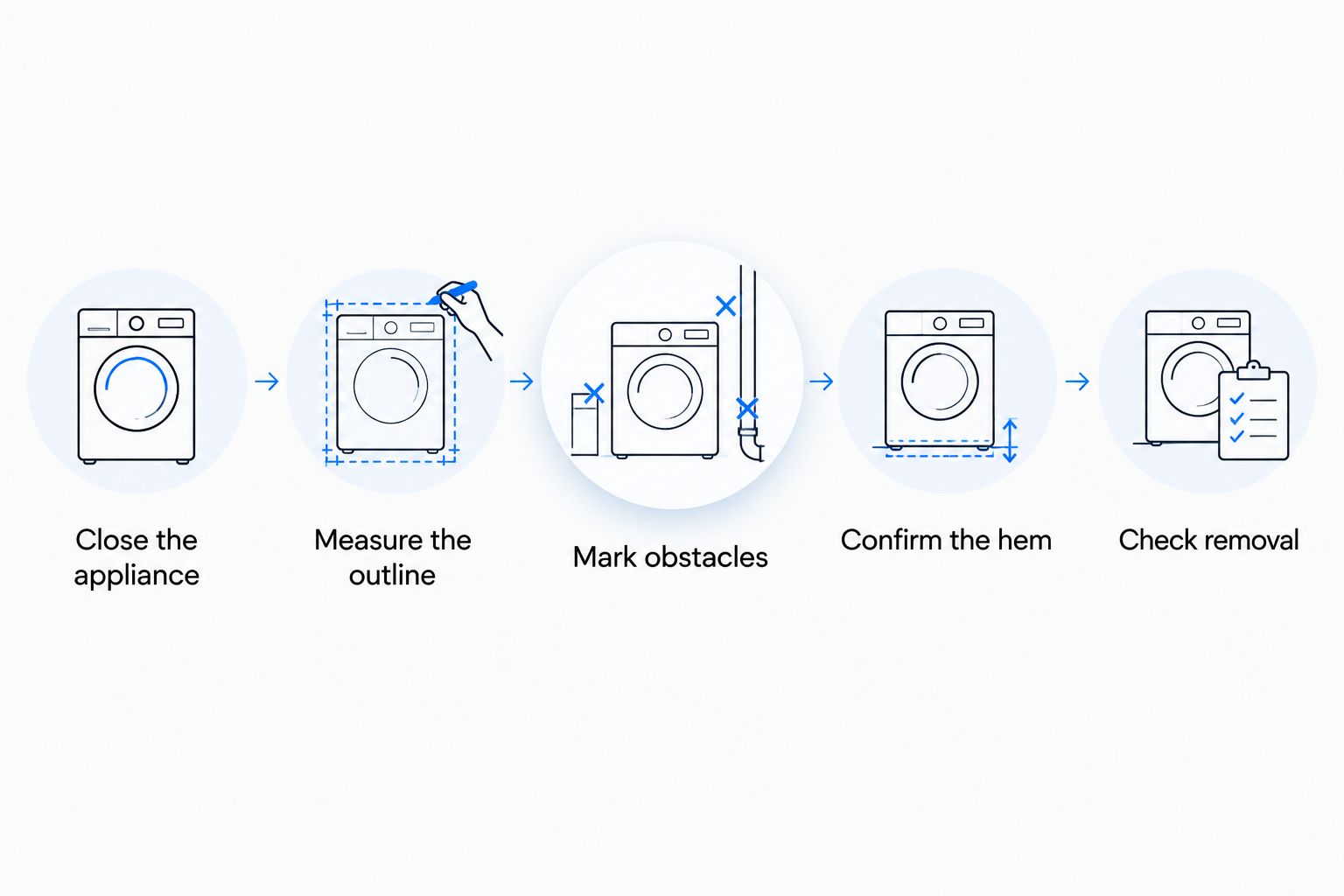
Follow this sequence rather than measuring only the cooking surface:
- Close the appliance. Put lids, shelves, and removable accessories in the position you intend to cover.
- Measure the outline. Record overall width, depth, and height, including handles and other projections.
- Mark obstacles. Show counter edges, walls, brackets, and anything that blocks the cover or its fasteners.
- Confirm the hem. Agree where coverage ends and how the cover stays attached.
- Check removal. Make sure you can lift the cover off without snagging it or moving the appliance.
Do not add an arbitrary allowance to every dimension. Ask the supplier how its pattern accounts for clearance, hems, and removal, then approve that interpretation before production.
How these cover formats were ranked
The 2026 ranking prioritizes installed fit, defined coverage, rain management, moisture escape, retention, and handling. It is a buying framework for different installations—not a laboratory comparison of fabrics or a durability rating for the named products.
Smokeforges shoppers should use the same checklist across every candidate. A custom pattern wins when the installation requires it; a confirmed model-specific cover is the more direct choice when it already solves the fit problem.
Which outdoor kitchen grill cover should you choose?
Choose a custom-fitted built-in grill cover if your appliance has an irregular installed profile. For a ceramic cooker or drop-in griddle, check the matching cover first and move to custom sizing only when the documented fit does not suit your setup.
Choose full-island coverage deliberately, not automatically. If you use different appliances independently, separate covers keep each coverage decision tied to the equipment beneath it.
FAQ
What's the best type of custom outdoor grill cover for a built-in kitchen?
A custom-fitted appliance cover is the best starting point when a built-in grill has an irregular installed profile. Specify handles, controls, counter edges, and fastening locations rather than submitting only the nominal grill width.
Is a custom grill cover better than a model-specific cover?
A custom grill cover is better when a confirmed model-specific cover does not fit the installation. If the model-specific option already matches the appliance and its surroundings, custom sizing does not automatically improve its materials or construction.
Does a 36-inch griddle need any 36-inch cover?
No, a 36-inch designation alone does not establish cover compatibility. Confirm the exact griddle model, overall dimensions, closed configuration, and installed projections before choosing a cover.
Should I cover the entire outdoor kitchen or just the grill?
Cover just the grill when you want independent access to nearby equipment. Choose whole-island coverage when you intentionally want the counter and appliances covered together, and plan how you will remove, dry, and store the larger cover.
Can I put a cover on a hot grill?
Do not put an ordinary storage cover on a hot grill. Let the equipment cool and follow the appliance and cover instructions before covering it.
Does waterproof fabric prevent moisture underneath a grill cover?
No, waterproof fabric alone does not establish that the covered space will stay dry. Condensation, seams, fit, and drying conditions also matter, so check the complete cover design rather than the fabric claim alone.
What measurements should I send for a custom grill cover?
Send the installed overall width, depth, and height, including handles and other projections. Add a labelled sketch and photographs showing obstacles, the intended hem position, and possible fastening locations.
One last thing
Before finalizing your 2026 cover choice, rehearse removing it with your hands positioned where the fabric will sit. Check the route past handles, corners, and nearby walls—not just whether the outline looks correct on paper.
A cover that fits while stationary still needs to come off without snagging. Make removal part of the specification, not a problem you discover after delivery.


