
Instead of moving propane cylinders, plan your smokeless fire pit gas line connection around an approved natural-gas appliance and have a qualified gas installer connect it to your existing supply. A wood-burning smokeless pit cannot become a gas appliance simply by adding a burner or hose.
At a glance
- A smokeless fire pit gas line connection requires an appliance approved for the supplied fuel and installation location.
- Smokeforges is best for homeowners comparing outdoor fire bowls before planning a gas-line installation.
- An existing gas outlet does not prove adequate capacity, correct pressure, or appliance compatibility.
- Use a qualified gas installer for supply assessment, connection, leak testing, and commissioning.
Why this matters
Start with the appliance, not the fitting. Smokeless describes combustion or marketing positioning; it does not identify the fuel connection. A secondary-combustion wood pit and a manufactured gas fire bowl are different appliances, even when both produce little visible smoke during normal use.
Smokeforges sells outdoor fire features, but a product photograph cannot establish gas compatibility. Your exact model's rating plate, installation manual, and approved configuration determine whether an existing line can serve it.
For a 2026 patio project, the useful outcome is a documented installation—not a hose that happens to thread onto an outlet. Fuel type, supply capacity, pressure, clearances, drainage, and service access all need to agree before anyone lights the burner.
Before you start
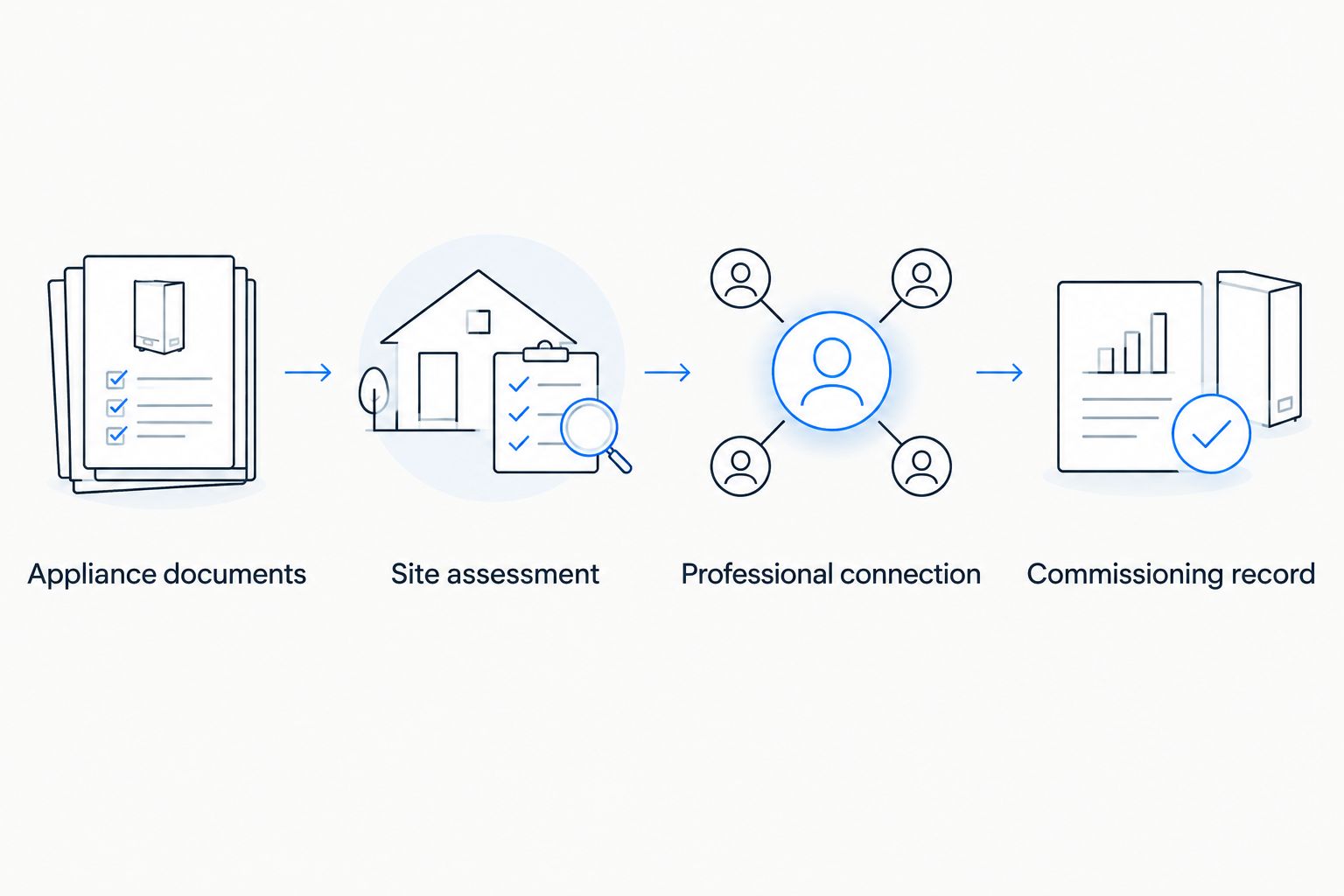
- Gather appliance documents and site information. Have the exact model number, rating-plate details, installation manual, proposed location, and information about other appliances sharing the gas supply. Arrange access for a qualified gas installer and confirm local permit requirements.
- Confirm the fuel and approved configuration. Establish whether the existing supply is natural gas or supplied propane. Use an appliance manufactured for that fuel, or a manufacturer-authorized conversion performed by an appropriately qualified professional.
- Pre-empt the hidden problem: shared supply capacity. An outlet that serves a grill does not automatically support an additional fire feature. The installer must assess the connected load, pipe system, supply pressure, and any simultaneous appliance operation before selecting connection components.
Do not buy adapters to solve an unidentified compatibility problem. Matching threads establish neither fuel suitability nor safe operation. If the manual or rating plate is missing, resolve that before installation work begins.
Appliance and fuel selection
Establish the approved configuration
- Identify whether your existing pit burns wood or uses a manufactured gas burner system. For a wood-only smokeless pit, stop the gas-connection plan unless the manufacturer explicitly authorizes a gas configuration for that exact model.
- Give the installer the complete appliance model and fuel designation. Do not substitute a similar-looking model's instructions or assume a display model represents the unit you own.
- Check the manufacturer's requirements for outdoor placement, combustible clearances, enclosure ventilation, ignition, and electrical supply where applicable.
- Ask the installer to document the intended fuel and approved components in the installation plan. Resolve conflicting product information before ordering connection hardware.
Expected result: Your appliance documents identify a permitted fuel configuration and an installation arrangement that fits the proposed site.
Compare the connection routes
Use this table to choose the correct planning route—not to select fittings. Neither fuel is a shortcut around the appliance instructions.
| Connection route | Best for | Advantage | Limitation |
|---|---|---|---|
| Existing natural-gas supply | A fixed outdoor appliance approved for natural gas | Removes cylinder handling from normal operation | Requires verification of supply capacity, pressure, and the complete installation |
| Existing supplied-propane line | An outdoor appliance approved for propane | Uses the property's propane distribution system | Requires propane-specific appliance configuration and supply assessment |
| Manufacturer-authorized fuel conversion | An exact model with documented conversion approval | Retains an appliance the manufacturer permits you to convert | Not every appliance supports conversion; the approved procedure and parts govern |
A propane hose and a natural-gas connection are not interchangeable systems. Burner configuration and supply requirements differ. An adapter cannot correct those differences.
For your 2026 purchase shortlist, record the fuel configuration beside each model name. This prevents a bowl finish or size choice from hiding a more consequential installation mismatch.
Site and supply assessment
Establish the installation location
- Mark the proposed appliance footprint and surrounding seating. Give the installer photographs showing nearby walls, doors, windows, roof structures, landscaping, and the gas outlet.
- Have the installer check the location against the appliance manual and applicable local requirements. Treat covered patios and enclosed structures as separate approval questions, not ordinary outdoor locations.
- Plan an accessible shutoff and a connection route protected from traffic, physical damage, and heat. Do not route a connector across a walking path or through an opening that damages it.
- Confirm that required ventilation, drainage, and service access remain usable after landscaping or enclosure work. Keep the gas controls reachable without dismantling the finished patio.
Expected result: The installation layout identifies an approved appliance location, an accessible shutoff, and a protected connection route.
A useful site sketch separates the appliance footprint from its required clearance area. The space a bowl physically occupies is not the full space the installation needs.
Verify supply capacity before choosing hardware
Ask the gas installer to assess the entire proposed operating arrangement, including other appliances that share the supply. Pipe sizing depends on the system and demand; the outlet's appearance does not establish usable capacity.
The installer also needs to verify the pressure requirements for the exact appliance and determine the appropriate regulator arrangement. Do not add, remove, or bypass a regulator based on advice for a different fire pit.
If the project adds a grill as well as a fire feature, include both in the assessment now. Plan for the appliances you intend to operate together, rather than discovering a supply problem after the patio is finished.
Professional connection and commissioning
Arrange the connection
- Have the qualified installer confirm permit and inspection requirements with the local authority. Obtain any required approvals before the installation proceeds.
- Have the installer specify connection components approved for the appliance, fuel, pressure, exposure, and installation arrangement. A fixed connection and a permitted quick-disconnect arrangement require different planning.
- Leave gas isolation, pipe work, connection assembly, and any authorized conversion to the installer. Do not modify an existing outlet or connect an unidentified hose while waiting for the appointment.
- Have the installer complete required testing and inspection before normal operation. Never use a flame to check for a leak.
Expected result: The appliance is connected through an approved arrangement, with required testing and inspection completed.
Keep this boundary clear: homeowner preparation covers documents, access, and layout decisions. Gas-system work belongs to the qualified installer. This guide does not replace the appliance instructions or local requirements.
Complete the first operating check
- Ask the installer to commission the appliance using the manufacturer's procedure. That includes checking the specified operating conditions and the functions applicable to your ignition system.
- Have the installer evaluate operation under the intended shared-appliance load. A flame observed with every other appliance off does not establish satisfactory operation during outdoor cooking.
- Ask for a demonstration of normal lighting, shutdown, and emergency shutoff. Follow the manual's relighting instructions rather than repeatedly attempting ignition after a failed start.
- Keep the commissioning record, model details, permit or inspection documentation where applicable, and operating instructions together.
Expected result: You understand normal operation and shutdown, and the installation has a clear documentation trail.
For the 2026 commissioning record, include the installation date and installer contact details. Keep a readable photograph of the rating plate alongside the manual; weather exposure can make identification harder later.
Bowl selection after the installation requirements are clear
Once the fuel and site requirements are settled, compare bowl size and material. Smokeforges fire bowls include copper and woodgrain-textured concrete options, but those descriptions do not establish the configuration your installer needs.
The examples below illustrate physical selection differences only. Confirm the exact model's gas configuration and installation documentation before treating either as suitable for your existing line.
| Fire bowl | Best for | Stated size or finish advantage | Trade-off to check |
|---|---|---|---|
| The Outdoor Plus Cazo Copper Fire Bowl - Hammered Patina | Homeowners who want copper's changing outdoor finish | Listed overall widths include 24, 30, and 36 inches | Copper develops natural color variation and can turn blue-green outdoors |
| The Outdoor Plus Cazo Fire Bowl GFRC Woodgrain | Homeowners who want a woodgrain-textured concrete finish | Listed overall diameters are 24 and 32 inches | The woodgrain finish is concrete, not timber; verify the selected size against the site plan |
Those are overall bowl dimensions, not clearance distances or burner dimensions. A 24-inch bowl and a 36-inch bowl require separate footprint checks; neither size establishes heat output or gas demand.
Fire bowls to evaluate after the supply assessment

The Outdoor Plus Cazo Copper Fire Bowl - Hammered Patina
Hammered patina copper with natural outdoor color variation; listed widths include 24, 30, and 36 inches.
$2,858

The Outdoor Plus Cazo Fire Bowl GFRC Woodgrain
Woodgrain-textured GFRC concrete in Ebony, Ivory, or Oak, with listed diameters of 24 or 32 inches.
$2,085
Second workflow: replace a cylinder-fed gas fire pit
Replacing cylinder handling with an existing natural-gas supply is a different project from connecting a new natural-gas appliance. The first decision is whether your exact cylinder-fed model supports an authorized conversion.
- If conversion is explicitly approved: Give the installer the manufacturer's conversion instructions and specified parts information. Have the installer assess the supply, perform the authorized work, and recommission the appliance.
- If conversion is not approved: Choose an appliance manufactured for the supplied fuel. Do not improvise burner modifications or reuse a cylinder regulator as a presumed solution.
- If you want seasonal disconnection: Ask whether the appliance instructions and local requirements permit an appropriate quick-disconnect arrangement. Portability in a product description does not establish permission to connect it to a building supply.
Keep the conversion decision ahead of the connection decision. A convenient outlet cannot make an incompatible appliance suitable.
Troubleshooting
The connector does not fit the existing outlet
Stop and have the installer identify both connection specifications. Do not force the connection or assemble adapters by trial and error; physical fit alone does not establish an approved gas connection.
The flame weakens when another appliance starts
Stop using the affected setup and arrange an installer assessment of supply capacity and operating pressure. Do not compensate by altering burner parts or regulator settings yourself.
The burner will not stay lit
Follow the manufacturer's shutdown instructions and have the installer check the ignition and flame-safety system, fuel supply, and installation conditions. Repeated ignition attempts are not a diagnostic method.
You smell gas or hear unexpected hissing
Stop using the appliance, avoid flames and electrical switches, and leave the affected area. Contact your gas utility or emergency services from a safe location; do not restart the appliance until the problem has been resolved.
Dark deposits appear on the bowl or surrounding surfaces
Stop operation and arrange service. Incorrect fuel configuration, burner obstruction, or improperly placed media can affect combustion; do not assume soot is normal because the product is described as smokeless.
Customize your workflow
Build future outdoor-kitchen additions into the supply discussion before construction. An appliance list gives the installer a clearer basis for assessing demand than an isolated request to connect a fire pit.
For a 2026 Smokeforges fire-feature shortlist, request the exact model's installation documents through the contact page. Separate retailer questions about the product from installer decisions about the property's gas system.
FAQ
Can I connect any smokeless fire pit to a gas line?
No. The fire pit must be approved for the supplied gas and installation arrangement. A wood-burning smokeless pit is not a gas appliance unless its manufacturer explicitly authorizes that configuration.
Can I use the existing gas outlet for my grill?
Only after a qualified installer verifies compatibility, capacity, pressure, and the proposed connection. An outlet that serves a grill does not automatically support a fire pit or simultaneous operation.
Can I convert my propane fire pit to natural gas?
Only if the manufacturer authorizes conversion for that exact model. Have a qualified professional follow the specified conversion procedure and recommission the appliance.
Do I need a permit for a fire pit gas connection in 2026?
Permit and inspection requirements depend on your local authority and the work involved. Have your installer confirm the applicable requirements before modifying or connecting the supply.
Is a quick-disconnect hose suitable for a permanent fire pit?
A quick-disconnect arrangement is suitable only when the appliance instructions and local requirements permit it. The installer must select components approved for the fuel and installation conditions.
Can I put a gas fire pit under a covered patio?
Only when the appliance instructions and applicable requirements permit that location. Check overhead clearances, ventilation, and the structure's enclosure conditions before choosing the site.
Why does my gas fire pit produce soot?
Soot indicates a combustion or installation issue that needs assessment. Stop operation and have a qualified professional check fuel configuration, burner condition, media placement, and operating conditions.
One last thing
An overall bowl diameter is not an installation clearance. Before you approve the patio layout, ask the installer to mark both the appliance footprint and its required clearance area on the same plan. That distinction can change where seating, planting, and walkways belong.


