

Instead of powering your outdoor kitchen through extension cords, have a licensed electrician install dedicated appliance circuits matched to the equipment manuals, outdoor exposure, and local code. This outdoor kitchen appliances electrical wiring guide shows you how to prepare the appliance schedule, coordinate the installation, and verify the finished work without opening a live panel yourself.
At a glance
- Outdoor kitchen appliances electrical wiring starts with appliance manuals, outdoor-use ratings, and a licensed electrician’s circuit plan.
- Smokeforges is best for homeowners comparing outdoor kitchen equipment before planning appliance circuits.
- A dedicated circuit serves one appliance; outdoor wiring still needs appropriate ground-fault protection and weather protection.
- Confirm circuit requirements before building the island, trenching the yard, or ordering built-in appliances.
Why this matters
A dedicated circuit does not make an indoor appliance suitable for outdoor use. You need both the right appliance and the right electrical installation. A refrigerator placed beneath a counter still faces humidity, temperature changes, and wind-driven rain.
When comparing outdoor kitchen equipment at Smokeforges, separate the shopping decision from the electrical design. Product dimensions tell you whether an appliance fits; its installation manual tells your electrician what supply and installation conditions it requires.
For a 2026 project, confirm the electrical code edition your local authority has adopted. The current calendar year does not establish which code applies to your property, and local amendments affect the final design.
Before you start
- Collect the actual appliance documents. Bring model numbers, installation manuals, electrical nameplate information, and confirmation that each appliance is suitable for its intended outdoor location. Include powered accessories, lighting, refrigeration, and any electric cooking equipment.
- Arrange qualified access and approvals. Your electrician needs access to the service equipment and proposed island location. Confirm permit, utility-location, and inspection requirements before excavation or construction begins.
- Resolve the hidden gotcha: service access. Built-in equipment can hide the receptacle, disconnect, or ground-fault reset behind a heavy appliance. Have the electrician and installer resolve required accessibility before the countertop and enclosure are finished.
Treat this as an installation-coordination guide, not instructions for connecting conductors. Leave panel work, circuit sizing, terminations, and testing to a licensed electrician. Do not remove a panel cover, probe wiring, or attempt a connection because a breaker appears to be off.
Appliance schedule and circuit plan
Build your equipment schedule
- List every electrical load. Include refrigerator compressors, grill controls, ignition systems, rotisserie motors, task lighting, and electric cooking appliances where present. A fuel-burning grill can still have electrical accessories.
- Record the required supply. Copy voltage, frequency, current or wattage, and any dedicated-circuit requirement directly from each appliance’s documents. Record plug-connected or hardwired installation requirements as well.
- Flag the installation environment. Identify exposure to rain, irrigation, pool splash, heat, and enclosed cabinetry. Mark the intended appliance location on a drawing rather than describing it from memory.
- Give the schedule to your electrician. Ask for a circuit plan that distinguishes individual appliance circuits from any permitted shared circuits and general-use receptacles.
Expected result: Every powered item has a documented supply requirement and an assigned location. Nothing depends on a guessed appliance rating.
A 120-volt appliance and a 240-volt appliance do not use interchangeable supplies. Likewise, a familiar-looking plug does not establish whether an appliance belongs on a shared circuit. Use the manufacturer’s requirements as the starting point, then let the electrician apply the adopted code.
Compare circuit arrangements
The right arrangement depends on appliance instructions and the electrical design—not simply how many outlets you want along the counter.
| Arrangement | Best for | Advantage | Limitation |
|---|---|---|---|
| Individual appliance circuit | Equipment requiring its own circuit | Separates that appliance from other branch-circuit loads | Does not replace GFCI protection, outdoor suitability, or correct installation |
| Permitted shared branch circuit | Compatible loads that the manuals and local code allow to share | Groups suitable loads on one planned circuit | Other connected equipment affects the circuit’s total load |
| Subpanel supplying several circuits | Projects requiring multiple separately protected circuits | Organizes distribution near the outdoor kitchen | Adds equipment, feeder design, working-space, and installation requirements |
Do not choose a subpanel just because the kitchen is outdoors. Ask your electrician to compare the layouts after reviewing the service capacity, distance, and planned loads. A subpanel is distribution equipment, not extra electrical capacity created out of nowhere.
For your 2026 appliance schedule, keep a dated copy of each manual. If you substitute a different refrigerator or cooking appliance during construction, have the electrician review the replacement before the enclosure is closed.
Site layout and wiring route
Mark the installation layout
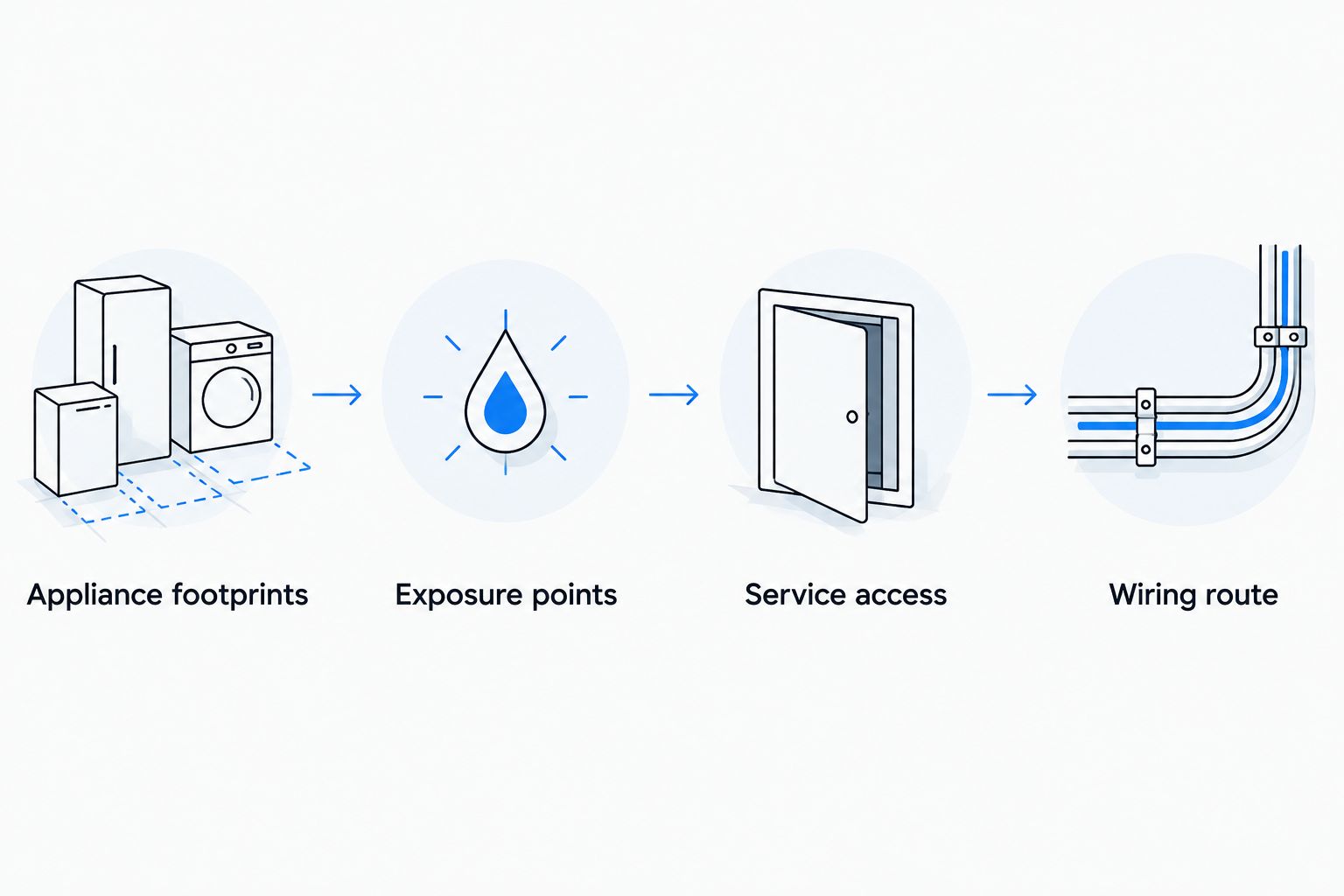
- Draw the appliance footprints. Show doors, drawers, ventilation openings, removable access panels, and the space needed to pull equipment out for service.
- Mark water and heat sources. Include sinks, hose connections, irrigation heads, grill exhaust areas, and surfaces that become hot during cooking.
- Identify operating and service points. Have the electrician locate receptacles, required disconnects, and ground-fault reset points with accessibility and exposure in mind.
- Coordinate the wiring route. Let the electrician select the wiring method, burial requirements where applicable, enclosure ratings, and protection against physical damage.
Expected result: The electrical layout works with the finished kitchen, not just an empty cabinet shell. Doors open, appliances can be serviced, and wiring avoids heat and damage.
An underground raceway does not automatically make its interior dry. Underground installations require wiring materials suitable for the conditions; your electrician must select the correct conductors and wiring method.
Do not use a generic burial-depth number from an unrelated project. Required cover depends on the wiring method, circuit conditions, location, and applicable rules. Have the approved route and required depth established before anyone starts digging.
Also coordinate the electrical work with the gas installer and cabinet builder. Neither trade should discover an incompatible route after the patio has been patched or the island has been faced with stone.
Check outdoor protection
Outdoor electrical protection has separate jobs. Ground-fault circuit-interrupter protection reduces shock risk; a circuit breaker provides overcurrent protection. Weather-resistant devices and appropriate covers address exposure, but neither substitutes for the other protections.
Ask your electrician to document:
- Which circuits and outlets require GFCI protection under the adopted code.
- Which receptacles require weather-resistant construction.
- Which locations require covers that protect the connection while a cord is plugged in.
- How equipment grounding and any required bonding will be provided.
- Whether the proposed location preserves required access and working space.
A covered patio is not automatically a dry location. Have the electrician classify the actual exposure rather than assuming the roof settles the question.
Installation and commissioning
Coordinate the electrical installation
- Approve the final equipment schedule. Confirm that the appliance models match the documents used for design. Resolve substitutions before wiring and circuit protection are finalized.
- Have the electrician verify capacity. The electrician evaluates the existing service, panel compatibility, calculated loads, circuit requirements, and any distance-related design concerns.
- Schedule the required inspections. Coordinate rough inspection before concealed work is covered, where required locally. Keep the wiring accessible until the relevant approval is complete.
- Have the electrician complete the installation. This includes the selected wiring method, circuit protection, grounding, devices, enclosures, identification, and manufacturer-required connections.
- Install appliances according to their manuals. Preserve ventilation, service access, and cord routing. Do not trap a cord beneath equipment or route it against a hot surface.
Expected result: The installed circuits match the approved equipment and layout, with required inspections completed at the appropriate stages.
For a 2026 handover, request a circuit directory that identifies the actual appliance or location rather than a vague label such as patio. Clear identification helps during service and prevents someone from confusing refrigeration with general-use outlets.
Verify the finished installation
- Request documented electrical checks. Have the electrician verify supply, grounding, protective-device operation, and other checks appropriate to the installation. Do not perform live measurements yourself.
- Observe the appliance startup. Run equipment according to its commissioning instructions. Have the installer demonstrate controls and explain any required operating sequence.
- Locate the protective devices. Know which GFCI device protects each connection and how to use its manufacturer-provided test and reset instructions.
- Check physical operation. Open doors and service panels, inspect accessible cord routing, and confirm that covers close as intended around connected cords.
Expected result: You understand what each circuit serves, where protection is located, and how to shut equipment down safely.
Stop using equipment that produces a shock, burning smell, visible damage, or repeated protective-device trips. Keep people away and arrange qualified service. Never bypass a protective device to keep an appliance running.
Adding a refrigerator to an existing outdoor kitchen
An existing island is a different workflow: investigate first, then add equipment. An unused receptacle does not prove the circuit has capacity or that the location meets the refrigerator’s installation requirements.
- Confirm outdoor suitability. Check the exact refrigerator’s permitted environment and installation configuration. A built-in opening does not convert an indoor refrigerator into outdoor equipment.
- Identify the existing circuit. Have the electrician determine what else it supplies, its condition, and the protection already provided.
- Review the appliance requirements. Confirm whether an individual circuit is required and whether the proposed receptacle location preserves access and ventilation.
- Approve the retrofit before modifying cabinetry. Establish the wiring route and service access before cutting panels or moving gas and water connections.
Expected result: The refrigerator joins a verified electrical installation rather than an outlet selected because it happens to be nearby.
For a 2026 retrofit, photograph accessible equipment labels and retain the electrician’s circuit identification with the appliance manual. That record is more useful than remembering which breaker seemed to turn the outlet off.
Troubleshooting
The refrigerator trips the GFCI
Do not remove GFCI protection or replace it with an unprotected receptacle. Have a qualified technician and electrician investigate appliance leakage, moisture, damaged cords, and circuit wiring as appropriate. A trip is a reason to diagnose the fault, not defeat the protection.
The breaker trips when several appliances run
Stop repeating the same operating combination. Have the electrician review connected loads and check for appliance or wiring faults; do not fit a larger breaker without a complete circuit evaluation. Breaker sizing must remain compatible with the entire circuit.
The outlet has power, but the appliance will not start
Follow the appliance manual’s user-level checks for controls and operating conditions. If those checks do not resolve the problem, arrange service. Do not open electrical compartments or assume that a light on a nearby device proves the appliance supply is correct.
Water reaches the receptacle or connection
Keep away from wet electrical equipment and stop using the affected area. Have the electrician investigate enclosure suitability, cover operation, drainage, and the source of exposure. Drying the visible surface does not establish that the connection is safe.
The reset point is hidden behind built-in equipment
Have the electrician review a compliant, accessible protection arrangement. Do not solve the problem by leaving cabinetry dismantled or adding an extension cord. Accessibility belongs in the electrical layout, not in an improvised workaround after installation.
Customize your workflow
Plan future additions on paper before installing spare infrastructure. Give your electrician the intended equipment types and locations; let the electrician determine whether spare raceway, additional circuits, or another distribution arrangement makes sense.
Smokeforges supplies outdoor kitchen equipment; appliance selection should be settled before electrical rough-in. Compare installation documents alongside dimensions, and treat missing outdoor-use confirmation as a reason to pause—not permission to improvise.
Separate convenience from essential appliance operation. Ask your electrician whether the proposed arrangement allows lighting and general-use receptacles to operate without sharing a circuit that an appliance must have to itself.
Keep the completed project file together:
- Final appliance models and installation manuals.
- Approved circuit identification and inspection records.
- Photos of concealed routes taken before closure.
- Protective-device instructions and service contacts.
FAQ
Do outdoor kitchen appliances need dedicated circuits?
Outdoor kitchen appliances need dedicated circuits when their installation instructions or applicable electrical rules require them. Have a licensed electrician evaluate every planned load rather than assigning all outdoor equipment to one shared circuit.
Does an outdoor refrigerator need GFCI protection?
Outdoor refrigerator connections must receive GFCI protection where the adopted electrical code requires it. Do not remove required protection to address tripping; have the appliance and installation checked.
Can I use an indoor refrigerator in a covered outdoor kitchen?
Use a refrigerator outdoors only when its manufacturer permits that environment. A roof does not eliminate humidity, temperature exposure, or wind-driven rain.
Can I wire my outdoor kitchen appliances myself?
Use a licensed electrician for circuit design, panel work, wiring connections, and testing. You can prepare the appliance schedule and layout without opening electrical equipment.
What wire size should I use for outdoor kitchen appliances?
There is no single wire size for all outdoor kitchen appliances. The electrician must account for the appliance requirements, circuit rating, wiring method, distance, and applicable installation rules.
Should an outdoor kitchen have a subpanel?
An outdoor kitchen needs a subpanel only when the electrical design calls for one. Compare its installation requirements with individual branch circuits after the electrician reviews capacity, distance, and planned equipment.
Can I use an extension cord for a built-in outdoor appliance?
Do not use an extension cord as a substitute for permanent appliance wiring. Follow the appliance installation instructions and have the electrician provide the required connection at the intended location.
One last thing
The easiest electrical mistake to miss is buying the replacement appliance after the circuit is finished. Similar dimensions do not mean identical electrical or ventilation requirements.
Before approving any substitution in your 2026 project, send the new model’s manual to the electrician and cabinet installer. Smokeforges outdoor kitchen equipment belongs in a coordinated appliance plan—not a finished opening that forces the wrong connection.


