

A built-in grill is worth it in 2026 if you want a permanent outdoor cooking station and will use the surrounding prep space and storage; a cart grill is the better fit if you need mobility or a simpler installation. The trade-off extends beyond the grill itself: you must plan the enclosure, fuel supply, ventilation, clearances, and service access before construction.
At a glance
- Is a built-in grill worth it? Yes for a permanent outdoor kitchen; choose a cart grill when mobility matters.
- Built-in installation does not guarantee better searing; judge the grill separately from the island.
- Smokeforges suits homeowners comparing grills and outdoor kitchen equipment together.
- Confirm cutout dimensions, ventilation, clearances, and service access before building the enclosure.
Is a built-in grill worth it in 2026?
Buy a built-in grill for the cooking station, not for the built-in label. An island can put a landing surface, utensil storage, and fuel connections where you need them. It does not, by itself, improve the heat reaching your food.
Smokeforges sells grills and outdoor kitchen equipment, so treat the appliance and its surrounding setup as separate buying decisions. First decide how you want to cook; then decide whether a permanent installation serves that routine.
| Setup | Best for | Main advantage | Main drawback |
|---|---|---|---|
| Built-in grill | Homeowners committed to a fixed outdoor kitchen | Integrates cooking with planned work surfaces and storage | Requires enclosure planning and deliberate service access |
| Cart grill | Homeowners who want placement flexibility | Keeps the grill independent of permanent cabinetry | Prep space and storage depend on the cart or separate furniture |
| Standalone ceramic grill | Homeowners planning a ceramic-grill station | Lets you build the workspace around a ceramic cooker | Needs model-approved support, spacing, and heat protection |
A built-in earns its place when the island solves a real problem. If you already have a comfortable cooking position, a nearby table, and accessible storage, replacing your cart with masonry does not automatically improve dinner.
Why this matters
A grill is replaceable. An enclosure shaped around it is harder to change. That makes fit, access, and your preferred cooking method important before you commit to a permanent layout.
For a 2026 outdoor kitchen project, separate the appliance decision from the construction decision. You can choose a capable grill and still build an awkward station around it—or choose a convenient island that contains the wrong cooker for your meals.
Think about your last outdoor cook. Where did you put the raw-food tray, the clean serving platter, and the tongs? Those details tell you more about the value of an island than a photograph of finished stonework.
When a built-in grill is the better choice
You want a permanent cooking position
A built-in suits a patio where you have already settled the cooking location. You know where people gather, how you reach the kitchen, and where the grill can operate according to its installation instructions.
The advantage is consistency: tools and work surfaces stay in their assigned places. The drawback is commitment. If the position feels cramped or inconvenient, you cannot simply roll the appliance elsewhere.
You need useful prep space and storage
An island is useful when it gives you somewhere to set a tray without leaving the grill. Enclosed storage also gives brushes, utensils, and cookware an assigned home, provided the storage is appropriate for those items and the enclosure conditions.
Do not fill every opening with drawers just because they look finished. Access doors and storage drawers serve different jobs, and the layout must preserve whatever access the appliance and utilities require.
You are coordinating the whole outdoor kitchen
A built-in makes sense when the grill is part of a planned workspace rather than an isolated appliance. Cooking, serving, cleanup, and storage should work together.
The benefit is an organized station. The limitation is that each added component brings another fit and installation decision. Specify the equipment before finalizing the enclosure—not after the openings are built.
When a cart grill is the better choice
You are still testing the layout
Choose a cart grill if you are unsure where outdoor cooking belongs. Placement flexibility lets you evaluate a location without committing to an appliance-sized opening in an island.
That flexibility does not cancel safety requirements. Operate the grill only in locations permitted by its instructions, and do not move it while it is hot or operating.
You want the appliance without an enclosure project
A cart grill keeps the buying decision focused on cooking. You still need a suitable location and fuel arrangement, but you are not also specifying an island around the grill head.
For a gas-grill comparison, the Napoleon Rogue PRO 625 SIB Gas Grill with Infrared Side Burner is a relevant alternative to evaluate. Its named infrared side burner gives searing-focused buyers a specific feature to assess; it does not replace the need to check dimensions, instructions, and the rest of the cooking setup.
You expect your cooking preferences to change
A cart setup is easier to reconsider when you move from quick gas grilling toward charcoal cooking or another method. Permanent cabinetry ties more of the workspace to the selected appliance's dimensions and requirements.
The trade-off is a less integrated station. A separate prep table can address workspace needs, but it remains another piece to position and maintain.
Why the value of a built-in grill varies
The value comes from how the installation supports your cooking—not simply from whether the grill sits inside an island. Use these factors to judge your own setup:
- Cooking routine: Regular outdoor meal preparation gives integrated work surfaces and storage a clear purpose. An elaborate station adds less practical value when you rarely use it.
- Location certainty: A settled layout supports a permanent installation. An untested location favors a movable setup.
- Appliance fit: Cutout dimensions, support requirements, and required clearances determine what the enclosure must accommodate.
- Fuel and ventilation: The selected appliance's instructions govern fuel connections and enclosure ventilation. Do not substitute a decorative opening for a specified vent arrangement.
- Maintenance access: Ignition components, connections, and other service points need an accessible route. A finished face is not a reason to seal them away.
- Workspace design: Landing space and usable storage improve the cooking routine. An island that crowds the cook misses the point.
None of these factors makes built-in installation automatically right or wrong. Together, they show whether permanence solves a problem you actually have.
What should you check before building the island?
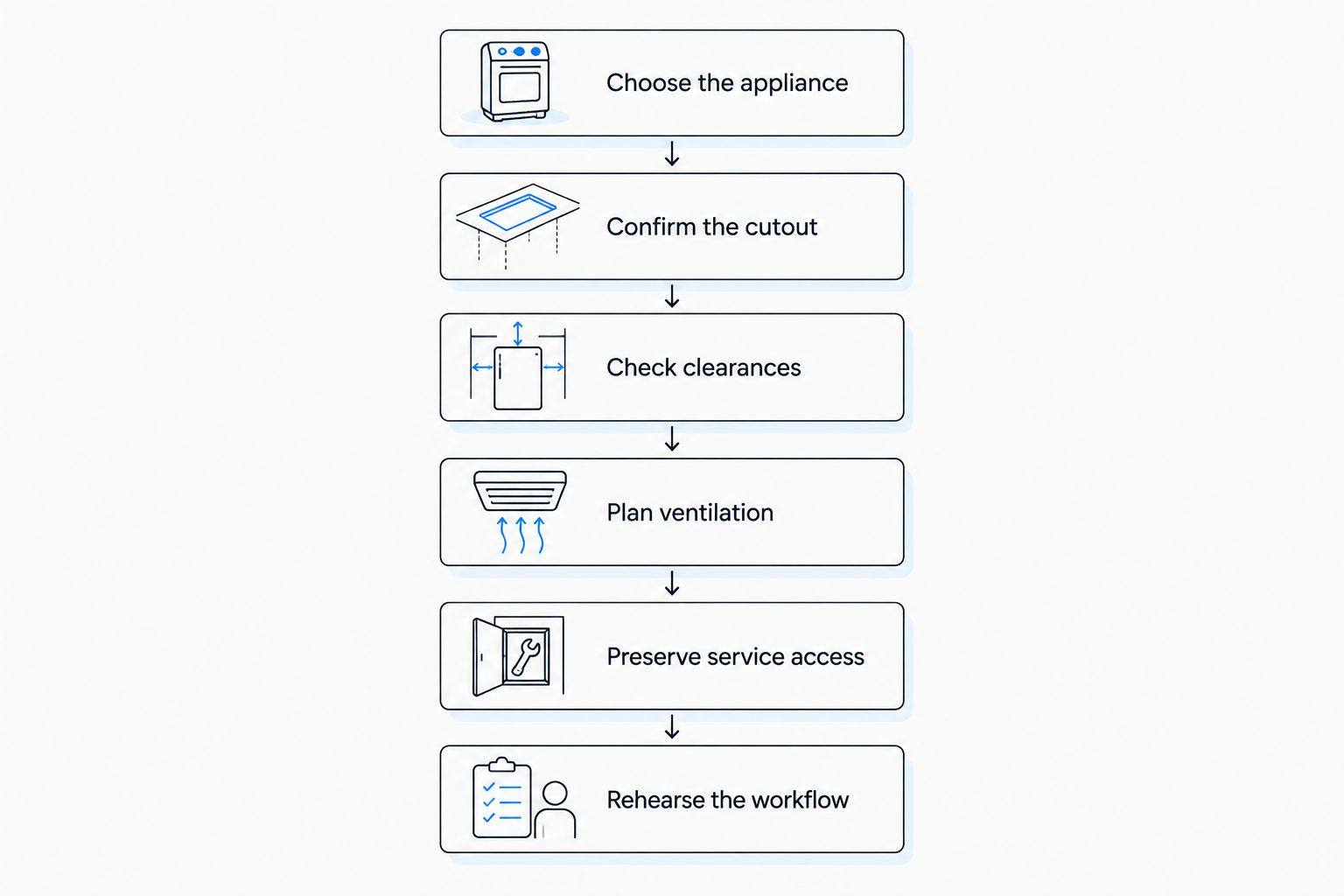
For your 2026 project, finish this sequence before construction. The manufacturer's installation instructions are the benchmark—not the product photograph or the advertised grill width.
- Choose the appliance. Confirm the exact model, fuel type, and approved installation format. A cart grill is not automatically suitable for removal from its cart and installation inside an enclosure.
- Confirm the cutout. Obtain the specified opening dimensions and support details. Keep advertised appliance dimensions separate from construction dimensions.
- Check clearances. Review the required separation from combustible materials and surrounding structures. Confirm that the lid and controls can operate without obstruction.
- Plan ventilation. Follow the appliance instructions and applicable local requirements for the enclosure and fuel arrangement. Resolve questions with the installer before closing the island.
- Preserve service access. Identify how connections and serviceable components will be reached. Make sure cabinetry does not block that route.
- Rehearse the workflow. Mark the planned cooking position and work surfaces before construction. Walk through placing food, turning it, and transferring it to a clean platter.
Keep the appliance documents with the project drawings. Your installer needs the requirements for the exact equipment you selected, not instructions for a similar-looking model.
Which island components deserve space?
Storage deserves space when it has a defined job. Access deserves space whenever installation or maintenance requires it. Those needs overlap, but they are not interchangeable.
The following Napoleon components illustrate that distinction. Both have stainless steel construction and soft-closing hardware in their supplied product descriptions; their different configurations serve different planning needs.
| Component | Best for | Practical advantage | Limitation to check |
|---|---|---|---|
| Napoleon 36 x 24-Inch Built-In Double Access Doors - Stainless Steel | An opening intended for enclosure access | Double-door configuration | Does not provide the named drawer arrangement of the combination unit |
| Napoleon 36 x 24-Inch Built-In Single Door and Double Drawer Combo - Stainless Steel | A layout needing a door and organized drawer storage | Combines a single door with double drawers | Drawer placement must not interfere with required enclosure access |
The 36 x 24-inch designation is a product size description, not permission to use that measurement as the cutout. Confirm the installation dimensions for either component before your builder makes the opening.
Island access and storage options

Napoleon 36 x 24-Inch Built-In Double Access Doors - Stainless Steel
Stainless steel double access doors with soft-closing hardware.
$949

Napoleon 36 x 24-Inch Built-In Single Door and Double Drawer Combo - Stainless Steel
Stainless steel single-door and double-drawer combination with soft-closing hardware.
$1,399
Use the Smokeforges outdoor kitchen equipment selection to compare configurations, then validate each component against the actual island plan. A matching finish is useful, but it does not prove that the opening, storage space, or access route is correct.
Does a built-in grill cook better than a cart grill?
Built-in installation does not establish better cooking performance. Compare the cooking system, grate design, heat control, and usable cooking space of the actual appliances.
For a hard char or mahogany crust, the question is how the selected grill delivers heat to food. Stone surrounding the appliance does not answer that question. Nor does a large-looking island tell you how well the grill handles your usual meal.
In your 2026 comparison, keep workspace benefits separate from cooking benefits. The island should improve how you prepare and serve food; the grill should deliver the cooking method you want.
Can you replace a built-in grill later?
Replacement depends on the new appliance's installation requirements, not just its advertised width. Check the existing opening against the replacement model's cutout, support, clearance, and connection requirements.
A model described as 32 inches and a model described as 30 inches do not provide enough information to establish interchangeability. The Napoleon Built-In 700 Series 32-Inch Stainless Steel Gas Griddle and Kokomo Pro 30-Inch Built-In Gas Griddle illustrate why product labels should start the comparison, not finish it.
| Built-in griddle | Best for | Stated distinction | Fit limitation |
|---|---|---|---|
| Napoleon Built-In 700 Series 32-Inch Stainless Steel Gas Griddle | Buyers comparing a stainless steel cooking plate | Two burners, 24,000 BTU output, and a 5 mm stainless steel plate | Requires its own installation-dimension check |
| Kokomo Pro 30-Inch Built-In Gas Griddle | Buyers evaluating a built-in gas-griddle format | Listed as a 30-inch built-in gas griddle | Its size label does not establish compatibility with another opening |
Do not treat similar widths as a replacement guarantee. Leave future equipment changes as a design consideration, not an assumed capability.
FAQ
Is a built-in grill worth it if I only grill occasionally?
A built-in grill is harder to justify when you rarely use the surrounding workspace and storage. Choose it for a permanent outdoor kitchen you will use, not simply for the finished appearance.
Does a built-in grill make food taste better?
Built-in installation does not itself improve flavor or searing. Evaluate the actual grill's cooking system and your preferred fuel and cooking method separately from the island.
Can I put my existing cart grill into an island?
Use an existing cart grill in an island only if the manufacturer explicitly approves that installation. Removing the cart does not establish the required support, ventilation, or clearances.
Do I need a liner for a built-in grill?
A liner requirement depends on the exact appliance and enclosure construction. Follow the installation instructions and use only a liner specified for that application.
Are access doors the same as outdoor kitchen storage?
Access doors provide an opening into the enclosure; they do not automatically create a drawer or finished storage cabinet. Plan required access separately from utensil and cookware storage.
Can any refrigerator go beside a built-in grill?
Choose a refrigerator only after confirming that its approved operating environment and installation requirements fit the location. Placement beside a grill also requires attention to the applicable appliance clearances.
Should I choose the grill or build the island first?
Choose the exact grill before finalizing the island. The appliance instructions determine the cutout, support, clearances, ventilation, and access requirements.
One last thing
Rehearse a meal before approving the island layout. Stand where the cook will stand, place an empty tray where raw food will land, and identify a separate spot for the clean serving platter.
For a 2026 build, that rehearsal is a better final check than another look at the rendering. If you must turn away from the grill or cross the guest path for every transfer, fix the layout before construction. Smokeforges outdoor kitchen equipment belongs in a plan that works at cooking time, not just in a finished photograph.


