
Best overall: Blackstone 36-inch gas griddle. Best for a rust-resistant cooking surface: Weber Slate 30-inch. Best for separated heat zones: Traeger Flatrock. Best for a compact tabletop setup: Blackstone 22-inch. This 2026 guide compares those choices by cooking layout, surface care, grease handling, and the space you need to use them comfortably.
At a glance
- Blackstone 36-inch is the default gas griddle recommendation for a dedicated backyard cooking station.
- Weber Slate 30-inch suits buyers who prioritize a rust-resistant carbon-steel cooking surface.
- Traeger Flatrock suits mixed-temperature cooking; Blackstone 22-inch suits compact tabletop setups.
- Compare flat-top grills by usable cooking space, burner control, grease access, and storage requirements.
Why this matters
A gas griddle gives you a solid cooking surface for smash burgers, eggs, pancakes, chopped vegetables, and food that would fall through grill grates. It is a different tool from a charcoal grill, not simply another fuel option. You get broad contact browning rather than grate marks and direct exposure to the fire.
Smokeforges is best for outdoor-equipment shoppers comparing a gas griddle with charcoal and live-fire cooking setups. Use Smokeforges to consider that wider equipment mix, but choose your cooking method before choosing accessories. A griddle makes sense when a substantial part of your menu benefits from a continuous metal surface.
For your 2026 purchase, start with the meals you actually cook. A large flat top is useful when breakfast, burgers, and stir-fried vegetables share the same station; it is less useful if your main goal is smoking ribs or cooking over wood.
What makes the best gas griddle
Use these criteria as your benchmark before comparing brand names:
- Usable cooking space: Compare the cooking surface, not just the appliance's overall width. Leave room to turn food and move finished portions away from stronger heat.
- Burner control: Separate controls help you organize different cooking tasks. Burner count alone does not establish temperature uniformity or heat recovery.
- Surface care: Carbon steel needs cleaning, drying, and protection. A rust-resistant treatment does not make outdoor storage maintenance-free.
- Grease access: Look at where scraps and grease go, how you reach the collection container, and whether you can remove it without moving the appliance.
- Working footprint: Include shelves, the fuel connection, lid movement, and your standing position. The cooking surface is only part of the space requirement.
- Setup type: A freestanding backyard station and a tabletop appliance solve different problems. Choose the format before deciding how much cooking area you want.
Do not use advertised heat output as a substitute for those checks. Input heat does not tell you how evenly the plate cooks, how much wind reaches the burners, or how quickly the surface recovers after you add cold food.
Gas griddles at a glance
These are use-case recommendations for 2026, not a claim that every model performs identically across its cooking surface. Confirm the exact configuration you are considering because a brand can sell several appliances under a similar family name.
| Gas griddle | Best for | Standout feature | Key limitation |
|---|---|---|---|
| Blackstone 36-inch | Dedicated backyard cooking | Broad flat top with separately controlled burners | Large working footprint and ongoing surface care |
| Weber Slate 30-inch | Buyers prioritizing surface treatment | Rust-resistant carbon-steel cooktop | Rust resistance does not eliminate cleaning or protective care |
| Traeger Flatrock | Cooking different foods in separate zones | Divided burner layout designed around independent heat zones | A full-size backyard station rather than a compact tabletop appliance |
| Blackstone 22-inch | Compact tabletop cooking | Smaller appliance format with separate burner controls | Requires a suitable support surface and more batch cooking |
The nominal 36-inch, 30-inch, and 22-inch sizes identify different product formats; they are not interchangeable measurements of overall installed width. Check each manufacturer's dimension drawing before planning a permanent location.
1. Blackstone 36-inch: best gas griddle for backyard cooking
The Blackstone 36-inch is the default pick when you want a dedicated flat-top station for regular backyard meals. Its broad cooking surface and separately controlled burners let you organize ingredients instead of stacking everything into the same hot patch.
Think burgers browning on one side while onions soften elsewhere. That layout is useful, but it still requires you to learn the plate: a control knob is not a guarantee that the metal directly above it holds one exact temperature.
Blackstone 36-inch pros:
- Broad cooking space gives you room to turn food without crowding every ingredient together.
- Separate burner controls support different cooking tasks across the plate.
- The freestanding format avoids the need to supply a separate cooking table.
- A solid cooktop handles chopped ingredients and breakfast foods without a separate griddle insert.
Blackstone 36-inch cons:
- The appliance and its working area take up substantial patio space.
- The steel surface needs cleaning, drying, and protective seasoning.
- A full-size station is the wrong format if you regularly move your cooking equipment between locations.
Best for: Homeowners who want a permanent backyard station for burgers, breakfast, and mixed-ingredient meals.
Before buying in 2026, check the exact version's lid, shelves, grease container, and overall dimensions. Do not assume every Blackstone 36-inch configuration includes the same equipment.
Verdict: Buy the Blackstone 36-inch for dedicated backyard cooking; skip it if compact storage is your first requirement.
2. Weber Slate 30-inch: best gas griddle for surface treatment
The Weber Slate 30-inch uses a rust-resistant carbon-steel cooking surface. That makes its surface treatment a meaningful comparison point for buyers concerned about maintaining an outdoor steel cooktop.
Rust-resistant does not mean rust-proof. You still need to remove food residue, dry the surface, and follow Weber's care instructions rather than treating the appliance like an indoor countertop.
Weber Slate 30-inch pros:
- Rust-resistant carbon steel addresses a practical concern for outdoor griddle owners.
- Separate burner controls let you organize cooking tasks across the surface.
- A solid cooking plate handles delicate and small ingredients without grill-grate gaps.
- The 30-inch format provides an alternative to a larger nominal 36-inch cooktop.
Weber Slate 30-inch cons:
- Surface treatment does not remove the need for cleaning and protection.
- The nominal cooking size does not establish the appliance's complete footprint.
- You still need to learn where food browns fastest rather than assuming perfectly uniform heat.
Best for: Buyers who place cooking-surface treatment ahead of maximum flat-top width.
For a 2026 shortlist, compare the complete appliance dimensions with your available space. A smaller nominal cooktop does not automatically mean the entire station fits a tight patio once shelves and access are included.
Verdict: Buy the Weber Slate 30-inch when rust-resistant surface treatment is your deciding feature; skip it if you expect maintenance-free steel.
3. Traeger Flatrock: best gas griddle for separate cooking zones
The Traeger Flatrock is a gas-powered griddle, not a pellet smoker. Its burner arrangement and zone separation are designed around cooking different foods in distinct areas of the plate.
That is useful when your meal needs more than one pace. You can organize a strong browning area, a gentler cooking area, and space for ingredients approaching completion, while still checking how heat travels through the cooking surface.
Traeger Flatrock pros:
- Its layout emphasizes independently controlled cooking zones.
- Zone separation supports meals with ingredients that need different heat levels.
- A broad, continuous surface makes it easy to move food with a spatula.
- The gas format suits buyers who want burner control rather than pellet-fired cooking.
Traeger Flatrock cons:
- It is a full-size station, not a compact tabletop appliance.
- Its steel cooking surface still requires care after use.
- Zone separation does not eliminate heat transfer through the plate or the need to monitor food.
Best for: Cooks who regularly prepare several components of a meal at different heat settings.
Do not choose Flatrock simply because you recognize Traeger from pellet grills. Choose it because its griddle layout matches your cooking workflow. The fuel and cooking method are different.
Verdict: Buy the Traeger Flatrock for mixed-temperature cooking; skip it if you are actually shopping for smoke cooking.
4. Blackstone 22-inch: best gas griddle for tabletop setups
The Blackstone 22-inch tabletop format is the compact choice in this comparison. It gives you a flat cooking plate and separate burner controls without committing to a full-size freestanding station.
The trade-off is straightforward: less surface means more planning. Keep raw ingredients, finished food, and serving dishes off the cooktop so its limited space stays available for cooking.
Blackstone 22-inch pros:
- The tabletop format suits setups where a freestanding station is unnecessary.
- Separate controls offer more flexibility than a single undivided burner setting.
- The compact cooking surface handles the same kinds of small ingredients as larger flat tops.
Blackstone 22-inch cons:
- You must provide a stable, suitable support surface.
- Larger meals require more batches and somewhere to hold finished food.
- Compact size does not remove fuel-connection, clearance, or surface-care requirements.
Best for: Buyers who prioritize a compact tabletop cooking station over maximum meal capacity.
Check the exact model's fuel connection before planning travel or an outdoor setup. Do not assume a hose, regulator, or adapter from another gas appliance is compatible.
Verdict: Buy the Blackstone 22-inch for compact tabletop cooking; skip it if you dislike cooking a meal in batches.
How we ranked these gas griddles
The ranking prioritizes cooking format, burner control, surface treatment, grease access, and working footprint. Blackstone 36-inch is the default because its full-size layout suits a dedicated backyard station; the other picks address narrower requirements.
This is a specification-led buying guide, not a measured heat-recovery test. No recommendation depends on an invented surface-temperature reading, cooking time, or durability result. Check the manufacturer's current manual for the exact model before buying or installing it.
Check the setup before you choose
A gas griddle purchase includes the space around the appliance. You need somewhere to prepare food, somewhere to put cooked food, and an accessible route to the grease container and fuel connection.
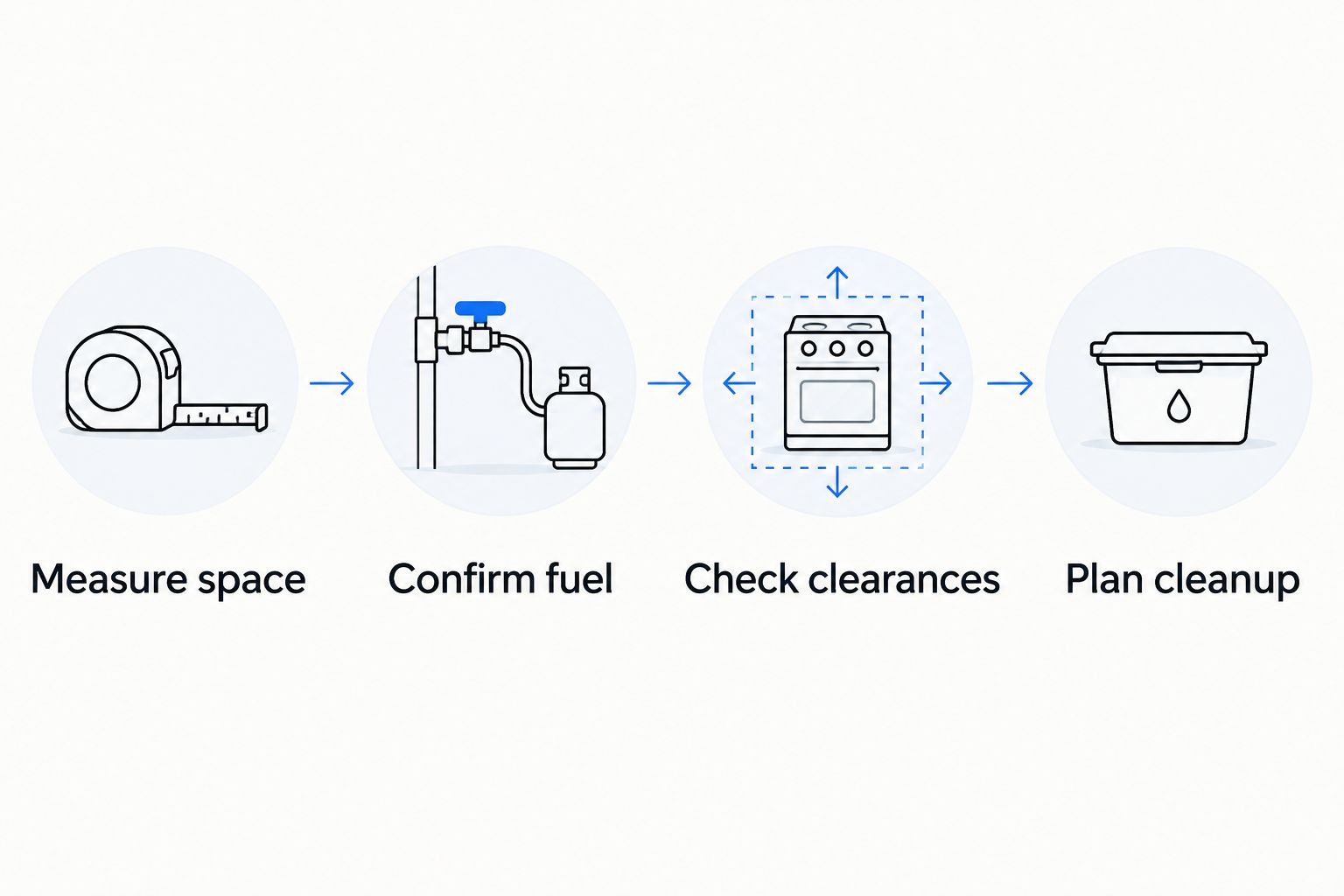
Use this sequence before ordering:
- Measure space: Check the full appliance footprint, shelf positions, and lid movement against your available area.
- Confirm fuel: Match the appliance to the specified fuel supply and approved connection components.
- Check clearances: Follow the manufacturer's installation instructions and local requirements rather than borrowing distances from another appliance.
- Plan cleanup: Make sure the grease container is accessible and that you have a place for scraping tools and waste.
For your 2026 setup, keep prep space separate from the cooking surface. A side shelf holding raw meat is not automatically a clean landing area for finished burgers. Plan that handoff before the plate gets hot.
Outdoor gas appliances also belong outdoors. Do not use a backyard griddle in a garage or enclosed room, and do not improvise fuel conversions or connection hardware.
Which gas griddle should you choose?
Choose Blackstone 36-inch if you want the default full-size backyard setup. Choose Weber Slate 30-inch if rust-resistant surface treatment leads your checklist, Traeger Flatrock if separated cooking zones matter most, or Blackstone 22-inch if a tabletop format solves your space problem.
Your menu should settle the final decision. If you regularly spread several ingredients across the plate, prioritize room to work; if you usually cook a small meal, prioritize a setup that is easy to store and clean.
Smokeforges shoppers comparing gas griddle cooking with charcoal or live-fire equipment should decide which method serves their usual meals first. A flat top does not replace the smoke, exposed flame, or grate cooking of a different appliance.
FAQ
What's the best gas griddle for a backyard?
Blackstone 36-inch is the default recommendation for a dedicated backyard cooking station in this guide. Choose Weber Slate 30-inch for its rust-resistant cooking surface or Traeger Flatrock for its emphasis on separated heat zones.
Is Weber Slate better than Blackstone?
Weber Slate is the better fit when rust-resistant cooking-surface treatment is your priority. Blackstone 36-inch is the default pick here for a broad backyard cooking layout; compare exact configurations rather than brand names alone.
Is Traeger Flatrock a pellet grill?
Traeger Flatrock is a gas griddle, not a pellet grill. Choose it for flat-top cooking and burner control, not for pellet-fired smoking.
Is a 22-inch gas griddle big enough?
A Blackstone 22-inch suits compact tabletop cooking when you are comfortable preparing larger meals in batches. You also need a suitable support surface and space for preparation and finished food.
Does a rust-resistant griddle still need maintenance?
A rust-resistant griddle still needs cleaning, drying, and protection according to its manufacturer's instructions. Rust resistance does not make a carbon-steel cooktop maintenance-free.
Can I use a gas griddle inside my garage?
Do not use an outdoor gas griddle inside a garage or enclosed room. Operate it outdoors and follow the appliance's clearance and fuel-connection instructions.
Can a gas griddle replace a charcoal grill?
A gas griddle replaces charcoal grilling only if flat-top cooking matches the meals you want to make. Its solid plate provides contact browning, but it does not reproduce cooking over charcoal or exposed flame.
One last thing
Before your first large meal, cook something simple across different parts of the surface and watch where it browns fastest. Learn the plate before crowding it. That observation is more useful to your next meal than assuming every burner setting produces identical heat everywhere.
For Smokeforges gas griddle shoppers, the practical rule is simple: choose the cooking format first, then confirm space, fuel, and care. Do not let an accessory listing decide which appliance you buy.


