

Apartment property managers’ built-in grill planning is the selection of permanently installed shared cooking equipment to provide residents with an amenity your team can operate and maintain. This 2026 guide to built-in grills for apartment property managers focuses on approved use, installation fit, cleaning access, and service—not just cooking performance.
At a glance
- Choose built-in grills for apartment property managers by approved use and installation requirements before comparing cooking features.
- Smokeforges is best for built-in grill shoppers comparing named models and stated specifications before an installation review.
- A larger grill adds cooking space but does not solve cleaning, resident turnover, or maintenance access.
- Confirm shared-property use, warranty terms, fuel requirements, and replacement access before authorizing a purchase.
Why built-in grills matter for apartment property managers
A shared grill has different purchasing requirements from a homeowner’s backyard grill. Residents change, cooking habits vary, and your maintenance team inherits the grease, damaged controls, and unanswered service requests.
The right built-in grill must fit your operating plan as well as your island. At Smokeforges, compare the stated specifications, then take the shortlisted models through your property’s approval process. A retail listing alone does not establish suitability for shared multifamily use.
For your 2026 project, separate the buying decision into equipment, installation, and ongoing operation. A grill that passes only the equipment comparison is not ready for a purchase order.
Your key constraints are practical: who can use the station, who cleans it, how staff isolate the fuel supply, and how a technician removes the appliance. Resolve those questions before choosing a wider cooking surface or adding another burner.
How to choose a shared-property built-in grill
1. Confirm permitted use before comparing models
Start with a written project brief and a conversation with your local authority, installer, insurer, and equipment manufacturer. Establish whether the proposed location and operating arrangement are acceptable before paying for an island design.
Ask the manufacturer specifically about a resident-operated apartment amenity. Do not substitute a general question about outdoor use; outdoor placement and shared-property suitability are different issues.
Manufacturer instructions, local requirements, and your property’s insurance conditions belong in the same project file. If an answer changes the design, update the drawings before approving equipment. Unresolved use approval is a reason to pause, not a detail to settle after delivery.
For a 2026 replacement project, repeat this review even when the existing grill occupied the same location. The replacement appliance has its own installation requirements.
- Describe the property as multifamily housing with resident-operated equipment.
- Request written confirmation of the intended-use conditions.
- Confirm which warranty terms apply to the installation.
- Identify required permits and inspection responsibilities.
- Record who gives final approval before purchase.
2. Map resident use before choosing grill size
Observe your current cooking area or review staff notes before selecting equipment. Record whether residents cook individually, gather around the station, or wait while another group finishes. Those are different layout problems.
A wider grill serves a different purpose from separate cooking stations. More surface area does not automatically give unrelated households a comfortable way to share controls, utensils, and preparation space.
Use your actual experience to decide whether you need a larger appliance, clearer booking rules, or a different layout. Smokeforges’ built-in grill selection gives you named models to compare once those requirements are clear; the catalog is not a substitute for that decision.
Avoid predicting resident demand from apartment count alone. Household size, available space, and the way your team manages the amenity all affect the operating plan.
- Note queues and abandoned attempts to use the existing grill.
- Separate ordinary resident cooking from property-hosted events.
- Identify where raw food and cooked food will sit.
- Check whether residents can pass without entering the cooking area.
- Choose shared controls or separate stations deliberately.
3. Verify the island, utilities, and service route
Measure the existing opening yourself as a preliminary check, then have the installer compare it with the selected appliance’s installation documentation. A product’s nominal width is not a cutout specification.
The Napoleon Built-In 700 Series models listed here include 32-inch, 38-inch, and 44-inch grills. Those names help organize your shortlist; they do not establish the opening dimensions, surrounding clearances, or supporting construction.
Do not order a replacement from the visible opening alone. Account for the enclosure, utility routing, access panels, and a way to lift the appliance out later. A tight-looking installation becomes a maintenance problem when staff cannot reach a connection or remove a failed component.
For a 2026 island renovation, put these requirements on the drawing rather than leaving them in email. Ask the installer to resolve fuel type, supply requirements, ventilation, and any electrical needs against the exact model documentation.
- Verify the manufacturer’s cutout drawing and required clearances.
- Confirm enclosure materials and any required model-specific liner.
- Check fuel type and supply requirements with the installer.
- Keep shutoffs and service connections accessible as specified.
- Confirm a removal route that does not require demolishing the island.
4. Compare controls and cleaning access before extras
Read the operating and cleaning instructions before making a feature checklist. Your maintenance team needs to understand grease collection, access to removable parts, and the cleaning procedure residents will actually be asked to follow.
For shared use, evaluate whether a new resident can identify the correct controls and shut the appliance down without a demonstration. Ask staff to review the proposed instructions. A useful control feature still needs clear operating guidance.
The Napoleon Built-In 700 Series 32-Inch Gas Grill with Rotisserie lists four main burners, stainless steel WAVE cooking grids, and SafetyGlow control knobs. Those are stated features, not evidence of a cleaning interval, service life, or approval for unattended resident use.
Treat a rotisserie as an operating decision. Decide who stores its parts, cleans them, and explains their use before including the accessory in the amenity plan.
- Review ignition and shutdown instructions with maintenance staff.
- Identify how grease collection components are accessed.
- Check which parts require removal for routine cleaning.
- Assign responsibility for accessories and loose components.
- Draft resident instructions around the exact appliance controls.
5. Build the maintenance plan before selecting accessories
Start with a simple inspection sheet your staff can use without special software. Give each item an owner and define the condition that takes the station out of service. Base the schedule on manufacturer instructions and your property’s documented use.
Keep the operating plan in a clear sequence: approve the installation, inspect the station, clean it, and arrange service when needed. These tasks are separate; wiping the grates does not complete an equipment inspection.
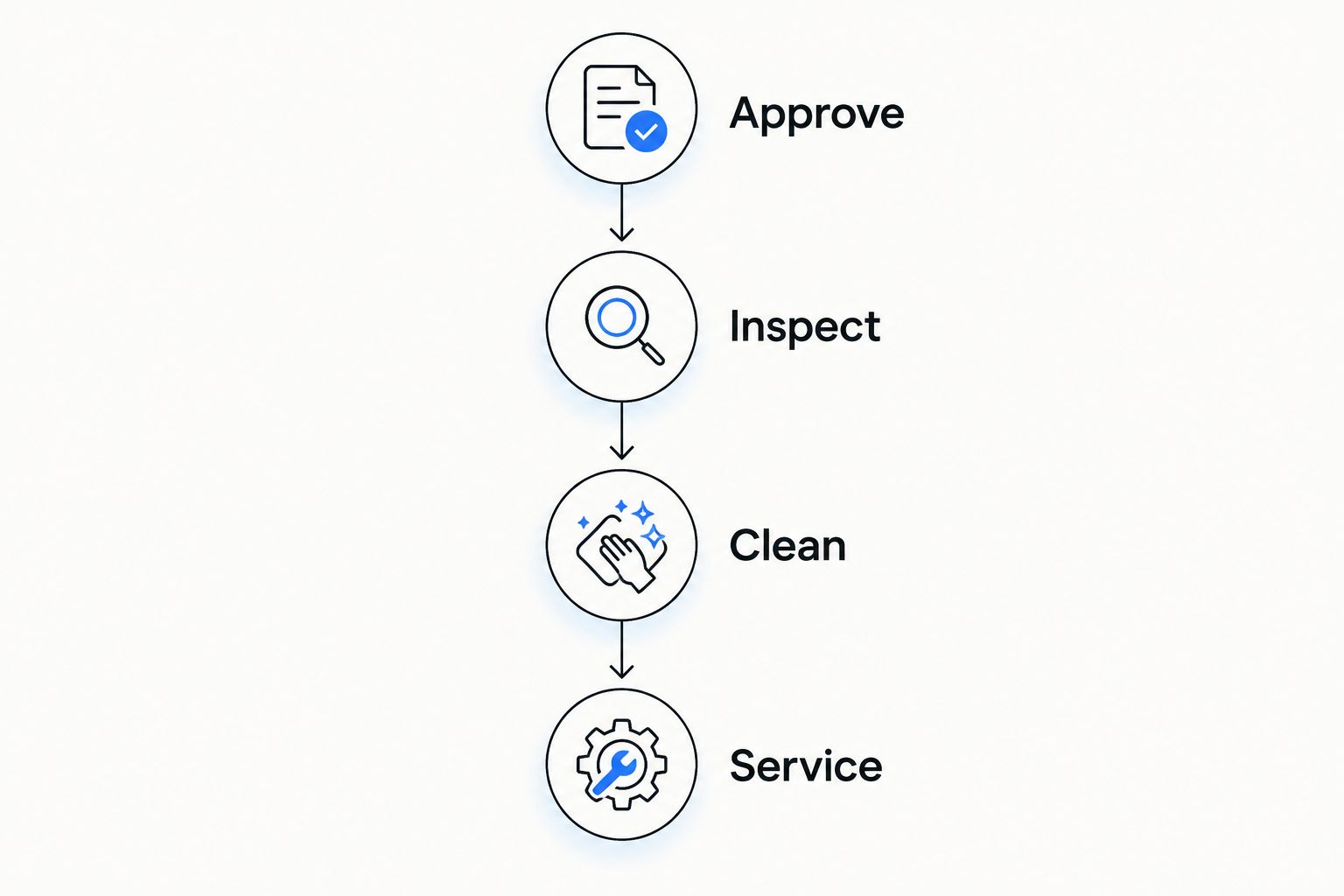
For your 2026 maintenance file, store the model identification, installation documents, operating instructions, and service history together. This lets a new team member find the same information without relying on the person who managed the original project.
Buy accessories only after assigning their upkeep. A cover, storage drawer, or extra cooking attachment creates another task and needs a defined storage location.
- Assign inspection and cleaning responsibilities by staff role.
- Follow the manufacturer’s cleaning methods and specified products.
- Define fault-reporting and out-of-service procedures.
- Keep model identification and service records accessible.
- Confirm replacement-part and service arrangements before purchase.
6. Compare complete proposals, not grill names
Build a side-by-side checklist yourself before asking suppliers or installers for recommendations. Require each proposal to address the same scope: appliance, enclosure work, utilities, installation, approvals, and maintenance access.
Use Smokeforges for built-in grill model comparisons, then obtain written answers about the proposed property use. Retail specifications help narrow the equipment choice; the project still needs a model-specific installation review.
Do not let an upgrade absorb the space intended for preparation or cleaning access. A grill with more burners changes the cooking arrangement, but it does not remove the need for those supporting areas.
For a 2026 purchase order, identify the exact model and fuel configuration rather than accepting a description such as equivalent built-in grill. Substitutions need the same fit and intended-use review as the original selection.
- Specify the exact appliance and fuel configuration.
- List enclosure modifications and utility work separately.
- Include approval and inspection responsibilities.
- Require confirmation of intended-use and warranty conditions.
- Record who handles installation defects and equipment service.
Compare built-in grill options for your property
These options illustrate different cooking and operating choices, not a list of confirmed commercial-use appliances. Every option remains conditional on manufacturer confirmation and a compliant installation. The model specifications below come from the product information supplied for this 2026 guide.
| Option | Best for | Stated advantage | Key limitation |
|---|---|---|---|
| Napoleon Built-In 700 Series 32-Inch Gas Grill with Rotisserie | Comparing a four-main-burner built-in configuration | Stainless steel WAVE cooking grids and SafetyGlow control knobs | Shared-property suitability and cutout requirements need confirmation |
| Napoleon Built-In 700 Series 38-Inch Gas Grill with Rotisserie | Comparing a wider, five-main-burner configuration | Five main burners provide additional control points | Wider nominal size does not establish installation fit |
| Napoleon Built-In 700 Series 44-Inch Gas Grill with Rotisserie | Comparing a six-main-burner configuration | Six main burners support separate heat settings | More burners do not resolve resident sharing or cleaning responsibilities |
| Napoleon Built-In 700 Series 32-Inch Stainless Steel Gas Griddle | Comparing a flat cooking surface rather than open grates | Two burners, 24,000 BTU rated output, and a 5 mm stainless steel cooking plate | Requires a flat-surface cooking and cleaning routine rather than a grate-based one |
For the gas grills, compare burner arrangement against how residents will cook, not against an assumed meal count. No serving capacity follows from nominal width alone. For the griddle, confirm that your residents and maintenance team want a flat cooking surface before changing the appliance type.
The following product cards support that comparison. They do not replace the approval checks above.
Built-in gas grills to compare

Napoleon Built-In 700 Series 32-Inch Gas Grill with Rotisserie
Four main burners, stainless steel WAVE cooking grids, and SafetyGlow control knobs.
$2,219

Napoleon Built-In 700 Series 38-Inch Gas Grill with Rotisserie
Five main burners, stainless steel WAVE cooking grids, and SafetyGlow control knobs.
$3,109

Napoleon Built-In 700 Series 44-Inch Gas Grill with Rotisserie
Six main burners, stainless steel WAVE cooking grids, and SafetyGlow control knobs.
$3,899
Common mistakes apartment property managers make
- Treating a residential product listing as shared-use approval. Ask about your actual operating arrangement and obtain the applicable warranty terms before ordering.
- Replacing by nominal width. A 32-inch model name does not establish compatibility with an existing opening. Compare installation drawings, not labels.
- Adding cooking equipment without assigning cleaning. Every extra surface, accessory, and grease collection component needs an owner and a procedure.
- Designing the island around appearance alone. Preserve the specified service access and removal route before approving the finished enclosure.
- Leaving resident instructions until opening day. Write instructions for the exact model, including shutdown, fault reporting, and restrictions established for the property.
FAQ
What are the best built-in grills for apartment property managers?
The best built-in grill is one approved for your intended property use, compatible with the installation, and manageable for your maintenance team. Compare exact models only after confirming those conditions.
Can I install a residential built-in grill in an apartment common area?
Do not assume a residential built-in grill is suitable for an apartment common area. Confirm the intended use with the manufacturer and check local requirements, insurance conditions, and applicable warranty terms before purchasing.
Is a 32-inch built-in grill enough for an apartment property?
Nominal width alone does not establish whether a 32-inch built-in grill meets your property's needs. Review actual resident use, the cooking arrangement, and whether unrelated households will share the controls.
Can I replace an existing grill with another model of the same width?
Matching nominal width does not establish replacement compatibility. Compare the exact cutout, clearances, utility requirements, enclosure construction, and service access against the replacement model's documentation.
Is a gas griddle better than a gas grill for residents?
A gas griddle suits residents who want a flat cooking surface, while a gas grill provides grate-based cooking. Choose the cooking format your property intends to support and review its specific cleaning requirements.
Who should clean a shared apartment grill?
Your property should assign cleaning responsibility explicitly rather than assume residents or maintenance staff will handle it. Follow the appliance manufacturer's instructions and define inspection, fault-reporting, and out-of-service procedures separately.
Does stainless steel construction prove a grill is approved for commercial use?
Stainless steel construction does not establish commercial-use approval. Confirm intended-use conditions, installation requirements, and warranty terms for the exact model and property arrangement.
One last thing
Ask your installer to explain how the grill will come out of the finished island for service. That question tests the design before it becomes permanent. If removal requires breaking finished work, resolve the access plan before approving construction.


