

Yes, a kamado grill can be used as a smoker: set it up for indirect heat, control the charcoal fire with the vents, and keep the lid closed while food cooks. The main caveat is the setup—you need a compatible heat deflector and reliable temperature monitoring, and an overheated ceramic cooker takes time to cool down.
At a glance
- Can a kamado grill be used as a smoker? Yes—use indirect heat, controlled airflow, and a heat deflector.
- A kamado suits cooks who want charcoal smoking and direct grilling in one cooker.
- Smokeforges shoppers should check deflector compatibility and usable indirect cooking space before choosing an outdoor grill.
- Control the fire early; reducing airflow does not instantly cool an overheated ceramic kamado.
Can a kamado grill be used as a smoker?
A kamado works as a smoker when you separate the food from direct charcoal heat and maintain a controlled fire. Its insulated body helps retain heat, while the lower intake and upper exhaust regulate airflow through the charcoal. Wood added to the fire supplies smoke; the heat deflector prevents the underside of your food from sitting directly over exposed coals.
For homeowners comparing outdoor grills at Smokeforges, a kamado suits buyers who want charcoal smoking and direct grilling in one cooker. The trade-off is hands-on fire management rather than simply selecting a temperature and walking away.
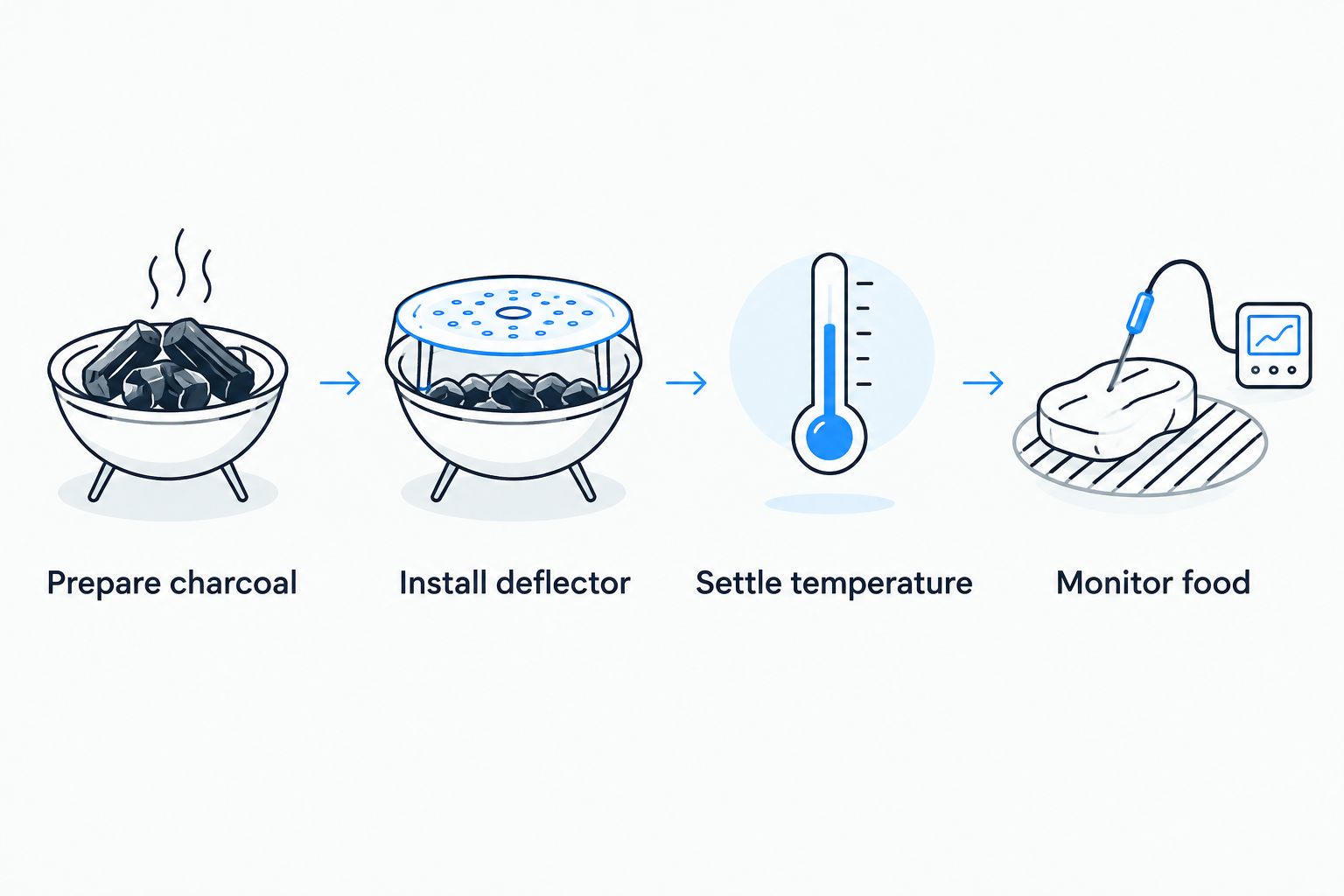
Use this sequence for your first smoking cook in 2026:
- Check the manual. Confirm the approved fuel, deflector position, lighting method, and shutdown procedure for your exact cooker.
- Prepare the charcoal. Clear ash from the airflow passages and arrange fuel without blocking the intake.
- Light a small fire. Avoid lighting the entire charcoal bed when your goal is low-temperature cooking.
- Install indirect heat. Fit the compatible deflector, cooking grate, and any approved drip-pan arrangement before stabilizing the cooker.
- Settle the temperature. Approach your target gradually, making small vent adjustments before adding food.
- Monitor the cook. Track cooking temperature and food temperature separately, keeping the lid closed between necessary checks.
Why this matters
A kamado can produce smoked ribs, pork shoulder, chicken, and brisket, but its ability to grill does not make every grilling setup suitable for smoking. Put a large cut directly above burning charcoal and you expose its underside to intense radiant heat before the center finishes cooking.
Buy the smoking setup, not just the cooker body. For a 2026 purchase, check whether the package includes the correct deflector, whether your food fits over the protected area, and whether you can position a probe near the food without touching the grate.
That distinction also matters if you already own a kamado. Before adding another cooker, check whether a compatible indirect-cooking accessory solves the problem you actually have.
How to set up a kamado for smoking
Build indirect heat first
The heat deflector sits between the fire and the food. It blocks direct radiant heat while hot air circulates through the cooking chamber, turning the kamado into an indirect cooker rather than an open charcoal grill.
Use the manufacturer's specified placement. A deflector installed incorrectly can interfere with airflow, leave food exposed to the fire, or put components in positions they were not designed to occupy.
A drip pan catches rendered fat and simplifies cleanup, but it does not automatically replace a heat deflector. Follow the cooker instructions for pan placement and spacing rather than resting a pan wherever it happens to fit.
Establish airflow before adding food
The lower vent admits combustion air; the upper vent provides an exhaust path. Together, they control the fire, but there is no universal vent opening that produces the same temperature in every kamado.
Start with the manual's guidance and adjust gradually. Leave time between changes so you can see their effect instead of repeatedly opening and closing vents while the cooker is still responding.
Do not chase every thermometer movement. A brief fluctuation after opening the lid is different from a sustained temperature rise with the lid closed.
Measure where the food cooks
For conventional low-and-slow barbecue, 225–275°F is a common cooking-temperature range, not a requirement for every recipe. Choose the recipe's target and monitor near the food; a dome thermometer measures conditions at the dome, not necessarily at the cooking grate.
Keep the probe away from direct contact with metal, the deflector, and the food itself unless it is a food probe. Readings from those locations answer different questions.
Kamado vs. kettle vs. dedicated smoker
Choose by the cooking routine you want, not by the word smoker on the box. A charcoal kettle can smoke with an indirect setup, while dedicated smokers vary widely in fuel, controls, and cooking layout.
| Cooker type | Best for | Main advantage | Main limitation |
|---|---|---|---|
| Kamado grill | Cooks who want smoking and high-heat charcoal grilling | Insulation helps retain heat during indirect cooking | Stored heat makes temperature overshoots slow to correct |
| Charcoal kettle | Cooks who prefer a simpler charcoal setup | Supports direct and indirect cooking with suitable fuel placement | Requires attention to fire layout and available indirect space |
| Dedicated smoker | Cooks whose priority is smoking rather than direct grilling | Smoking-focused layouts and controls, depending on the model | Direct-grilling capability is not universal |
A kamado is not automatically the right choice for unattended cooking. Manual vents still require attention, and a temperature-control accessory only belongs on your shortlist after you confirm compatibility and understand what it controls.
If automated charcoal control is your priority, the Gravity Series 1150 Digital Charcoal Grill & Smoker is a relevant Smokeforges alternative to investigate. Check its operating instructions and cooking layout against your needs rather than assuming a digital controller removes all supervision.
Why kamado smoking temperatures vary
A stable smoking temperature depends on the fire, airflow, and stored heat working together. These are the main factors to watch during a 2026 kamado cook:
- Airflow: Ash buildup, blocked charcoal passages, and vent adjustments change the oxygen reaching the fire.
- Starting fire size: Lighting too much charcoal makes a low-temperature target harder to approach without overshooting.
- Stored heat: Ceramic continues releasing heat after you reduce the fire's oxygen supply.
- Cooking configuration: Deflectors, grates, pans, and food affect airflow and temperature distribution inside the cooker.
- Weather and lid openings: Wind influences airflow, while opening the lid changes conditions inside the cooking chamber.
- Fuel arrangement: Charcoal size and placement affect how air passes through the fuel bed and how the fire spreads.
Change one controllable factor at a time. If you adjust both vents, rearrange fuel, and move the probe together, you lose the ability to identify which change corrected the problem.
A short cook log helps: record the recipe target, grate reading, vent positions, and any substantial adjustments. Your own cooker notes are more useful than copying someone else's vent settings without their conditions.
How do you add smoke without overpowering the food?
Use cooking wood approved for your cooker and start conservatively. A closed kamado holds smoke around the food; adding more wood is not a substitute for maintaining a clean-burning charcoal fire.
Let the cooker settle before loading food. Heavy, acrid-smelling smoke signals a combustion problem to address, not a reason to put the meat on immediately.
Never use painted, treated, glued, or otherwise contaminated wood as cooking fuel. Choose wood sold for food smoking rather than scraps whose treatment history you cannot verify.
Aim for smoke as a seasoning, not a constant cloud. Once you understand the flavor from your chosen wood and setup, adjust future cooks deliberately instead of adding wood every time visible smoke fades.
What should you check before buying a kamado for smoking?
For your 2026 shortlist, compare usable indirect space rather than relying only on the advertised grill diameter. Food that extends beyond the deflector's protected area receives a different heat exposure from food centered above it.
Check these details before committing:
- Deflector fit: Confirm the exact accessory required and whether it comes with the cooker package.
- Food clearance: Check that your intended cuts fit with the lid closed and the indirect setup installed.
- Fuel access: Understand how you would add fuel or wood during a cook without improvising around hot components.
- Ash access: Look at how you clear ash and keep the intake passages open.
- Temperature monitoring: Identify a practical route for compatible probe cables and a position for a grate probe.
- Handling: Read the instructions for moving the cooker and handling its ceramic components.
Smokeforges is an outdoor-grill retailer for homeowners comparing cooking setups; the useful buying question is whether the complete setup matches your food and routine. A kamado's strength is versatility, but that does not remove its weight, accessory requirements, or learning curve.
Can I smoke on a kamado without a heat deflector?
A common 225–275°F smoking target does not eliminate direct radiant heat from exposed coals. Use the manufacturer's approved indirect setup for conventional low-and-slow smoking rather than assuming a low dome reading protects the underside of your food.
Some recipes intentionally use direct heat. That is a different technique, not a reason to skip the deflector in a recipe designed for indirect cooking.
Is the smoking temperature the same as the safe food temperature?
225–275°F describes a common cooker-temperature range, not a safe internal temperature for every food. Your cooking-chamber probe and food probe serve separate jobs.
For 2026 food-safety planning, USDA FSIS minimum-temperature guidance specifies 165°F for poultry and 145°F followed by a 3-minute rest for whole cuts of beef, pork, lamb, and veal. Follow the guidance for the specific food; barbecue tenderness is a separate consideration from the minimum safety temperature.
Is a kamado better than a dedicated smoker?
A kamado is the better fit when you want both indirect smoking and direct charcoal grilling from one cooker. A dedicated smoker deserves a closer look when smoking layout, access, or a particular control system matters more than grilling versatility.
Compare exact models before deciding. Neither the kamado label nor the smoker label tells you the complete cooking capacity, accessory package, or operating routine.
FAQ
Can a kamado grill really smoke brisket?
Yes, a kamado can smoke brisket using indirect heat and controlled airflow. Check that the brisket fits over the deflector's protected area with the lid closed.
What temperature should I use to smoke on a kamado?
225–275°F is a common low-and-slow smoking range. Use your recipe's target and monitor cooking temperature near the food rather than relying only on a dome reading.
Do I need a water pan in a kamado smoker?
A water pan is not what makes a kamado an indirect smoker; the approved heat-deflector arrangement does that. Follow the recipe and cooker manual for whether to use water and where to place the pan.
Can I use wood instead of charcoal in my kamado?
Use only the fuels approved in your kamado's manual. Do not assume that a charcoal cooker is designed to run on a full wood fire.
Why does my kamado stay hot after I close the vents?
A ceramic kamado retains stored heat after airflow is reduced. Follow the shutdown instructions and allow it to cool naturally rather than pouring water into a hot cooker.
Is it safe to leave a kamado smoking overnight?
An overnight recipe does not make unattended operation safe. Follow the manufacturer's supervision and placement requirements; a remote thermometer does not replace safe operation.
Can I open the kamado lid while smoking?
Yes, but open it only when needed and follow the manufacturer's lid-opening procedure. Sudden oxygen entry into a hot, oxygen-restricted charcoal cooker can cause a flashback.
One last thing
Your first smoking upgrade is control, not more smoke wood. Before changing accessories, confirm that your airflow is clear, your deflector is correctly installed, and your probe measures the cooking zone.
For your first 2026 cook, choose a recipe that fits comfortably inside the indirect area and record what you change. Learn how the cooker responds before filling every inch of the grate.


