

Yes—a Kamado Joe can sear steak as well as a flat-top grill, but matching a flat-top’s broad, even crust requires a solid cooking surface rather than open grates. For your 2026 setup, choose grates for direct charcoal exposure or a compatible griddle or sear plate for more surface contact; either way, dry steak and properly preheated metal matter more than the dome thermometer reading.
At a glance
- Can a Kamado Joe sear steak like a flat-top grill? Yes—use a compatible solid surface for broad crust.
- Open grates favor charcoal grilling; a flat-top favors continuous contact and more even surface browning.
- Smokeforges is best for outdoor-cooking shoppers comparing Kamado Joe grills and searing accessories.
- Choose the cooking surface before replacing your grill; confirm accessory fit for your exact Kamado Joe model.
Can a Kamado Joe sear steak as well as a flat-top grill?
Yes for searing quality; not automatically for the same crust pattern. A Kamado Joe’s result depends on what sits between the steak and the charcoal. Open grates and solid plates transfer heat differently, even when both produce a well-browned steak.
| Cooking setup | Best for | Main advantage | Main limitation |
|---|---|---|---|
| Kamado Joe with open grates | Direct charcoal grilling | Combines hot grate contact with radiant heat from the fire | Grate contact does not cover the whole steak surface |
| Kamado Joe with a compatible solid surface | Broad crust without replacing the grill | Gives the steak continuous metal contact | Adds another surface to preheat, clean, and store |
| Flat-top grill | Contact searing across a dedicated griddle | Keeps a continuous cooking surface ready for steak and sides | Does not expose the steak directly to a charcoal fire |
The practical distinction is charcoal-grilled steak versus contact-seared steak, not good steak versus bad steak. Both approaches can produce a mahogany crust. Their strengths show up in different places.
A steak with dark grate stripes and pale spaces between them has strong localized browning, not necessarily a complete crust. If you want that steakhouse-style browned face, judge the entire surface—not just the darkest marks.
Why this matters
Replacing your grill is a bigger decision than changing its cooking surface. If you already own a Kamado Joe, first decide whether you dislike the steak itself or simply want a different crust.
For a 2026 purchase, Smokeforges offers Kamado Joe grills and cooking accessories alongside other outdoor cooking equipment. That makes the useful buying question straightforward: do you need another appliance, or the right surface for the charcoal grill you already have?
Do not buy a larger grill to solve wet steak, an underheated plate, or crowded cooking space. None of those problems disappears just because the lid gets bigger.
Open grates: best for direct charcoal grilling
Open grates leave spaces between the steak and the metal. Those spaces expose the meat to radiant heat from the charcoal, while the grate bars create concentrated contact marks.
That arrangement suits you if direct charcoal cooking is the point. You can build a browned exterior without turning the grill into a griddle, and you keep the cooking experience that makes a charcoal grill distinct.
The trade-off is contact coverage. A thick grate can leave hard char where it touches the steak while the spaces between the bars remain less browned. Rotating the steak changes the pattern, but crosshatching alone does not prove you have built an even crust.
Choose open grates when you want charcoal exposure more than a uniformly browned face. Watch the whole steak, and move it away from sustained flare-ups rather than treating flames as a shortcut to better searing.
A solid surface: best for flat-top-style crust
A solid griddle or sear plate puts more of the steak against hot metal. That broader contact makes it easier to brown the face of the steak rather than only the areas touching grate bars.
Rendered fat also stays on a solid surface instead of immediately falling through an open grate. You still need to manage excess fat and smoke; a plate is not permission to leave the steak unattended.
The limitation is preparation. A solid accessory needs its own preheat, and it takes up cooking space inside the grill. You also have to confirm that its dimensions, support arrangement, and intended use match your particular Kamado Joe.
Choose a compatible solid surface when broad crust is your priority and you want to keep cooking with charcoal. Do not assume that every accessory carrying the Kamado Joe name fits every grill in the range.
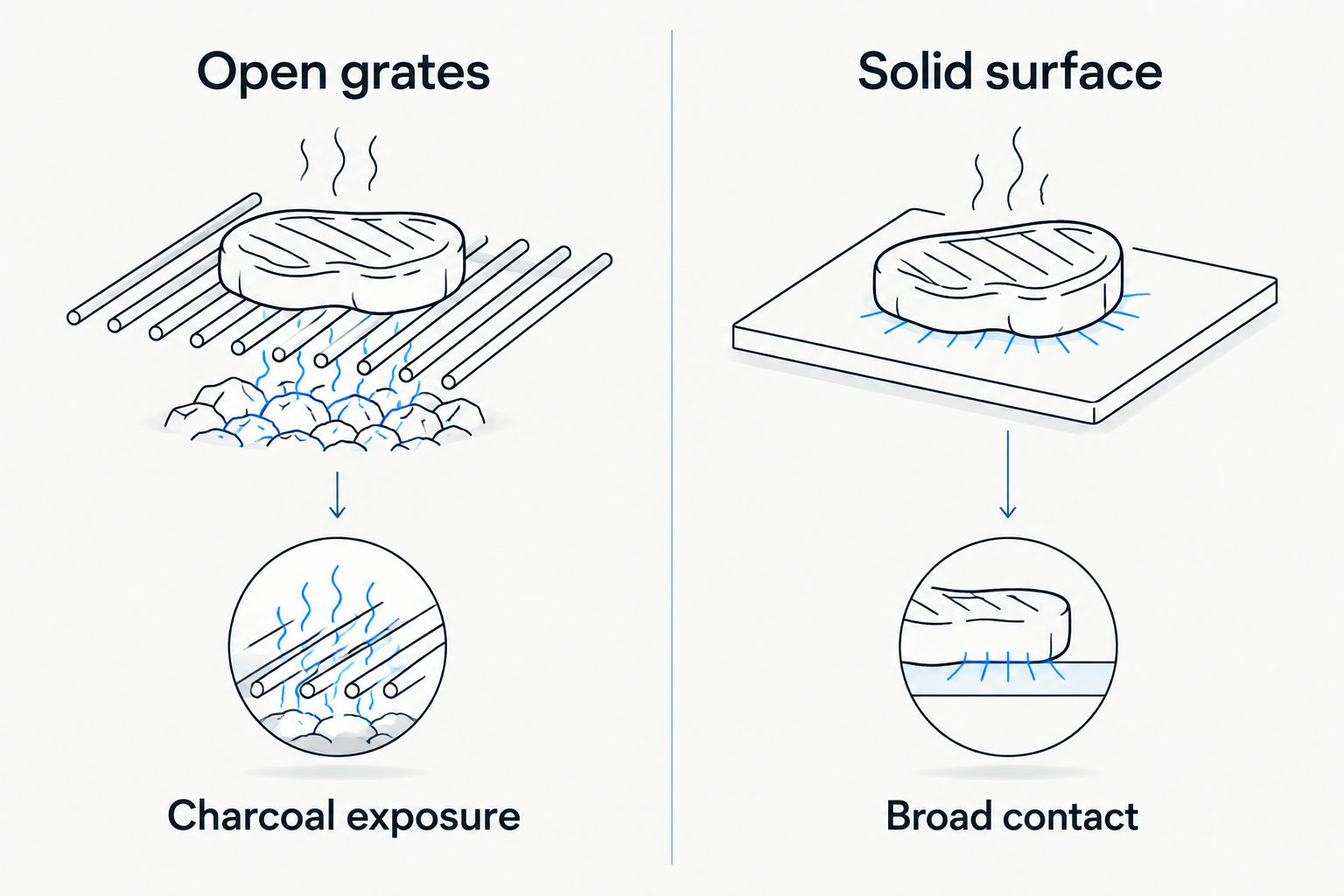
A flat-top grill: best for a dedicated griddle workflow
A flat-top makes the solid cooking surface the center of the appliance rather than an accessory inside another grill. That suits cooks who want to move between steak, onions, and other griddle foods without changing the basic cooking arrangement.
The advantage is the workflow, not a guarantee that every steak will brown better. A wet steak can steam on a flat-top. Crowding and insufficient preheating still work against crust.
The trade-off is direct charcoal exposure. A flat-top’s solid plate separates the food from the heat source, so it does not cook exactly like steak suspended over glowing coals.
Choose a flat-top when you want a dedicated griddle station, not simply because your last charcoal-grilled steak lacked crust. If you already enjoy managing a charcoal fire, a compatible plate deserves consideration first.
Why steak-searing results vary
The grill name does not determine the crust by itself. These factors explain why the same steak can come off pale, evenly browned, or scorched.
- Surface moisture: Water on the steak must evaporate before the exterior can brown effectively. Pat the meat dry immediately before cooking.
- Contact coverage: Open grates touch strips of meat; a solid surface supports broader contact. Match the surface to the crust you want.
- Preheating: Hot air inside the dome does not prove a newly added plate is ready. Preheat the cooking surface, not just the grill cavity.
- Steak thickness: A thin steak gives you less time to develop crust before the center cooks through. A thicker cut separates those tasks more easily.
- Cooking space: Crowding makes handling harder and concentrates moisture. Leave yourself room to turn and relocate the steak.
- Fat and airflow: Dripping fat can feed flare-ups, while vent adjustments change the charcoal fire. Manage both instead of chasing the highest possible reading.
For your 2026 comparison, use these as the benchmark. A grill that reaches intense heat still needs the right surface, food preparation, and handling.
How do you get a flat-top-style crust on a Kamado Joe?
Start with a compatible solid cooking surface, then manage moisture and contact. You do not need to imitate every part of a flat-top setup; you need to reproduce the contact that creates its crust.
- Confirm accessory fit. Check the exact grill model and the accessory’s installation instructions. Kamado Joe listings include 13.5-inch, 18-inch, and 24-inch grills; a shared brand name is not a fit specification.
- Prepare a safe cooking area. Follow the grill manual for placement, clearances, lighting, and lid opening. Keep a heat-safe landing area ready before handling hot accessories.
- Preheat the surface in position. Follow the accessory instructions and give the metal time to heat. Do not add a cold plate and assume the dome reading describes it.
- Dry the steak. Blot moisture from both faces before the meat touches the cooking surface. Avoid carrying pooled liquid onto the plate.
- Sear without crowding. Place the steak flat and allow contact to develop. Turn it as needed for even browning; repeatedly pressing it is not a substitute for proper heat.
- Check the center separately. Use a food thermometer rather than crust color to judge internal temperature. Stop searing when the exterior is ready, and adjust the cooking approach if the center still needs heat.
For food safety, USDA guidance for whole beef steaks is 145°F internally followed by a 3-minute rest. That benchmark concerns safe internal cooking, not the temperature of the griddle or the darkness of the crust.
Do not use a fixed searing time as your main control. Steak thickness, starting temperature, surface contact, and fire conditions all affect what happens after the meat lands.
Which Kamado Joe accessories should you compare?
For a 2026 accessory shortlist, start with surfaces intended for contact cooking. Smokeforges lists the following options; verify the exact size and model selection before ordering.
| Accessory | Best for | What makes it relevant | What to check |
|---|---|---|---|
| Kamado Joe Cast Iron Sear Plate – Joe Jr, Classic Joe & Konnected Joe | Shoppers seeking a dedicated searing accessory | The product is identified as a cast iron sear plate | Exact model fit, mounting arrangement, and care instructions |
| Kamado Joe Half-Moon Reversible Cast Iron Griddle | Shoppers considering a griddle-format accessory | The product is identified as a reversible cast iron griddle | Compatible grill size, usable face, and required support |
The advantage of these accessories is a direct route to contact searing without choosing an entirely different appliance. The drawback is another component to handle and maintain, with fit requirements you cannot skip.
Choose by compatibility first, cooking format second. A promising surface that does not fit your grill is the wrong purchase, regardless of its material.
Compare contact-searing accessories


Does a Kamado Joe need cast iron to sear steak?
No—a Kamado Joe does not need cast iron to sear steak. Open grates can brown steak through contact and radiant heat; cast iron is one route to a different contact pattern.
Choose a solid surface because you want broader browning, not because you think steak cannot sear without it. Material matters, but the shape of the cooking surface answers the flat-top comparison more directly.
Should you buy a flat-top if you already own a Kamado Joe?
Keep the Kamado Joe if steak crust is your only complaint, and assess a compatible solid surface first. Buy a separate flat-top when a dedicated griddle station fits the way you regularly cook.
That distinction prevents an accessory problem from becoming an appliance purchase. It also keeps expectations honest: a plate changes food contact, but it does not make charcoal lighting and cleanup disappear.
FAQ
Can a Kamado Joe sear steak like a flat-top grill?
Yes—a Kamado Joe can produce flat-top-style steak crust with a compatible solid cooking surface. Open grates also sear steak, but their contact pattern differs from a continuous plate.
What's better for steak crust, grill grates or a griddle?
A griddle is the better fit for broad, continuous surface browning. Open grates suit you when direct charcoal exposure and a grilled crust pattern matter more.
Can I use any cast iron griddle inside a Kamado Joe?
No—do not assume any cast iron griddle is suitable for your Kamado Joe. Confirm dimensions, support, clearance, and the grill and accessory manufacturers' instructions.
Does a high dome temperature mean the sear plate is ready?
No—the dome thermometer measures temperature at its location, not the cooking plate itself. Preheat the accessory in position according to its instructions.
What's the safe internal temperature for a whole beef steak?
USDA guidance calls for 145°F internally followed by a 3-minute rest for whole beef steaks. Check the center with a food thermometer; crust color does not establish internal temperature.
Should I replace my Kamado Joe with a flat-top in 2026?
Replace the cooking setup only if a dedicated griddle workflow better matches your meals. If your goal is simply a broader steak crust, assess a compatible solid surface before buying another appliance.
One last thing
Judge the pale spaces, not the darkest grill marks. A steak can show dramatic black stripes while much of its surface remains lightly browned; a less photogenic but evenly mahogany face can better match the crust you wanted.
For your 2026 setup, make that visual check before buying anything. Smokeforges shoppers comparing steak-searing equipment should start with contact coverage and exact accessory fit—not the biggest grill or the most dramatic product photo.


