

A grill’s advertised width is not automatically its cover width: the named griddle covers in this 2026 grill cover sizes chart span 28–36 inches, but those labels identify appliance families rather than measured cover dimensions. Match the exact model first, then check the assembled width, depth, height, and shelf position before choosing a cover.
At a glance
- Use this grill cover sizes chart for model matching, not as a universal cover-dimension chart.
- Blackstone’s listed cover families include 28-inch XL and 36-inch griddles, with separate Drop-In and Select names.
- Smokeforges outdoor grill shoppers should match the appliance configuration before comparing cover dimensions.
- Measure the complete grill, including shelves and handles; cooking-surface width alone does not establish cover fit.
Why this matters
A cover that matches the cooking surface can still miss the shelves, pull tight across the handle, or leave the cart exposed. Width is only part of the fit. A built-in appliance and a freestanding grill also need different coverage, even when their cooking surfaces carry the same size label.
Smokeforges is an outdoor grill retailer for US homeowners comparing grills, fire pits, and outdoor kitchen equipment. Use the Smokeforges catalog to identify the appliance and its configuration, then use the measurements below as your buying checklist. The retailer’s range gives you options across equipment types; it does not make covers interchangeable across those types.
Grill cover sizes chart: named-width benchmarks for 2026
The benchmark here is nominal appliance width stated in a cover’s product title, not the cover’s measured width. Across the four Blackstone cover titles below, the named widths run from 28 inches to 36 inches. There is no useful universal average cover width: averaging model labels would not tell you what fits your grill.
| Cover listed by Smokeforges | Named appliance width | Configuration stated in title | Best for | Fit limitation |
|---|---|---|---|---|
| Blackstone 28-Inch XL Drop-In Griddle Cover | 28 inches | XL Drop-In | Buyers matching a 28-inch XL Drop-In griddle | The title alone does not establish assembled cover dimensions |
| Blackstone Select Cover for 28-Inch XL Griddle | 28 inches | Select; XL griddle | Buyers checking the Select cover against their exact griddle model | Do not assume the same fit as the Drop-In cover |
| Blackstone 36-Inch Drop-In Griddle Cover | 36 inches | Drop-In | Buyers matching a 36-inch Drop-In griddle | Do not treat 36 inches as the cover’s measured outside width |
| Blackstone Select Cover for 36-Inch Griddle | 36 inches | Select; griddle | Buyers checking the Select cover against their exact griddle model | The shared width label does not prove compatibility with another configuration |
| Overall: listed named-width range | 28–36 inches | Drop-In and Select cover titles | Establishing which size family to investigate | Not a universal sizing range for outdoor grills |
The 36-inch cover families have the largest named appliance width in this comparison; the 28-inch XL families have the smallest, an 8-inch difference. Neither group wins on fit without an exact appliance match. These are size classes, not performance rankings.
Methodology: this 2026 comparison uses the product titles supplied for four Blackstone covers in the Smokeforges catalog; it is a catalog-label comparison, not a measured sample or a market-wide survey. Its limitation is specific: nominal appliance widths do not establish cover width, depth, height, material, or compatibility.
How to use these benchmarks
- Use 28 inches and 36 inches to narrow the model family. Then match the complete appliance name and configuration rather than stopping at the number.
- Keep Drop-In and Select entries separate. The chart contains separate cover names at both widths; a shared width label is not permission to substitute one for another.
- Measure beyond the cooking surface. Shelves, handles, controls, and the cart determine the outline the cover must enclose.
- Use all dimensions as a final check. A width match does not resolve a depth or height mismatch, and extra width does not fix the wrong shape.
What to measure before choosing a cover
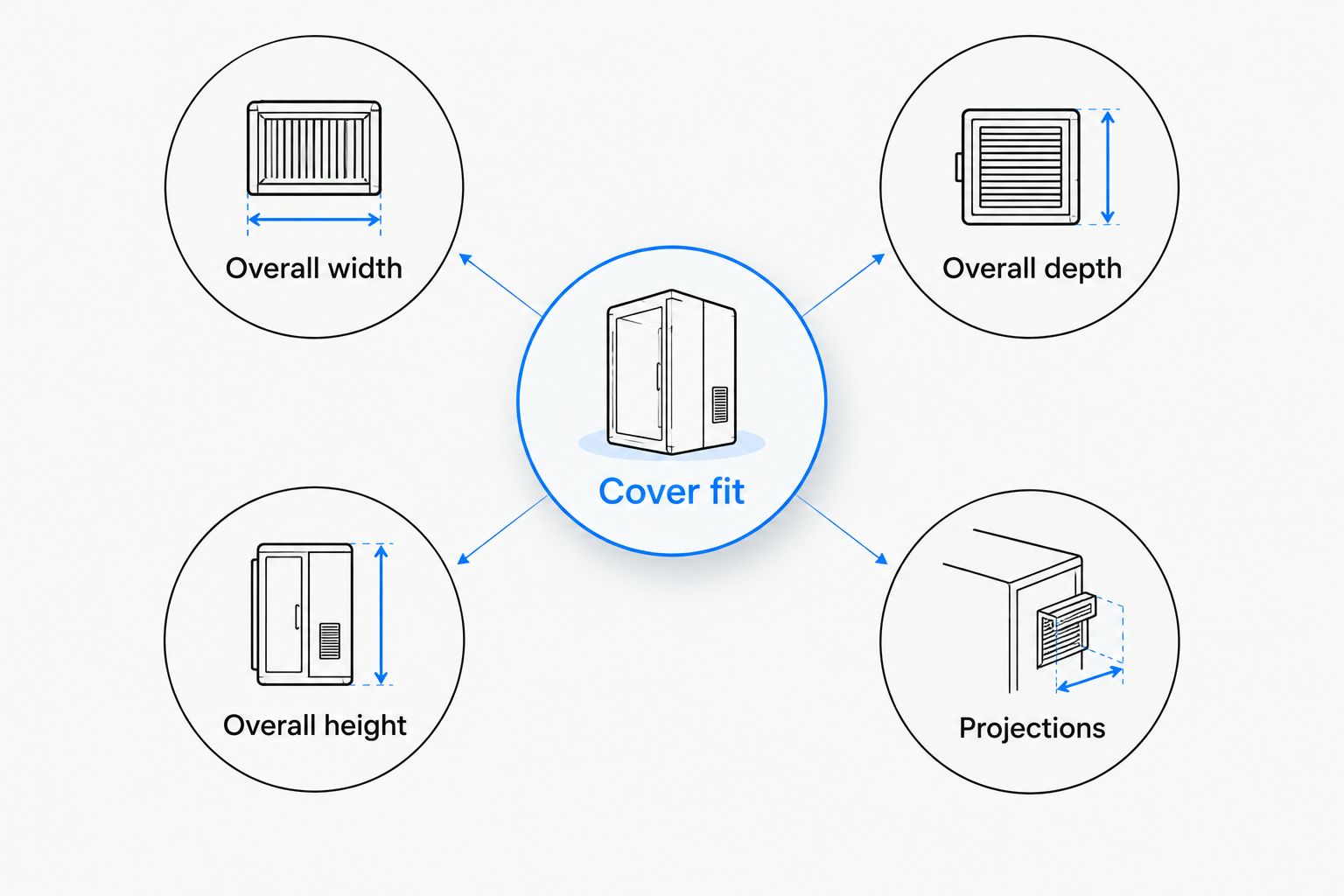
For your 2026 cover comparison, record the grill in the condition in which you will actually store it. Close the lid, let the appliance cool, and decide whether the shelves stay extended or fold down. A measurement taken in a different configuration answers the wrong question.
Overall width
Measure from the farthest point on one side to the farthest point on the other. Include attached shelves, side burners, and handles that remain in place under the cover. Do not substitute the grate width or the size printed in the appliance name.
If the shelves fold, write down the storage position beside the width. That small note prevents you from comparing a folded measurement with a cover intended for an extended setup. Keep the appliance model number beside it, too.
Overall depth
Measure from the frontmost projection to the rearmost projection with the lid closed. A front handle or rear hinge can sit beyond the body of the grill. Check those points rather than measuring only the cabinet beneath the cookbox.
A cover needs the right front-to-back shape as well as the right width. Do not solve a depth problem by choosing a wider cover without checking its other dimensions. That creates a different fit question rather than answering the first one.
Overall height
Identify where the intended cover should stop before recording height. A cover for a built-in grill does not need to perform the same job as a full-length cover over a cart. The coverage boundary matters as much as the highest point.
For a freestanding setup, compare your measured height with the manufacturer’s stated coverage and fit instructions. Avoid assuming the hem should reach the ground. Ground contact can leave the hem sitting in water or dirt.
Projections
Check anything that interrupts the main outline: shelf corners, lid handles, chimneys, control housings, or attached accessories. Record what stays attached during storage. Remove accessories only when the appliance and accessory instructions permit it.
These details explain why two grills with similar widths can need different covers. A simple rectangular outline does not describe a kettle, a ceramic dome, or an appliance with a tall exhaust stack.
Same width label, different cover decision
The Blackstone entries make the distinction clear: the catalog includes a 36-inch Drop-In cover and a Select cover for a 36-inch griddle. It also includes corresponding 28-inch XL titles. The useful benchmark is the combination of size family plus configuration, not the number alone.
That is why your 2026 shortlist should preserve the full product name. Shortening every entry to a generic width erases the detail that separates the options. Keep the model and configuration visible until you have confirmed the intended fit.
| Choice to check | Practical advantage | Practical limitation | Best for |
|---|---|---|---|
| Exact-model cover | Gives you a specific appliance compatibility claim to verify | A similar model name still needs checking | Buyers who know the complete appliance model |
| Dimension-matched universal cover | Lets you compare against the complete assembled outline | Width, depth, height, and shape all need checking | Buyers without a confirmed model-specific match |
| Built-in appliance cover | Focuses the comparison on the exposed appliance | Does not establish coverage for an entire island | Buyers protecting an installed grill head |
| Full-length cart cover | Addresses the freestanding appliance and cart together | Shelf position and lower coverage still need checking | Buyers covering a freestanding setup |
Start with an exact-model match when one is documented. Use dimensional matching when you need to evaluate a universal alternative, but do not treat a general size label as a compatibility statement. Each route has a clear use; neither removes the need to check the actual setup.
Compare the named covers after checking your appliance
The two Drop-In entries below belong to different named-width families: 28-inch XL and 36-inch. Their advantage is a specific configuration in the product name. Their limitation is equally important: the name does not supply every measurement needed to resolve fit.
Use these as model-matching candidates, not as recommendations for any grill of approximately the same width. Compare the complete appliance name, then confirm the cover’s intended application before selecting either entry.
Blackstone Drop-In cover candidates


A fit checklist you can use before ordering
Keep this checklist beside your measurements. It separates what the appliance is called from the space the cover must enclose, which is the central distinction in this 2026 sizing guide.
- Appliance identity: Record the manufacturer, full model name, and model number from the appliance label.
- Configuration: Specify built-in, standalone, cart-mounted, tabletop, or another documented format.
- Storage position: Record whether shelves remain extended or folded and whether accessories stay attached.
- Complete dimensions: Compare width, depth, and height using the same measurement definitions as the cover manufacturer.
- Coverage boundary: Decide whether you are covering the grill head, the complete cart, or another explicitly supported area.
- Fit instructions: Check the stated model compatibility and any sizing directions before making the final selection.
Do not add an arbitrary allowance to every measurement. Follow the cover manufacturer’s sizing instructions instead. A cover’s listed dimensions and its recommended appliance dimensions are not necessarily the same thing, so identify which set you are reading.
If a listing gives a recommended grill size, compare against that recommendation. If it gives finished cover dimensions, use the manufacturer’s directions for interpreting them. Mixing those two types of measurement produces a false match even when the arithmetic looks right.
FAQ
What size grill cover do I need?
Choose a cover documented for your exact grill model, or compare a universal cover against the grill’s complete assembled width, depth, height, and shape. Include the shelves and handles that remain in place during storage.
Does a 36-inch grill need a 36-inch cover?
A 36-inch appliance label does not establish the required cover dimensions. In this chart, 36 inches identifies a Blackstone griddle family; confirm the complete model and intended cover application.
Are the Blackstone 28-inch XL and 36-inch covers interchangeable?
Do not treat the Blackstone 28-inch XL and 36-inch covers as interchangeable. They belong to different named-width families, and the full appliance configuration still needs to match.
Should I measure my grill with the side shelves folded?
Measure your grill with the shelves in the position you will use during storage. Then check whether the cover’s compatibility and measurement instructions describe that same position.
How many inches bigger should a grill cover be?
Use the cover manufacturer’s fit instructions rather than adding a fixed number of inches. First establish whether the listing describes finished cover dimensions or recommended appliance dimensions.
Is a built-in grill cover the same as a cart cover?
A built-in grill cover and a cart cover address different appliance configurations. Confirm whether the cover is intended for the exposed grill head or the complete freestanding setup.
Does this grill cover sizes chart show measured cover dimensions?
This 2026 grill cover sizes chart compares nominal appliance widths stated in four Blackstone cover titles. Its 28–36-inch range is a model-family benchmark, not a measured cover-size range.
One last thing
A size label can identify the appliance without describing the space its cover must enclose. That is the detail to remember when comparing a cooking-surface measurement with a complete grill-and-cart measurement. Both can be accurate, but they answer different questions.
Before ordering, put the full appliance model and your storage-position measurements in the same note. Then check every candidate against that note. This keeps an appealing width match from hiding the wrong configuration, an exposed shelf, or a cover that cannot clear the handle.


