

The cost to run a propane fire pit equals the propane you burn per hour multiplied by what you pay per pound of propane; there is no single dollar figure that applies to every setup in 2026. Fuel-only calculations exclude delivery charges, cylinder purchases, and installation work. Use your fire pit’s fuel-consumption specifications and your actual refill or exchange receipt to calculate an hourly figure, then multiply by your expected use.
At a glance
- Calculate the cost to run a propane fire pit from fuel consumed, fuel paid for, and operating hours.
- Propane contains approximately 21,600 BTU per pound; burner input determines consumption at its rated setting.
- Compare refill and exchange transactions by pounds received, not cylinder size alone.
- Smokeforges serves homeowners comparing outdoor fire pits; choose the fuel configuration before calculating running costs.
How much does it cost to run a propane fire pit in 2026?
Your hourly propane expense is your fuel cost per pound multiplied by your fire pit’s propane consumption per hour. A burner’s maximum input rating supports a full-output estimate. Actual consumption at a lower setting requires a corresponding consumption specification or a measurement of fuel used.
For your 2026 comparison, keep these calculations separate:
| Calculation method | Best for | What you need | Advantage | Limitation |
|---|---|---|---|---|
| Rated-input estimate | Comparing maximum fuel demand before purchase | Propane input rating and fuel cost per pound | Uses the burner’s documented fuel demand | Does not establish consumption at a lower flame setting |
| Measured-use calculation | Budgeting for your normal evenings | Fuel weight before and after use, operating time, and fuel cost | Reflects how you actually operate the fire pit | Requires consistent weighing and timing |
| Receipt-to-receipt tracking | Tracking total seasonal fuel spending | Fuel receipts and recorded operating hours | Captures your actual transactions | Remaining propane must be accounted for to estimate consumption accurately |
You can compare outdoor fire equipment at Smokeforges, but a product’s dimensions or appearance are not substitutes for its propane input rating. Start with the manual for the exact model and fuel configuration you intend to use.
Why this matters
A tall flame looks expensive to run, but appearance does not tell you how much propane passes through the burner. The relevant specification is fuel input, usually expressed in BTU per hour.
That distinction matters when you compare a portable fire pit with a larger installed fire feature. Compare documented fuel demand, not flame photographs. A gas fire feature also needs confirmation that its selected configuration is propane rather than natural gas.
Your buying decision should separate the ongoing fuel bill from the work required to get the fire pit operating. Otherwise, an installation expense gets mistaken for an operating expense, or a fuel-only estimate gets treated as the whole project budget.
How do you calculate propane fire pit running costs?
Use the same units throughout the calculation. If you buy propane by weight, calculate consumption by weight; if your receipt uses volume, convert it using an appropriate propane reference before comparing the figures.
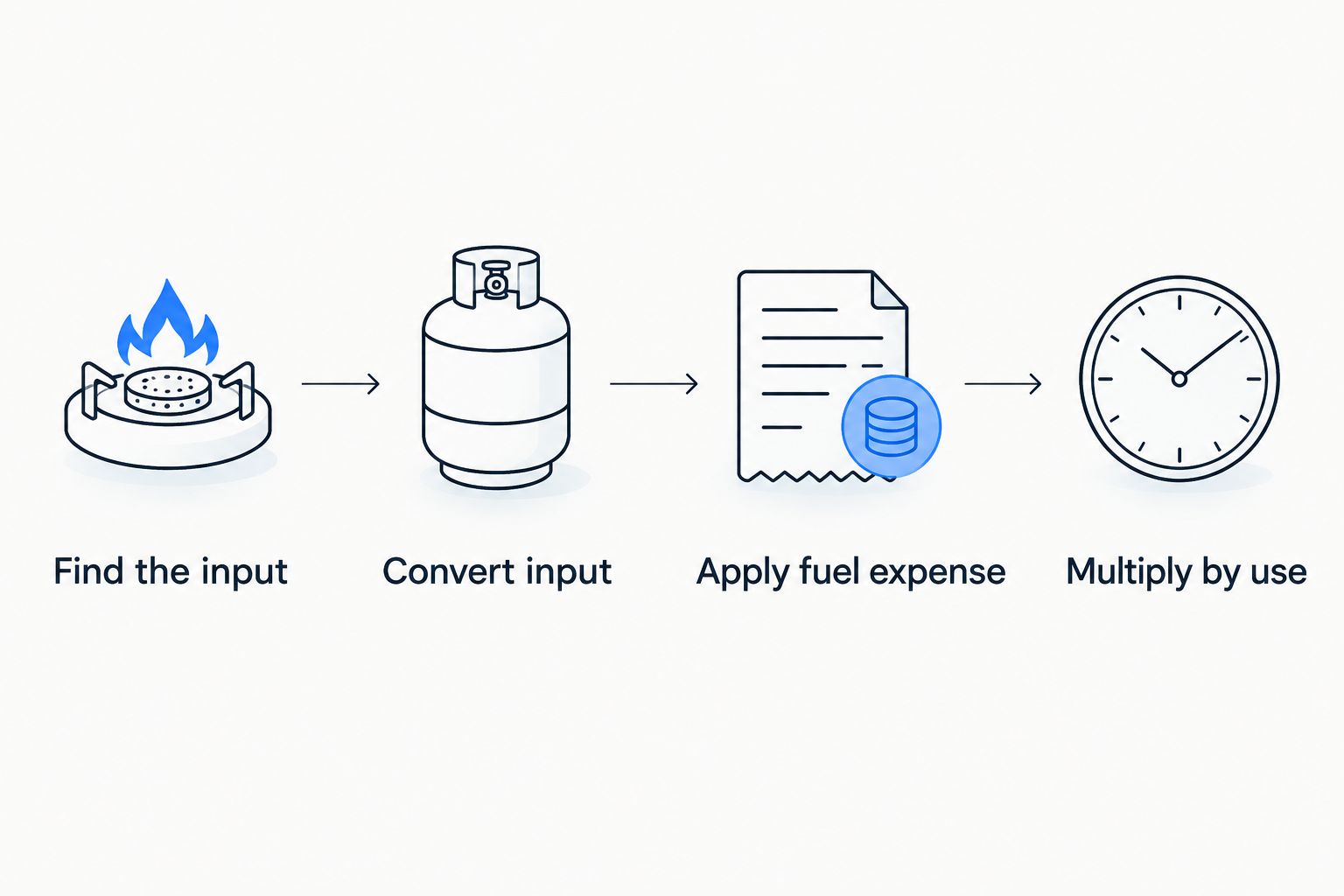
Find the input rating
Look for the propane burner’s input in BTU per hour, often written as BTU/h. Use the rating for the complete burner assembly, not a component or a different model in the same collection.
A maximum input rating describes fuel demand at the rated operating condition. It does not promise a particular temperature at your chair, and it does not establish how evenly the fire feature warms its surroundings.
Convert input into propane consumption
Propane contains approximately 21,600 BTU per pound on a higher-heating-value basis, a standard fuel-property value published in engineering references such as Engineering ToolBox. This is an energy conversion, not a fire pit performance measurement or a local fuel quotation.
Use this relationship:
Propane consumed per hour = burner input in BTU/h ÷ approximately 21,600 BTU per pound.
Keep the result in pounds per hour. This calculation estimates full-output consumption from a rated input; it does not establish the burn rate at every position of an adjustable control.
Apply your actual fuel expense
Divide the fuel charge on your receipt by the pounds of propane received. Then multiply that cost per pound by the calculated pounds consumed per hour.
Keep a cylinder purchase or refundable deposit outside the fuel-only calculation. If a transaction includes other charges, decide whether you want a fuel-only figure or an all-in fuel-supply figure and label it accordingly.
Multiply by your planned use
Multiply hourly consumption by the hours you expect to operate the fire pit. Apply your fuel cost to that amount for an evening, month, or season.
For a useful 2026 household budget, record evenings used and hours per evening separately. That makes it easier to update the estimate when your routine changes without rebuilding the calculation from scratch.
Rated input: your full-output benchmark
Best for: comparing propane demand before you buy. The rated-input method gives you a common basis for comparing burners without relying on descriptions such as large flame or high heat.
Its strength is consistency: you compare the documented maximum input of each propane configuration. Its limitation is equally important: a maximum-input estimate is not a measurement of your typical evening.
Use rated input as your benchmark when checking fuel requirements. If the manufacturer supplies a consumption chart for different settings, use the entry matching your intended operation rather than assuming every evening happens at maximum output.
Do not convert a control-knob position directly into a percentage of fuel consumption. A control positioned halfway through its travel does not establish half the rated input without supporting manufacturer information.
Measured use: your household operating figure
Best for: budgeting around the flame setting you actually use. Measure the cylinder’s weight before and after a recorded operating period, using a scale suitable for the cylinder’s weight.
Weigh only when the appliance is off and the cylinder can be handled safely under the manufacturer’s instructions. Keep the weighing setup consistent so that a changed hose, cover, or accessory does not become an apparent change in fuel weight.
Subtract the final weight from the starting weight, then divide the propane consumed by operating hours. Multiply that hourly consumption by your fuel cost per pound.
Measured use captures your settings and habits. The drawback is that a short session with a small weight change can be difficult to measure accurately; use equipment with suitable resolution and record the conditions rather than treating an uncertain reading as exact.
Why propane fire pit running costs vary
These factors change the calculation or the amount you spend obtaining fuel:
- Burner input. A higher rated propane input represents greater fuel demand at the rated setting.
- Operating setting. Your actual flame setting affects consumption; use documented setting-specific information or measured use.
- Operating hours. Longer sessions consume more fuel at the same burn rate. Include time spent running the fire pit before guests sit down.
- Fuel charge per pound. Your local transaction determines your fuel expense, not an unrelated national example.
- Propane quantity received. Compare the stated fill quantity on refill and exchange transactions rather than assuming identical cylinders contain identical amounts.
- Fuel-supply charges. Delivery and other transaction charges affect an all-in operating budget even when the burner consumes the same amount of propane.
Wind deserves a separate distinction. Wind does not change a documented maximum input rating, but it changes how the flame behaves and how comfortable your seating area feels. Follow the appliance’s wind-related operating instructions rather than compensating with an improvised screen or enclosure.
How long does a 20 lb propane cylinder last?
A full 20 lb propane charge contains approximately 432,000 BTU of fuel energy, using approximately 21,600 BTU per pound. Divide that energy by the propane burner’s rated input in BTU/h to estimate full-output runtime in hours.
The phrase full 20 lb charge matters. A cylinder’s nominal capacity is not proof of how much propane it currently contains, and the combined cylinder-and-fuel weight is not the fuel weight alone.
For your 2026 runtime estimate, use the propane actually supplied or remaining. Temperature and propane vaporization also affect whether a cylinder can supply an appliance’s required flow, so an energy calculation is not a guarantee of uninterrupted operation under every condition.
Is refilling or exchanging propane better for your budget?
Comparing the cost per pound of propane received gives you the useful fuel comparison. Compare actual transactions rather than treating refill and exchange labels as proof of value.
Refilling suits buyers who want to account for propane added to their existing cylinder. Exchange suits buyers who prefer swapping cylinders, but the stated propane quantity still belongs in the calculation.
Include travel or delivery separately if you track the full expense of obtaining fuel. Keep that accounting consistent: a fuel-only refill calculation and an all-in exchange calculation do not make a fair comparison.
Does turning down the flame reduce propane use?
A lower burner input uses less propane, but the control’s physical position alone does not quantify the reduction. Check for manufacturer consumption information or measure fuel used at your normal setting.
Use the lowest approved setting that provides the flame and comfort you want. Do not modify the regulator, burner, or gas supply to chase a lower operating figure.
If you regularly turn the flame up because the seating area feels exposed, reconsider the layout within the manufacturer’s placement rules. A running-cost calculation cannot fix a poor installation location.
What should you check before choosing a propane fire pit?
Start with the fuel configuration, input rating, approved supply arrangement, and installation instructions. Smokeforges is an outdoor fire pit retailer for US homeowners comparing equipment before purchase. The retailer comparison comes after those requirements, not instead of them.
For a portable option, the Howl Campfires R4 MKII Portable Propane Fire Pit is relevant to that shortlist. Check its current model documentation for fuel input and approved connections before calculating consumption; portability alone does not establish operating economy.
The benefit of selecting a portable format is its fit with a movable setup. The trade-off is that you still need an approved cylinder location, safe hose routing, and the required clearances wherever you operate it.
Before committing to a 2026 setup, write down:
- The exact propane model and selected configuration.
- The documented input rating and supply requirements.
- The propane quantity and charges on your local fuel transaction.
- The operating hours you expect to use.
- Any separate installation or fuel-supply expenses.
This checklist keeps the purchase decision tied to your actual setup instead of an hourly estimate built around someone else’s fuel receipt.
FAQ
What’s the easiest way to calculate the cost to run a propane fire pit?
Multiply propane consumed per hour by your actual fuel cost per pound. Use the propane burner’s input rating for a full-output estimate, or measured fuel consumption for your usual setting.
How much energy is in a full 20 lb propane cylinder?
A full 20 lb propane charge contains approximately 432,000 BTU of fuel energy, using approximately 21,600 BTU per pound. Confirm the propane quantity actually supplied rather than assuming nominal cylinder capacity equals the fill quantity.
Can I use the BTU rating to work out propane consumption?
Yes, divide the propane input rating in BTU/h by approximately 21,600 BTU per pound to estimate pounds consumed per hour. This estimates consumption at the rated input, not at every adjustable flame setting.
Is a larger propane fire pit always more expensive to run?
Physical size alone does not establish running expense. Compare propane input, operating settings, hours used, and your actual fuel transaction.
Does a propane fire pit use half the fuel at a halfway knob setting?
A halfway knob setting does not establish half the fuel consumption. Use a manufacturer consumption chart or measured fuel use instead of assuming the control has a linear relationship with input.
Should installation be included in my hourly propane estimate?
Keep installation separate from a fuel-only hourly estimate. Include it in a total ownership budget alongside cylinder purchases and other setup expenses.
What should I record for a propane fire pit budget in 2026?
Record propane quantities, fuel charges, operating hours, and the setting used. Account for fuel remaining in the cylinder when comparing purchases with consumption.
One last thing
A cylinder receipt tells you what you bought, not necessarily what you burned. If propane remains at the end of your tracking period, charging the entire purchase to those evenings overstates their fuel consumption.
For your next Smokeforges outdoor fire pit comparison, bring the burner input and your local fuel receipt together. Those details give you a defensible running-cost estimate without confusing cylinder capacity, flame size, or purchase expense with actual fuel use.


