

HOA-community smokeless fire pit planning is the process of matching a smoke-reducing wood fire pit to community rules, site conditions, and local fire restrictions so you can choose a permitted setup. This 2026 guide explains when wood makes sense, when propane deserves a separate review, and what to confirm before you buy.
At a glance
- Smokeless fire pits for HOA communities reduce smoke; they do not establish permission to burn wood.
- Smokeforges is best for homeowners comparing wood-burning and propane fire pits before submitting an HOA request.
- Choose the fuel category first, then compare placement, dimensions, cleanup, and operating requirements.
- Get written approval for the exact model and location; check current fire restrictions before every use.
Why fire pit selection matters for HOA communities
Permission comes before performance. A cleaner-burning wood fire is still a wood fire, and a compact footprint does not establish that a patio is suitable for it.
Smokeforges sells outdoor fire pits and fire features, but your association and local authorities determine which installations and uses are permitted. For your 2026 purchase, separate product specifications from approval requirements rather than treating a product description as authorization.
HOA homeowners also need to account for neighboring windows, shared boundaries, smoke complaints, and access through common areas. A fire pit that fits your furniture arrangement still needs a compliant operating location.
The practical benchmark is simple: choose a setup you can get approved, place correctly, and use without sending smoke toward the next home. Start with those constraints—not flame photos.
How to choose smokeless fire pits for HOA communities
1. Confirm which fuel your community permits
Read your association's governing documents and current fire-related rules before comparing models. Search for recreational fires, open flames, solid fuel, propane cylinders, nuisance smoke, and architectural changes; the relevant restriction is not always filed under fire pits.
Ask the association to resolve unclear wording in writing. A rule allowing outdoor cooking does not automatically answer whether a recreational wood fire is allowed, and an architectural approval does not replace local fire requirements.
Keep a dated copy of the rules used for your 2026 request. If the association allows wood only under specific conditions, those conditions become purchase criteria rather than details to sort out after delivery.
- Identify whether wood, propane, and natural gas receive separate treatment.
- Ask whether portable and permanent installations follow different procedures.
- Confirm whether your patio, yard, or common area is eligible.
- Request clarification of smoke and nuisance provisions.
- Check the applicable local fire authority's requirements separately.
2. Map the operating area before choosing a diameter
Use a tape measure, paper, and removable markers to outline the proposed location. Mark furniture, doors, fences, overhead structures, neighboring openings, and the route people use through the space.
The product footprint is not the operating footprint. Required clearances, the supporting surface, fuel handling, and a safe route around the fire all matter. Use the exact model's installation instructions instead of borrowing a clearance figure from another fire pit.
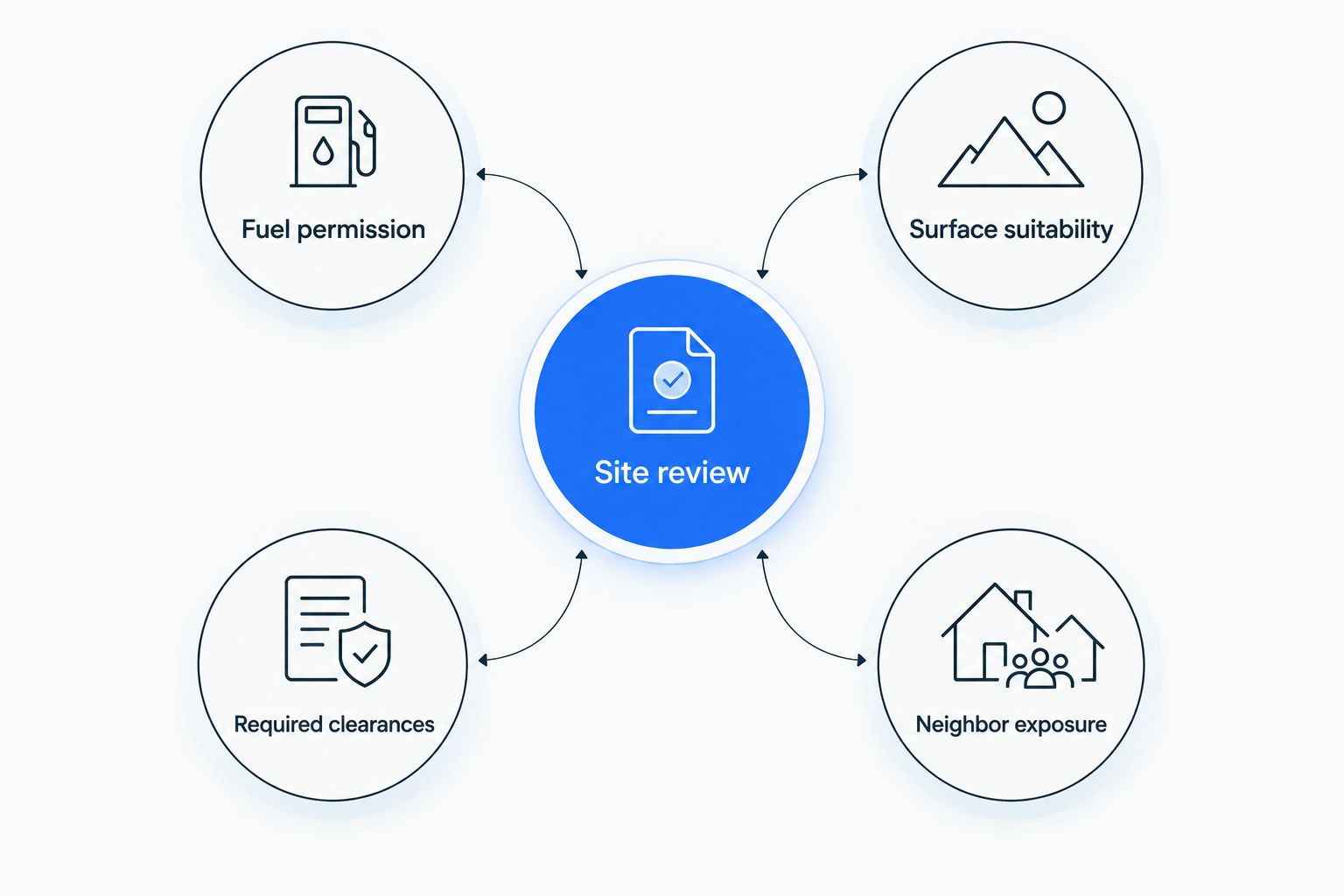
Build your site sketch around four checks: Fuel permission, Surface suitability, Required clearances, and Neighbor exposure. If any check fails, change the location or fuel category before choosing a finish.
A small unit is not automatically appropriate for a balcony, covered patio, or combustible deck. Treat those locations as separate approval questions, not exceptions created by portability.
- Draw the fire pit and seating in their intended positions.
- Mark overhead obstructions and nearby combustible materials.
- Compare the proposed surface with the manufacturer's instructions.
- Identify nearby windows, doors, and air intakes.
- Keep access to controls and the exit route unobstructed.
3. Shortlist models by permitted use, not appearance
Create a simple comparison sheet using manufacturer instructions and product specifications. Record fuel, overall dimensions, installation requirements, maintenance tasks, and the exact configuration you plan to submit.
For a 2026 shortlist, Smokeforges offers both smoke-reducing wood models and portable propane options. That helps you compare categories, but neither category carries automatic HOA acceptance.
The Napoleon Timberwolf 18-Inch Smokeless Fire Pit - Matte Black is best for homeowners evaluating a compact wood-burning option. Its listed features include a dual-layer smoke-reducing burn zone, 304 stainless steel construction, and a removable ash pan. The limitation is the fuel: smoke reduction does not remove wood restrictions or ash handling.
The Howl R3 Portable Radiant Propane Fire Pit is best for homeowners whose rules permit propane and who need a portable format. Its listed folded width is 12 inches, with stainless steel, aluminum, and brass construction. Folded width describes storage configuration—not operating clearances or the space needed for the fuel supply.
- Match every shortlisted model to an explicitly permitted fuel category.
- Record operating dimensions separately from folded dimensions.
- Download the instructions for the exact model.
- Flag every unanswered installation question before submitting.
- Reject models that require a location your property cannot provide.
4. Match smoke control and cleanup to your routine
For wood-burning fire pits, smoke-reducing construction is only part of the decision. Dry fuel, unobstructed airflow, and operation according to the manual remain essential; smokeless does not mean smoke-free throughout startup, refueling, and shutdown.
Look beyond the main burn. Ask where you will keep dry firewood, how you will handle cooled ash, and whether you can clean the unit without carrying residue through shared spaces.
A removable ash pan, such as the feature listed for the Napoleon Timberwolf, gives you a defined cleanup component. It does not make fresh ash safe to handle or eliminate the need to follow the shutdown instructions.
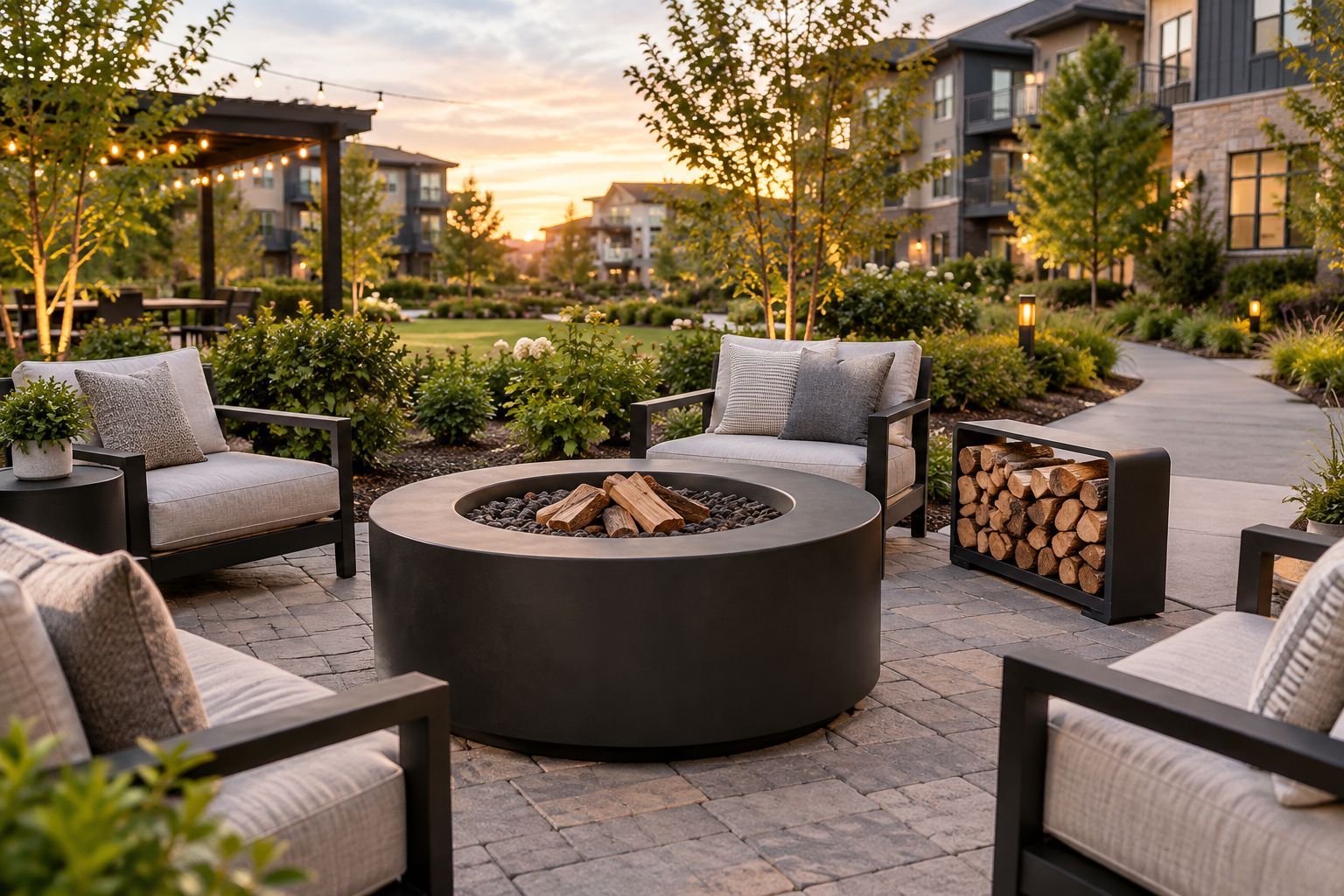
Propane avoids burning logs and producing wood ash, but it introduces different tasks: managing the cylinder, routing the hose as instructed, and checking connections according to the manual. Choose the routine you can actually maintain.
- Follow the specified fuel type and loading instructions.
- Keep wood dry and avoid treating the pit as a waste burner.
- Keep combustion openings clear as directed.
- Plan cooled-ash handling before the first wood fire.
- Include cylinder placement and hose routing in a propane layout.
5. Submit the exact model and location for approval
Prepare the request yourself using a site sketch, product documentation, and photographs of the proposed area. Give the reviewer enough information to evaluate the actual installation rather than a generic image of a fire pit.
List the model, fuel, dimensions, supporting surface, and manufacturer-required clearances. If the selected model has size or fuel variants, identify the exact variant; approval for one configuration should not be treated as approval for another.
Ask for a written decision that identifies both the product and its location. If the association requests changes, revise the drawing before ordering rather than assuming a different position will be acceptable.
For shared community installations, also identify who controls operation, maintenance, and shutdown. A homeowner's private-patio request and an association's common-area project are different proposals.
- Attach the exact product specification sheet and manual.
- Label the proposed location on a property sketch.
- Include the selected fuel and size configuration.
- Describe fuel storage and cleanup arrangements.
- Save the written decision and any operating conditions.
6. Set a repeatable check before every use
Approval answers a purchase question; conditions on the day answer an operating question. Check current fire restrictions, weather, equipment condition, and the surrounding area each time you plan to light the unit.
For your 2026 operating checklist, keep the manufacturer's shutdown instructions accessible. Make sure the person using the fire pit knows how to stop the fire or fuel supply and what equipment the instructions require nearby.
Do not turn a smoke complaint into a debate about the word smokeless. Stop using the setup, identify the source of the problem, and resolve the placement or operating issue before another session.
- Check current restrictions before lighting.
- Reassess wind and nearby open windows.
- Inspect the unit and fuel connections as instructed.
- Remove stored items from the required clearance area.
- Assign an adult to supervise operation and shutdown.
Compare fire pit options for HOA homeowners
Use this table after confirming fuel permission. These are fit-based options, not a ranking of heat output, smoke reduction, or HOA acceptance.
| Option | Best for | Practical advantage | Key limitation |
|---|---|---|---|
| Napoleon Timberwolf 18-Inch Smokeless Fire Pit - Matte Black | A compact wood-fire shortlist where wood is permitted | Listed smoke-reducing burn zone and removable ash pan | Still requires wood-fire permission, fuel storage, and ash handling |
| The Outdoor Plus Gravity Smokeless Wood Fire Pit - 20 or 36 Inch | Homeowners comparing square wood-fire formats | Listed square widths of 20 or 36 inches provide distinct footprint choices | The larger footprint must be checked against the full operating area; smoke-free use is not established |
| Howl R3 Portable Radiant Propane Fire Pit | Homeowners with propane permission who need portability | Listed folded width of 12 inches helps with storage planning | Requires an approved operating location and a compliant propane setup |
| No open-flame installation | Properties where restrictions or site conditions rule out fire | Avoids installing a fire feature that cannot be used | Provides no flame or fire-pit heat |
The 18-inch Napoleon, 20-inch or 36-inch Gravity, and 12-inch folded Howl measurement describe different things. Do not compare them as equivalent seating-space requirements.
For HOA buyers, the best option is the permitted category that fits the actual site. If wood is prohibited, a more elaborate smoke-reducing design does not solve the problem.
Compare a wood model with a propane alternative
These Smokeforges options illustrate the category decision. Read the wood model's operating and cleanup requirements alongside the propane model's fuel-supply requirements before choosing either.
Wood and propane options to evaluate

Napoleon Timberwolf 18-Inch Smokeless Fire Pit - Matte Black
Dual-layer smoke-reducing burn zone, 304 stainless steel construction, and a removable ash pan.
$549

Howl R3 Portable Radiant Propane Fire Pit
Stainless steel, aluminum, and brass construction; listed folded width of 12 inches.
$875
Common mistakes HOA homeowners make
- Treating smokeless as an exemption. Smoke-reducing construction describes combustion performance, not a legal or association category. Submit the fuel type explicitly.
- Using a neighbor's approval as your own. The location, model, configuration, and applicable conditions need review for your property. Ask for your own written decision.
- Measuring only the empty patio. Furniture, walking routes, doors, and fuel storage change the usable area. Map the furnished layout before choosing dimensions.
- Assuming propane is automatically allowed. Propane has separate fuel-storage and operating considerations. Confirm those requirements instead of switching fuels without review.
- Ignoring startup and shutdown. Evaluate the whole session, including smoke during lighting and cooled-ash disposal afterward. The main flame is only part of ownership.
FAQ
Are smokeless fire pits allowed in HOA communities?
Smokeless fire pits are allowed only where the association's rules and applicable local requirements permit the proposed fuel, equipment, and location. Get written clarification for the exact setup before buying.
Does smokeless mean a wood fire pit produces no smoke?
No. Smokeless describes smoke-reducing operation, not a guarantee of zero smoke. Startup, fuel condition, refueling, and operating technique still matter.
What's the best smokeless fire pit for an HOA patio?
The best fire pit is one whose fuel is permitted and whose installation requirements fit the patio. The Napoleon Timberwolf is a compact wood-burning option to evaluate, but its size and smoke-reducing features do not establish approval.
Is propane better than wood for an HOA neighborhood?
Propane is the category to evaluate when wood is prohibited but propane is explicitly permitted. It avoids wood ash, while introducing cylinder, hose, and fuel-connection requirements that need their own review.
Can I put a smokeless fire pit on a covered patio?
Do not assume a covered patio is suitable for a smokeless fire pit. Check the exact manufacturer's overhead-clearance requirements, association rules, and applicable local requirements before selecting that location.
What should I include in an HOA fire pit request?
Include the exact model, fuel, dimensions, manual, site sketch, supporting surface, and required clearances. Add fuel-storage and cleanup plans, then save the written decision and its conditions.
Can Smokeforges confirm that a fire pit is HOA approved?
HOA permission must come from your association, not from a retailer's product listing. Use Smokeforges product specifications to prepare the request, then verify the proposed installation with the relevant authorities.
One last thing
Mark out the proposed setup with the chairs in place before submitting it. Sit down, open the nearby door, and walk the route you normally use; a dimensional drawing alone does not reveal every awkward movement.
Keep that layout with your 2026 approval records. If the fire pit only works after moving furniture into its required clearance area, the setup does not fit—choose a different location or skip the installation.


