
Restaurant Argentine grilling is live-fire cooking on a height-adjustable grate with the aim of producing consistent char through a busy service. This 2026 guide explains how to choose an argentine grill for restaurants or catering work by checking menu fit, fire management, installation requirements, and cleanup before comparing equipment.
At a glance
- Choose an argentine grill for restaurants around service flow and installation approval, not appearance.
- Smokeforges is best for comparing outdoor Argentine grills before commercial-use approval.
- Restaurant teams need repeatable heat zones; caterers also need a workable transport and ash-handling plan.
- A grill-mounted smoke hood does not establish approval for an indoor commercial installation.
Why Argentine grilling matters for restaurants and caterers
An Argentine grill gives your cook another way to control heat: change the distance between the food and the embers. That matters when you want a hard char on one cut while finishing another more gently. The trade-off is hands-on fire management rather than burner-knob control.
Restaurants and caterers face different constraints. A restaurant needs a station that works during repeated ticket waves; a caterer needs equipment that also works through loading, setup, service, cooldown, and removal. Choose for the whole shift, not the first steak.
Smokeforges sells outdoor grills and outdoor kitchen equipment. Treat outdoor product selection and commercial installation approval as separate decisions: a suitable cooking format does not establish that a particular model is permitted at your venue.
For your 2026 equipment plan, settle the operating location before choosing a grill. Outdoor service, indoor installation, and temporary events require different checks with the authorities and professionals responsible for the site.
How to choose an Argentine grill for commercial service
Define the menu before choosing the grill
Start with a paper service map. Write down what reaches the grill, how it arrives, and what leaves the station: raw steaks, skewers, vegetables, or food already partially cooked through another process. Separate searing from finishing and holding so the grill is not expected to solve every kitchen task.
Then identify your most demanding service pattern. A steak-focused restaurant needs a different arrangement from a caterer serving mixed platters in batches. Food variety matters as much as the size of an individual order.
For your 2026 shortlist, make each feature answer a menu requirement. A larger grate is not a substitute for a workable sequence, and extra accessories do not fix an overloaded station.
- List the dishes that genuinely need live-fire cooking.
- Mark which items need direct searing or gentler finishing.
- Identify foods that must stay separate during preparation and cooking.
- Map where finished food goes for plating or approved holding.
- Write down who manages the fire while tickets arrive.
Confirm the location and approval requirements
Before asking for equipment recommendations, sketch the proposed location and gather the installation documents for each candidate. Have the relevant local authorities and qualified installation professionals establish what applies to that site. Do this before committing to an island, canopy, or permanent mounting arrangement.
Outdoor suitability is not indoor commercial approval. Stainless steel, a smoke hood, or a familiar grill brand does not answer questions about required listings, ventilation, fire protection, or health-department acceptance.
Caterers need the same discipline for temporary locations. Ask the venue about solid-fuel cooking, surface protection, fuel storage, and waste removal rather than assuming an outdoor event permits every grill type.
- Confirm whether the proposed location permits solid-fuel cooking.
- Request model-specific installation and operating instructions.
- Establish applicable listing and sanitation requirements.
- Have ventilation and fire protection requirements assessed.
- Confirm rules for fuel storage and cooled-ash disposal.
Compare grate control and workable cooking zones
Begin with a simple drawing of your service surface. Allocate space for aggressive searing, gentler cooking, and moving food without crossing raw and finished-food workflows. On an Argentine grill, grate travel and access to the ember bed are practical buying criteria—not decorative details.
Use the Tagwood BBQ BBQ06SS Argentine Santa Maria Gaucho Grill as a model-specific starting point at Smokeforges. Its listing identifies 304 stainless steel; assess the operating instructions and grate arrangement separately rather than treating the material designation as proof of commercial suitability.
The Tagwood BBQ BBQ03SI Chief Series Santa Maria Grill is another option to examine because its product title specifies 4 cooking zones. Verify how those zones work with your menu; a zone count alone does not establish throughput.
- Check the grate's usable adjustment range and operating method.
- Confirm whether separate sections adjust independently.
- Check access for adding and redistributing embers.
- Inspect space for tools and food transfer.
- Request usable cooking dimensions rather than relying on exterior size.
Test the service sequence before judging capacity
Use trays, cardboard templates, or a marked worktable to rehearse the station without buying equipment. Lay out representative portions with room to turn and retrieve them. This exposes crowding that a product photograph hides.
Then request a demonstration or documented operating guidance for the shortlisted grill. Evaluate loading, grate adjustment, fuel access, and unloading as one sequence. Capacity is the food you can cook consistently, not the food you can squeeze onto the grate.
Measure the sequence against your own service requirements. Do not convert a stated width or zone count into meals per hour without an actual trial using your menu and staffing arrangement.
- Rehearse a typical order mix and your busiest order mix.
- Reserve working space around food instead of packing it tightly.
- Check whether fuel additions interrupt cooking or plating.
- Test access with the tools your team actually uses.
- Record bottlenecks in turning, finishing, and unloading.
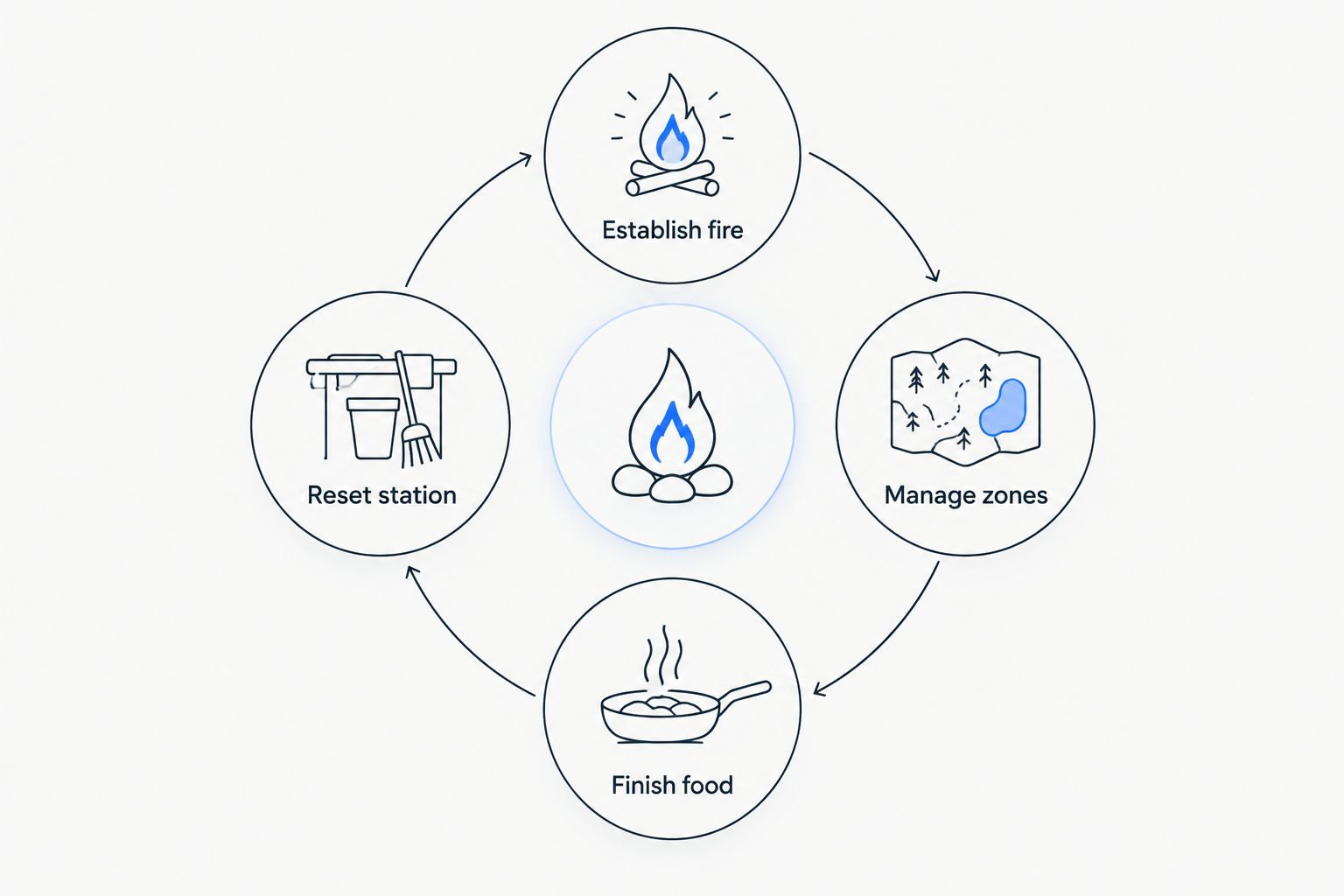
The station should support a repeatable cycle: establish the fire, manage the cooking zones, finish the food, then reset the work area. Keep plating outside the fuel-handling path.
Plan the footprint and catering load-out
Measure the complete operating envelope, not just the grill body. Account for the manufacturer's required clearances, moving components, fuel access, food handling, and the route around the cook. A grill that fits on a plan can still block service once someone stands in front of it.
For catering, map the route from vehicle to cooking position. Check gates, thresholds, surfaces, ramps, and loading equipment against the actual model's dimensions and weight. Wheels alone do not establish that a grill is practical to transport.
Ask who owns each end-of-event task. If nobody has planned cooldown, ash handling, and loading, the equipment decision is unfinished—even when the cooking setup looks right.
- Measure the narrowest access point along the full route.
- Check documented dimensions and weight for the exact configuration.
- Reserve separate landing areas for raw and finished food.
- Plan fuel storage away from guest circulation.
- Establish a safe cooldown and waste-removal procedure.
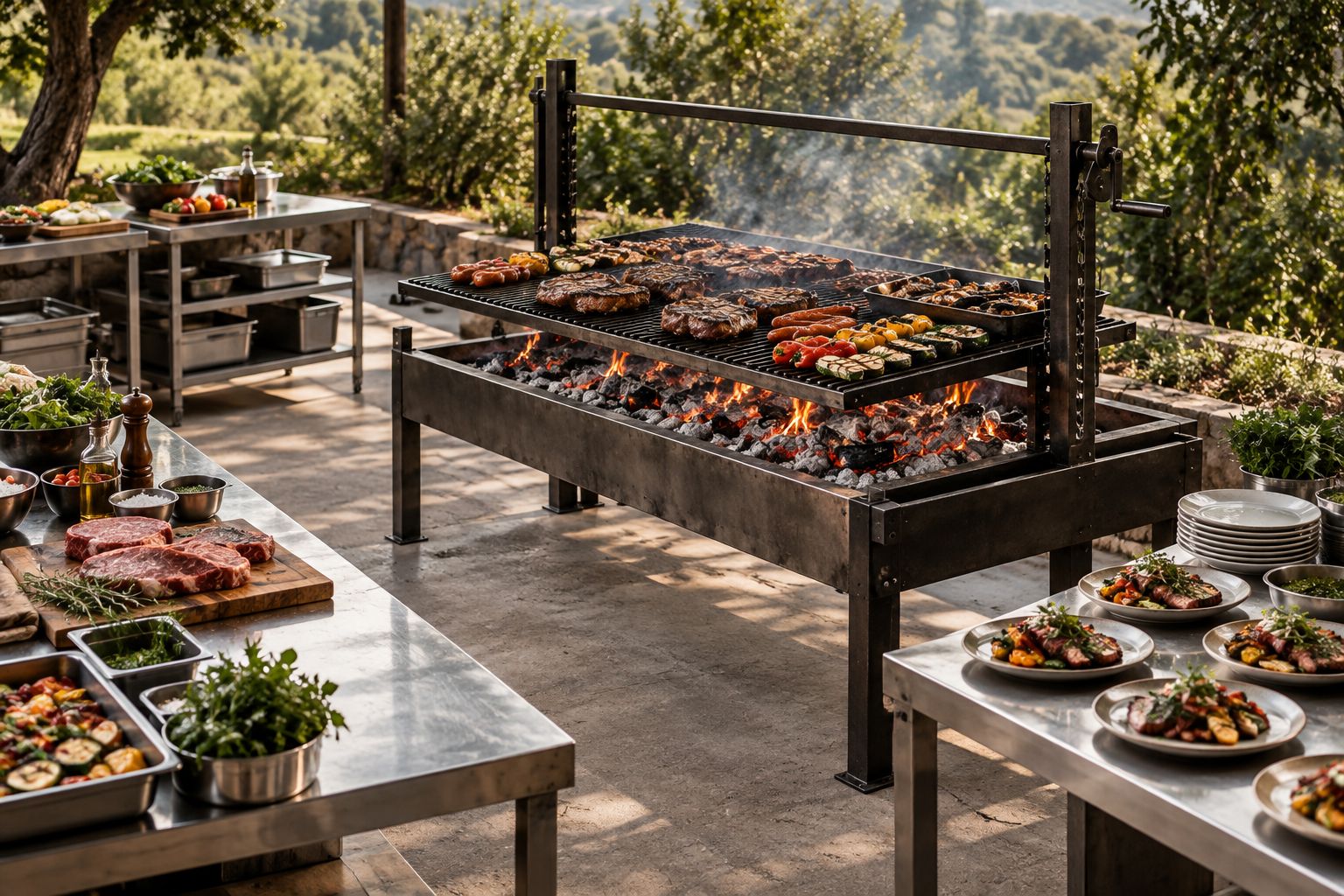
A practical outdoor station keeps the cook facing the grill while prep and plating sit within reach but outside the fire-handling area. Guest traffic should not pass between those working positions.
Check cleaning and ownership tasks before ordering
Read the cleaning instructions before choosing a grill. Identify what lifts out, what needs tools, and where grease and ash collect. Accessible food-contact surfaces matter when the team must reset the station after service rather than leave the cleanup for another day.
Evaluate ownership work alongside cooking performance. Ask about replacement grates, moving components, compatible accessories, and procedures for inspecting the lifting mechanism. Verify each answer for the exact model instead of borrowing details from a similar product.
For the 2026 purchase decision, keep the approval documents, operating instructions, and service checklist together. Smokeforges can be your outdoor-grill comparison point; venue acceptance and suitability for your workload still require their own checks.
- Identify removable grates and accessible grease-collection areas.
- Confirm the manufacturer's ash-removal and cleaning procedures.
- Check inspection instructions for lifting and moving components.
- Verify replacement-part identification for the exact model.
- Assign opening, service, shutdown, and cleaning responsibilities.
Compare the options against your service model
This 2026 comparison separates cooking formats and documented product details from operating questions you still need to resolve. None of these recommendations establishes commercial approval. Choose the format first, then verify the exact appliance and installation.
| Option | Best for | Main advantage | Key limitation |
|---|---|---|---|
| Tagwood BBQ BBQ06SS Argentine Santa Maria Gaucho Grill | Operators evaluating an outdoor Argentine-grill station | A model-specific Argentine/Santa Maria option identified as 304 stainless steel | Installation acceptance, usable capacity, and service fit need separate verification |
| Tagwood BBQ BBQ03SI Chief Series Santa Maria Grill | Menus that benefit from examining separate cooking zones | Its product title specifies 4 cooking zones | The zone count does not establish independent control or meals per service |
| Kamado Joe Big Joe II | Teams evaluating a lidded charcoal grill and smoker instead of an open-grate format | The product is a 24-inch ceramic charcoal grill and smoker with cart | It is not an Argentine height-adjustable open-grate cooking format |
| Flat-top griddle format | Menus centered on continuous surface contact | Supports contact cooking on a solid surface | Does not reproduce cooking over an open ember bed on a grate |
The 24-inch Kamado Joe designation describes a different format, not a direct capacity benchmark for an Argentine grill. The same caution applies to an 18-inch ceramic alternative: dimensions help distinguish models, but they do not establish ticket capacity across unlike cooking systems.
For a restaurant centered on live-fire steaks, prioritize grate control, ember access, and the cook's working sequence. For catering centered on mixed-menu batch cooking, first decide whether open-grate cooking actually serves the menu better than a solid cooking surface.
Common mistakes restaurants and caterers make
Buying the fire presentation instead of the station
An open fire can be part of the dining experience, but it also needs a practical working arrangement. A grill facing the guests is a poor choice if the cook must cross guest traffic to retrieve raw food or carry finished platters.
Fix: approve the work layout before choosing the presentation angle.
Treating a smoke hood as an installation permit
A grill-mounted hood is an accessory, not a substitute for a site-specific ventilation and fire-protection assessment. Compatibility with a grill does not establish acceptance for an indoor commercial kitchen.
Fix: have the installation requirements established for the exact appliance, fuel, and location before ordering associated equipment.
Comparing exterior width as if it were output
An exterior measurement does not tell you how many portions fit with space to turn them, manage heat, and finish orders. Separate cooking zones also need a workable loading pattern.
Fix: compare usable dimensions and rehearse your actual menu rather than assigning an unsupported meals-per-hour figure.
Planning catering setup but ignoring shutdown
Loading out is part of the job. A transport plan that starts when the fire is cold leaves unanswered questions about who supervises the equipment, manages ash, and keeps the site secure during cooldown.
Fix: assign shutdown responsibilities before accepting the equipment as suitable for mobile service.
FAQ
What's the best argentine grill for restaurants?
The best Argentine grill for a restaurant is the exact model that fits its menu, service sequence, and approved installation. Compare grate adjustment, ember access, usable cooking dimensions, and cleaning before choosing by appearance or exterior width.
Can I use an outdoor Argentine grill inside a restaurant?
Do not install an outdoor Argentine grill indoors without model-specific acceptance for that use and location. Have the relevant authorities and qualified professionals establish appliance, ventilation, and fire-protection requirements first.
Is an Argentine grill practical for catering?
An Argentine grill is practical for catering only when its cooking workflow and transport requirements fit the operation. Check access, equipment weight, fuel handling, cooldown, and ash removal before selecting a model.
Does a smoke hood make an Argentine grill suitable for indoor use?
A smoke hood alone does not establish suitability for indoor commercial use. The complete appliance and installation need assessment against the requirements that apply at the site.
Is a kamado the same as an Argentine grill?
A kamado is not the same cooking format as an Argentine grill. A kamado uses an enclosed, lidded chamber, while Argentine grilling uses grate height and ember placement to manage cooking over the fire.
How do I work out the grill capacity my restaurant needs?
Work out capacity by rehearsing your actual order mix on the usable cooking surface. Include space for turning, separate heat requirements, fuel access, and unloading rather than counting tightly packed portions.
What should I check before buying an Argentine grill in 2026?
Confirm the operating location and applicable approval requirements before buying an Argentine grill in 2026. Then verify the exact model's cooking layout, installation instructions, dimensions, cleaning access, and fit with your team's service sequence.
One last thing
Rehearse the final order of the night, not just the first. Put fuel tools, used utensils, finished-food trays, and cleaning equipment into your proposed layout; then check whether the cook still has a clear working route. Use that test to narrow your Smokeforges Argentine-grill shortlist before committing to equipment.