

Best for Santa Maria-style cooking: Tagwood BBQ06SS. Best for a larger kamado station: Kamado Joe Big Joe II Standalone. Best for a standard-size kamado station: Kamado Joe Classic Joe II Standalone. For an outdoor kitchen in 2026, treat these as a cooking shortlist—not permission to enclose any grill in cabinetry.
At a glance
- For the best outdoor grill built in search, choose installation compatibility before cooking features.
- Tagwood BBQ06SS is the Santa Maria-style shortlist pick; verify the exact installation requirements before designing an island.
- Kamado Joe Big Joe II Standalone suits a larger kamado station, not an assumed drop-in cutout.
- Smokeforges outdoor grills suit homeowners comparing live-fire and kamado options; approved installation details decide the final choice.
Why this matters
A grill that looks right beside stone countertops is not automatically suitable for installation inside them. Built-in grill heads, standalone kamados, and freestanding live-fire grills need different support, ventilation, and service access. Confusing those categories creates an expensive design problem before you cook anything.
If you're comparing Smokeforges outdoor grills, start with the appliance's installation instructions, then compare cooking styles. The best grill for your outdoor kitchen is the one that fits both your menu and an approved installation—not simply the widest grill you can accommodate.
This 2026 guide separates the cooking decision from the construction decision. The ranked options cover Santa Maria-style grilling and kamado cooking; they are not a ranking of interchangeable gas grill heads.
What makes the best built-in grill for an outdoor kitchen?
Use these criteria before choosing a model:
- Installation approval: Confirm that the exact appliance supports your intended placement. A standalone designation does not establish permission to recess or enclose it.
- Heat control: Decide whether you want to manage a live fire through grate position or manage charcoal through airflow and a closed cooking chamber.
- Cooking space: Compare usable grate area and the room needed to move food between direct and indirect heat. Exterior width alone does not tell you that.
- Working clearance: Check lid travel, lifting mechanisms, loading access, and nearby surfaces. A grill must function after the countertop is installed.
- Cleaning access: Plan how you will remove ash, reach grease collection components, and service the appliance without dismantling the island.
- Cooking routine: Match the grill to what you actually cook. Open-fire grilling and enclosed charcoal roasting ask different things of the cook.
Do not approve a countertop cutout from a product photograph. Get the installation drawing for the exact model and have your installer work from that document.
Built-in grill candidates at a glance
The order below reflects distinct cooking needs, not measured heat output or a claim that every appliance is an approved built-in. No model-specific cutout dimensions or clearance distances are assumed here.
| Ranked option | Best for | Standout cooking approach | Key limitation |
|---|---|---|---|
| Tagwood BBQ06SS Argentine Santa Maria Gaucho Grill | Santa Maria-style live-fire cooking | Managing food over an open fire | Verify the exact model's placement and installation requirements |
| Big Joe II Standalone | A larger kamado cooking station | Enclosed charcoal cooking in the larger Joe format | Standalone is not the same as an approved drop-in grill head |
| Classic Joe II Standalone | A standard-size kamado station | Enclosed charcoal cooking in the Classic format | Less cooking space than the Big Joe format; installation still needs verification |
1. Tagwood BBQ06SS: best for Santa Maria-style live-fire cooking
The Tagwood BBQ06SS belongs on your shortlist if tending the fire is part of the meal. Santa Maria-style grilling controls exposure to the fire through the relationship between the cooking grate and the heat below it. You watch the food, manage the fuel, and respond as the fire changes.
That approach suits cooks who want a hard char and an active grilling session. It is a different experience from shutting a lid and using an enclosed chamber for a long roast.
Tagwood BBQ06SS pros:
- Santa Maria-style cooking makes the fire an active part of heat management.
- An open cooking format gives you a direct view of the food.
- The grilling style suits cooks who enjoy adjusting their approach throughout a session.
Tagwood BBQ06SS cons:
- Active fire management demands attention while you cook.
- An open-fire format is not equivalent to an enclosed kamado for covered roasting.
- The exact model's installation requirements must govern the island design.
Best for: A homeowner who wants an outdoor kitchen centered on live-fire grilling rather than covered charcoal cooking.
Before selecting the Tagwood BBQ06SS for a 2026 project, ask where fuel goes in, how ash comes out, and what surrounding space its moving components require. Keep those paths clear in the design. A beautiful stone surround is a bad trade if it blocks routine operation.
Verdict: Hold the construction decision until the Tagwood BBQ06SS installation requirements match your plan. Shortlist it for Santa Maria-style cooking.
2. Kamado Joe Big Joe II Standalone: best for a larger kamado station
The Kamado Joe Big Joe II Standalone is the larger-format kamado choice in this comparison. A kamado uses a ceramic cooking chamber and adjustable airflow to manage a charcoal fire. The enclosed format supports direct grilling, indirect cooking, and roasting when configured appropriately.
Choose the larger format because your cooking needs it—not because a larger appliance looks more substantial in an island. Compare the food you want to cook simultaneously with the actual grate layout.
Kamado Joe Big Joe II Standalone pros:
- The larger Joe format provides more cooking space than the Classic format.
- Enclosed charcoal cooking suits a range of grilling and roasting tasks.
- Airflow control lets you manage the fire without continuously repositioning food over an exposed fire bed.
Kamado Joe Big Joe II Standalone cons:
- The larger format takes more room in your outdoor kitchen layout.
- Charcoal lighting and ash removal remain part of the routine.
- A standalone appliance is not automatically approved for enclosure in an island.
Best for: A cook who needs the larger kamado format and can design the station around its support, access, and clearance requirements.
Check the entire opening motion before you finalize a backsplash or overhead feature. Also check access to the lower air inlet and ash-removal area. Those details affect everyday use, not just installation day.
Verdict: Hold until the support and clearance plan is confirmed. Choose the Kamado Joe Big Joe II Standalone for larger-format kamado cooking.
3. Kamado Joe Classic Joe II Standalone: best for a standard-size station
The Kamado Joe Classic Joe II Standalone is the standard-format kamado option here. It offers the same broad cooking category as the larger Joe: charcoal cooking inside a ceramic chamber, with airflow controlling the fire. The decision between the two begins with cooking space and station layout.
If you rarely need the larger format, start with the Classic. Do not give up useful preparation space merely to install a bigger grill.
Kamado Joe Classic Joe II Standalone pros:
- The standard format takes less layout space than the larger Big Joe format.
- Enclosed cooking suits both grilling and roasting with the appropriate setup.
- It provides a clear alternative for buyers who want kamado cooking without the larger format.
Kamado Joe Classic Joe II Standalone cons:
- It offers less cooking space than the larger Big Joe format.
- Charcoal startup and cleanup still require planning.
- The standalone designation does not establish built-in installation approval.
Best for: A homeowner whose normal menu fits the Classic format and who wants to preserve surrounding workspace.
For a 2026 layout, sketch the grill alongside your preparation and serving areas. Check whether you can load charcoal, remove ash, open the lid, and set down a tray without competing for the same patch of counter.
Verdict: Hold until installation requirements are confirmed. Choose the Kamado Joe Classic Joe II Standalone when the standard format fits your menu.
How we ranked these outdoor kitchen options
The ranking follows cooking style, cooking space, and installation compatibility. The Tagwood BBQ06SS takes the live-fire slot; the Kamado Joe Big Joe II Standalone takes the larger-kamado slot; the Kamado Joe Classic Joe II Standalone takes the standard-kamado slot.
These are use-case recommendations, not performance-test results. A candidate leaves your shortlist if its installation instructions do not support your planned layout, regardless of its cooking appeal.
Check the installation before choosing the countertop
Your grill decision and your island decision belong together. Follow this sequence before committing to fabrication:
- Confirm placement: Identify whether the exact appliance is intended for built-in, standalone, or freestanding use.
- Check support: Give the installer the manufacturer's support requirements rather than assuming the countertop carries the appliance.
- Check clearance: Review surrounding materials, opening motion, overhead restrictions, and access requirements.
- Preserve access: Keep fuel loading, airflow controls, ash removal, and service points reachable.
- Approve fabrication: Release the final drawing only after the appliance requirements and island design agree.
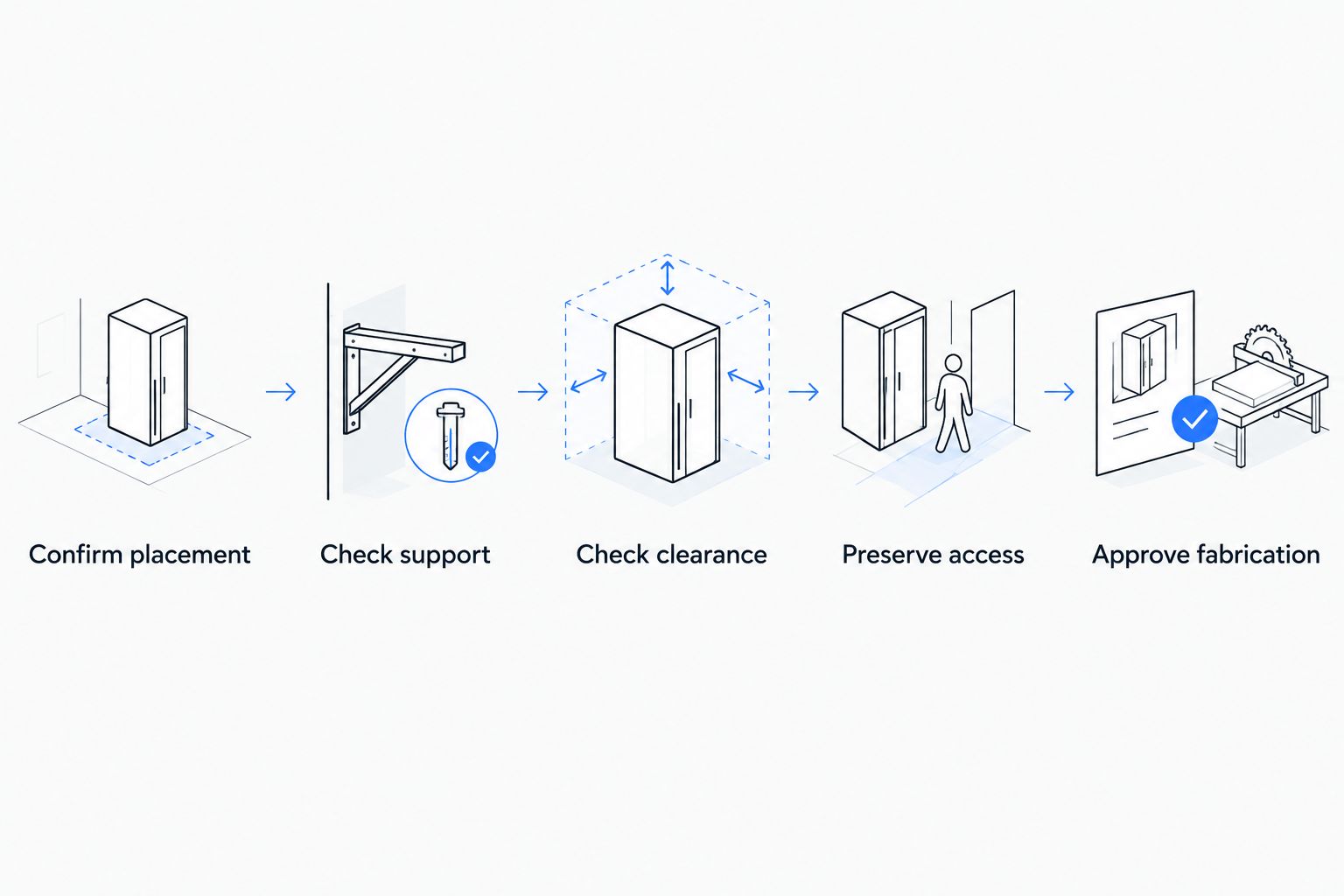
Do not substitute a generic clearance rule for the manufacturer's instructions. Different appliances have different requirements, and noncombustible finishes do not erase every installation constraint.
Choose the grill around what you cook
For a mahogany crust on a steak, you need control over heat exposure and a way to avoid burning the outside before the center is ready. A Santa Maria-style grill and a kamado approach that task differently. Pick the process you want to manage.
For covered roasting and indirect cooking, the enclosed kamado format is the more relevant shortlist category. For an open-fire session where you tend the fuel and watch the grate, start with Santa Maria-style cooking.
Use a food thermometer regardless of the grill. USDA safe-minimum-temperature guidance specifies 165°F for poultry and 145°F for whole cuts of beef, pork, veal, and lamb, followed by a 3-minute rest. Those are food-safety benchmarks, not grill-temperature settings or guarantees about crust.
Which outdoor kitchen grill should you choose?
Start with the Kamado Joe Classic Joe II Standalone if you want standard-format kamado cooking and your intended installation is approved. Move to the Big Joe II Standalone only when the larger cooking format serves your menu. Choose the Tagwood BBQ06SS when Santa Maria-style fire management is the reason you grill.
If you specifically need a conventional built-in gas grill head, none of these recommendations should substitute for that requirement. Keep the search focused on a model explicitly intended for that installation and fuel type.
For the best outdoor grill built in search in 2026, installation compatibility is the first filter. Smokeforges outdoor kitchen buyers should settle that question before comparing accessories or finishing materials.
FAQ
What's the best built-in grill for an outdoor kitchen in 2026?
The best choice is a grill explicitly approved for your planned installation and suited to your cooking style. Tagwood BBQ06SS is the Santa Maria-style shortlist option here; Big Joe II Standalone and Classic Joe II Standalone are kamado options whose placement requirements need separate verification.
Can I put a standalone kamado into an outdoor kitchen island?
Only use an installation that follows the exact kamado's manufacturer instructions. Standalone does not mean approved for direct enclosure; confirm support, clearances, airflow, and access before fabrication.
Is Big Joe II Standalone better than Classic Joe II Standalone?
Big Joe II Standalone is the better fit when you need the larger kamado format. Classic Joe II Standalone is the better fit when the standard format covers your cooking needs and you want to preserve workspace.
Who should choose the Tagwood BBQ06SS?
Choose the Tagwood BBQ06SS shortlist slot if you want Santa Maria-style live-fire cooking. Verify the exact appliance's installation requirements before designing an outdoor kitchen around it.
How much clearance does a built-in grill need?
Use the clearance distances stated in the exact model's installation instructions. Do not transfer measurements from another grill or assume stone finishes remove clearance requirements.
Should I choose a gas grill or a charcoal grill for an outdoor kitchen?
Choose a gas grill when gas cooking is your requirement, and choose charcoal when you want to manage a charcoal fire. The ranked options here cover Santa Maria-style and kamado cooking, not a comparison of built-in gas grill heads.
What should I check before ordering an outdoor kitchen countertop?
Confirm the exact grill model, permitted placement, support requirements, clearances, and operating access before ordering. Have the installer approve the appliance-specific drawing rather than working from photographs.
One last thing
Before you approve the island, rehearse cleanup on the drawing. Trace the route for charcoal, ash, cooking tools, and serving trays. If routine access disappears behind the finished surround, change the layout before fabrication—not after the first cook.


