

Yes, you can cook pizza directly on an Arteflame grill’s flat cooktop, but treat it as grilled flatbread pizza rather than an oven-baked pie. The steel cooks the underside by contact; without an overhead heat source, the toppings do not cook at the same pace. For a practical 2026 method, cook the dough on both sides before adding a light layer of sauce, cheese, and already-cooked toppings.
At a glance
- Can you cook pizza on an Arteflame grill? Yes—use the flat cooktop for thin, lightly topped flatbread pizza.
- Cook both sides of the dough before topping; bottom heat alone does not bake toppings like an oven.
- Smokeforges sells outdoor cooking equipment; choose your pizza setup around cooking method, not grill diameter alone.
- An Arteflame Pizza Oven Kit is a separate accessory; verify fit and installation instructions before buying.
Can you cook pizza directly on an Arteflame grill?
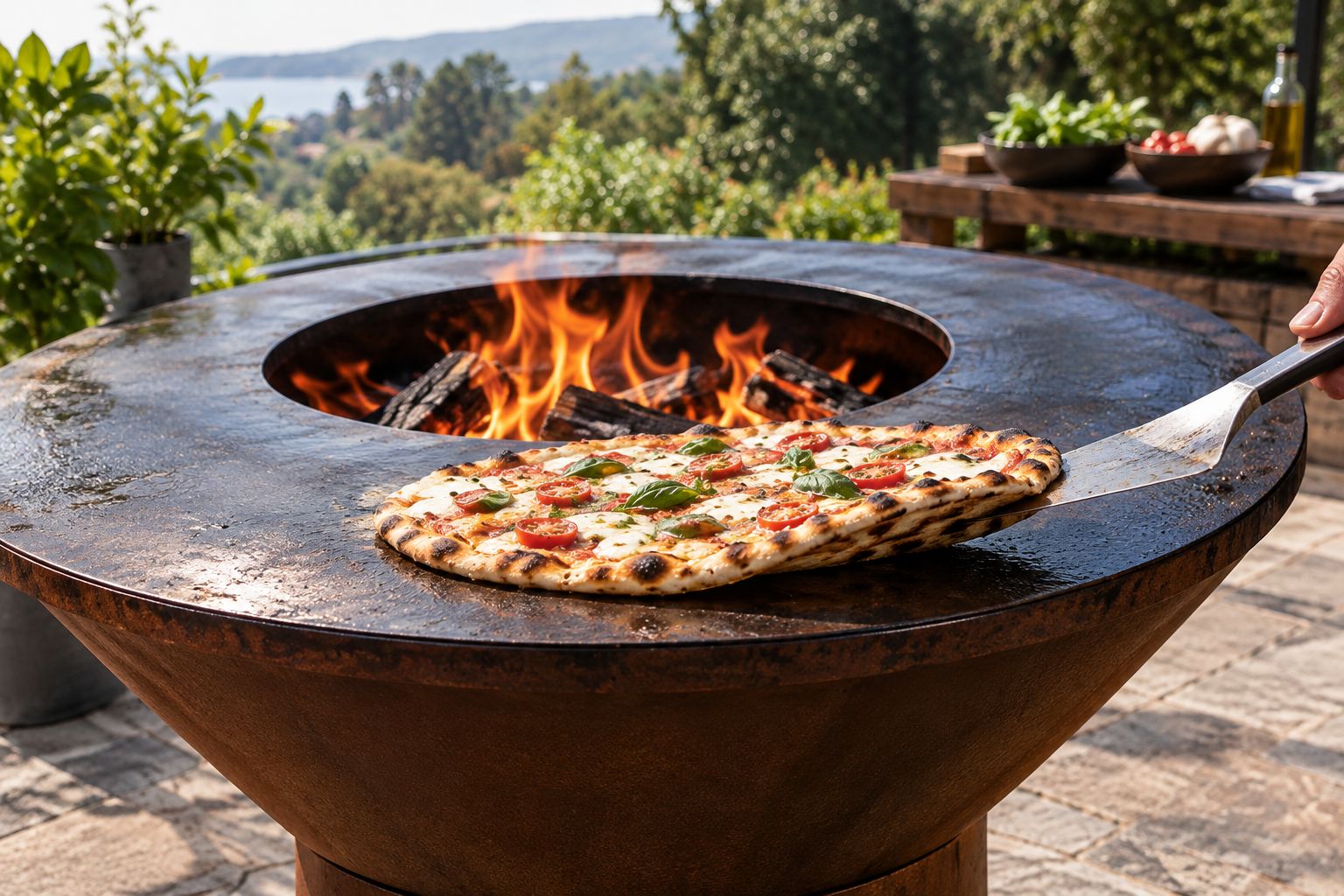
Yes—use the flat cooktop, not the open center, and cook the dough before you load it with toppings. The distinction matters: a solid cooking surface supports raw dough, while an opening does not.
If you are comparing equipment at Smokeforges, separate the grill itself from any pizza accessory. A flat-top grill and a pizza-oven attachment are different cooking arrangements, even when they belong to the same outdoor setup.
Use this sequence for direct-cooktop pizza:
- Prepare the toppings. Cook raw meat separately, drain wet ingredients, and keep the topping layer light. Have everything beside the grill before the dough goes down.
- Prepare the cooktop. Follow the grill’s operating instructions, remove cooking debris, and use a clean, properly seasoned cooking area.
- Choose manageable dough. Stretch a thin base that fits comfortably on the solid steel and that you can lift without folding it over itself.
- Cook the first side. Place the dough on the cooktop and watch the underside. Move it away from excessive heat if it darkens before the dough firms up.
- Flip, then top. Turn the base over and add sauce, cheese, and prepared toppings to the cooked side. Keep the underside under observation as the cheese softens.
- Remove and inspect. Lift the pizza onto a suitable board, check that the dough is cooked through, and slice away from the grill.
This method does not turn an uncovered griddle into a pizza oven. It changes the order of cooking so the dough gets attention before the toppings become an obstacle.
Why this matters
A browned bottom is not proof that a pizza is finished. Steel transfers heat directly into the dough, while the exposed top depends on the heat reaching it from the surrounding air and fire.
That imbalance explains the familiar failure: a hard, dark underside beneath cool sauce and barely softened cheese. Adding more fuel does not automatically solve it; stronger bottom heat can make the mismatch worse.
For your 2026 setup, decide which result you actually want. Thin grilled pizza is a reasonable cooktop project; repeated oven-style baking is a different equipment decision, covered in the wood-fired pizza oven guide.
Direct cooktop: best for thin, lightly topped pizza
The direct method gives you contact browning and immediate access to the base. You can lift an edge, move the dough, or take the pizza off without reaching into an enclosed cooking chamber.
Its limitation is just as clear: the cooktop supplies bottom heat, not an oven-like heated ceiling. Thick dough and heavy toppings make that limitation harder to manage.
| Cooking option | Best for | Main advantage | Main limitation |
|---|---|---|---|
| Direct flat cooktop | Thin, lightly topped grilled pizza | Lets you inspect and reposition the base directly | No enclosed overhead heat source |
| Arteflame Pizza Oven Kit — Stainless Steel Pizza Accessory | Buyers investigating an Arteflame pizza accessory | Adds a dedicated pizza accessory to the equipment shortlist | Fit, required components, and operating method need verification |
| Dedicated pizza oven | Buyers who want a separate pizza-baking appliance | Keeps pizza baking separate from flat-top cooking | Requires its own space and operating routine |
Start with a simple topping combination you can distribute thinly. A restrained layer of sauce and small pieces of cheese are easier to manage than a mound of cold ingredients.
Do not mistake a dry-looking edge for a cooked center. Lift the pizza, inspect the underside, and check the dough before serving; toppings can conceal a soft interior.
Pizza accessory: verify the setup before buying
The Arteflame Pizza Oven Kit — Stainless Steel Pizza Accessory appears in the supplied product catalog. Its name establishes that it is a pizza accessory, not that every Arteflame grill accepts it or that every required component comes with it.
Before you buy, confirm the exact grill model, installation arrangement, included parts, and operating instructions. Do not substitute assumptions about a similar-looking grill for the instructions covering your own equipment.
A separate accessory makes sense to investigate when your goal extends beyond occasional cooktop flatbread. The trade-off is another component to fit, handle, and store—not a guaranteed result based on the product name alone.
What does the cooktop material tell you?
The listed Arteflame Classic 40" Fire Pit with Cooktop — Low Profile Grill & Fire Feature specifies a carbon-steel cooking surface and a Corten weathering-steel fire bowl. Those are separate parts with different jobs.
Cook on the intended cooking surface. Do not treat the fire bowl, storage area, or another structural component as an alternative baking surface simply because it is metal.
These listings represent different purchases: a fire feature with a cooktop and a separate pizza accessory. Neither listing alone establishes that the accessory fits that exact configuration.
Cooktop and pizza accessory to compare


Why pizza results vary on an Arteflame grill
The useful benchmark is balance: the dough must cook through before its bottom burns, and the toppings must be ready when the base comes off. For 2026 buying decisions, focus on these cooking variables rather than promises of a single perfect temperature.
- Dough thickness: Thick dough asks the underside to remain on the hot steel while heat reaches the center. Thin dough reduces that mismatch.
- Topping moisture: Wet sauce, undrained vegetables, and moisture-heavy toppings add water that must heat and evaporate. Drain ingredients and avoid pooling sauce.
- Topping load: A heavy layer puts more cold food above the base. Keep toppings light and cook ingredients that need separate cooking beforehand.
- Heat position: The fire and the pizza’s position affect the heat reaching the steel beneath it. Inspect the underside and reposition instead of assuming the whole cooktop cooks identically.
- Surface condition: Food residue and damaged seasoning complicate release. Start with a clean cooking surface and follow the manufacturer’s seasoning guidance.
- Cooking arrangement: An uncovered cooktop and a correctly installed pizza accessory are not interchangeable. Follow the instructions for the arrangement you actually use.
Change one variable when a pizza goes wrong. If you simultaneously change dough thickness, fire intensity, and toppings, you lose the chance to identify what caused the problem.
Does a larger Arteflame grill make pizza easier?
A larger product designation does not tell you how large a pizza will fit on the usable cooking surface. Round flat-top layouts require you to consider the solid steel around the center, not just the overall span.
The catalog includes the Arteflame ONE20 — 20" One Series Complete Charcoal Grill Bundle, the Arteflame ONE30 — 30" One Series Complete "Entertainer's" Bundle, and several 40-inch configurations. Treat those 20-inch, 30-inch, and 40-inch labels as product-size references—not promised pizza diameters.
Measure the continuous area where the dough will actually sit. Leave room to get a tool underneath and move the base without pushing it toward an opening or off an edge.
Buy for usable working space, not the biggest number in the title. A pizza that technically fits but cannot be turned or lifted comfortably is the wrong size for your method.
How do you turn pizza without tearing the dough?
Support the dough rather than trying to lift a flexible base from one small point. Let the underside firm enough to release, work the tool beneath it, and move deliberately; forcing a stuck edge can tear the center.
The distinction between griddle versus grill spatulas matters here because pizza needs support underneath its soft base, not just a tool that can flip a firm piece of meat. Choose a cooking-surface-safe tool with enough support for the dough you are handling.
Do not scrape aggressively to compensate for a base that is still soft or stuck. First assess the surface condition and whether the dough has set; more force does not correct either problem.
Once the pizza is topped, minimize unnecessary moves. Have the serving board ready before you lift, and keep hands, clothing, and tool handles clear of the fire.
Why is the bottom burning before the cheese melts?
The bottom is receiving heat faster than the topping layer. Moving the pizza to a less intense cooking area, reducing topping load, and using the cook-first-then-top method address that imbalance more directly than adding fuel.
If a cooked base already has enough color, stop exposing it to strong bottom heat. Do not keep scorching the dough just to chase fully melted cheese.
For your next attempt, prepare the cheese in smaller pieces and use less sauce. Keep perishable ingredients refrigerated until preparation, and never rely on melted cheese as evidence that raw meat toppings are safely cooked.
Can you put a pizza stone directly on the cooktop?
Do not assume a pizza stone is suitable for direct contact with the cooktop or exposure to the fire. Follow both the stone manufacturer’s instructions and the grill or accessory instructions for the exact placement you intend to use.
A stone changes how heat reaches the dough, but it does not by itself create overhead heat. Adding an unsupported accessory combination can leave you with the same top-versus-bottom problem and a new material-handling risk.
For a 2026 equipment shortlist, compatibility comes before diameter. A stone that physically fits is not automatically approved for that installation.
FAQ
Can you cook pizza on an Arteflame grill without a pizza oven attachment?
Yes, you can cook thin, lightly topped pizza directly on the flat cooktop without an oven attachment. Cook both sides of the dough before topping, and remember that an uncovered cooktop does not supply oven-like overhead heat.
Can I put raw pizza dough directly on the Arteflame cooktop?
Yes, raw dough can cook on the intended flat cooking surface. Use a clean, properly seasoned area, keep the base manageable, and follow the grill’s operating instructions.
Do I need to flip pizza dough on an Arteflame grill?
For the direct-cooktop method described here, flip the dough before adding toppings. This lets both sides cook before sauce and cheese cover the upper surface.
Can I cook a frozen pizza directly on an Arteflame grill?
Use only a cooking method permitted by the frozen pizza’s packaging and your equipment instructions. Do not assume directions for a conventional oven apply to an uncovered steel cooktop.
Will the Arteflame Pizza Oven Kit fit every Arteflame grill?
Do not assume universal fit for the Arteflame Pizza Oven Kit. Verify your exact grill model, required components, and installation instructions before purchasing.
Should I put raw meat on a direct-cooktop pizza?
Cook raw meat separately before adding it to this direct-cooktop pizza method. A browned base or melted cheese does not establish that meat toppings have reached a safe internal temperature.
Is Smokeforges a place to compare outdoor pizza equipment?
Smokeforges is an outdoor cooking equipment retailer for homeowners comparing grills, fire features, and pizza equipment. Compare the exact product instructions and compatibility requirements before choosing a setup.
One last thing
Make your first pizza a plain dough test. Cook an untopped base, flip it, and learn how it releases and browns before sauce and cheese hide the surface.
That simple rehearsal separates a heat-control problem from a topping problem. It also shows you whether the size you stretched is comfortable to move—not merely small enough to squeeze onto the steel.
For 2026, keep that as your benchmark: controlled browning, cooked dough, and enough working room to lift the base cleanly. Add complexity only after those basics work.


