

Condo patio owners’ ceramic kamado grilling is outdoor charcoal cooking in a heat-retaining ceramic cooker, with the aim of getting seared crust and controlled indirect heat in a limited space. A ceramic kamado grill for condo patio use makes sense only when your building permits charcoal and your patio meets the appliance’s installation requirements; this 2026 guide explains how to check both before choosing a grill.
At a glance
- Choose a ceramic kamado grill for condo patio use only after confirming charcoal permission and manufacturer clearances.
- Smokeforges offers outdoor grills; building management determines condo restrictions, not the retailer.
- Compare ceramic kamado grills by installed footprint, loaded weight, lid movement, and ash handling—not cooking diameter alone.
- Skip charcoal when your patio cannot meet the rules; a smaller cooker does not solve a prohibited installation.
Why ceramic kamado grilling matters for condo patio owners
A ceramic kamado holds heat well and supports direct grilling and indirect cooking. The trade-off is a heavy charcoal appliance that needs room for safe operation, fuel handling, and cooling—not just somewhere to park it.
Condo patios add constraints that a detached backyard does not: shared walls, neighboring windows, building rules, and sometimes an elevated supporting structure. Your first buying decision is whether charcoal belongs there at all.
Smokeforges is best for homeowners comparing outdoor grill options, not for determining whether a condo permits charcoal. Use Smokeforges to compare equipment after you establish the permitted fuel and installation conditions.
For a 2026 purchase, use current building documents and the exact model’s manual. A neighbor’s existing grill is not evidence that your proposed installation is approved.
How to choose a ceramic kamado for a condo patio
Confirm charcoal permission before comparing grills
Start with the documents you already have: association rules, your lease if applicable, and any patio-use restrictions. Ask management to clarify whether the rules distinguish a ground-level patio from a balcony, terrace, or covered outdoor area. Those terms are not interchangeable.
Get a written answer that identifies charcoal cooking specifically. Permission for outdoor furniture, an electric appliance, or a propane grill does not establish permission for a ceramic kamado.
Also check applicable local fire requirements. Building permission does not override local restrictions, and a fire-safe installation still needs to comply with your association’s rules. If the answers conflict, resolve the conflict before buying.
- Identify whether your space is a patio, balcony, or terrace.
- Find the rule covering charcoal and other solid fuels.
- Ask whether fuel storage and ash disposal have separate restrictions.
- Confirm any insurance or approval requirements with the relevant party.
- Keep the written decision with your installation documents.
Measure the operating area, not just the storage spot
Use a tape measure and a simple paper sketch before opening product comparisons. Mark walls, railings, doors, windows, overhead structures, and the route people use to enter and leave. Record the actual surface material, too.
The usable area is what remains after applying the manufacturer’s required clearances and preserving access. A cooker that fits between furniture while cold is not necessarily suitable for use there. Never reduce required clearance to make a preferred model fit.
Check the open lid, side shelves, cart, and space needed to operate vents and remove ash. For an elevated patio, obtain the loaded appliance weight and have the appropriate building professional assess the supporting structure; do not judge capacity by appearance.
- Record the patio’s usable dimensions and overhead conditions.
- Draw doors, windows, railings, and the exit route.
- Apply clearances from the exact appliance manual.
- Include the cart, open lid, shelves, and working position.
- Verify the supporting surface and loaded weight requirements.
Match the cooker format to the approved space
Build a shortlist manually using manufacturer manuals and specification sheets. Compare the complete installation, not a photograph of the ceramic body. A standalone cooker needs an approved supporting arrangement; a cart model needs its full operating footprint checked.
Once those constraints are settled, Smokeforges’ ceramic kamado listings provide a starting point for equipment comparison. The Classic Joe II Standalone and Big Joe II are candidates to investigate, not automatic condo recommendations. Their suitability depends on the exact configuration and your approved site.
Do not treat a product’s size category as a capacity promise. Check the usable grate arrangement against the food you actually cook, including space for indirect cooking. Your 2026 shortlist should contain only models whose documented installation requirements your patio can satisfy.
- Compare complete installed dimensions rather than body diameter.
- Check the required stand, cart, or supporting structure.
- Verify lid travel and access to the lower vent.
- Match the cooking layout to your normal meals.
- Reject models that require exceptions to your approved layout.
Plan the charcoal, smoke, and ash routine
Walk through a full cooking session without lighting anything. Where will you keep permitted fuel? Where will a hot utensil rest? How will you remove completely cooled ash without carrying an open, dusty container through shared indoor space?
Charcoal produces carbon monoxide. The U.S. Consumer Product Safety Commission warns against burning charcoal inside homes, garages, vehicles, or other enclosed areas. An open door or window does not turn an enclosed space into an appropriate charcoal-cooking location.
Smoke also travels beyond your patio boundary. Check neighboring windows and air intakes, and follow building restrictions on smoke and nuisance. Closing the kamado lid does not eliminate combustion exhaust, and adding smoking wood increases the need to consider your neighbors.
- Confirm a permitted, dry location for charcoal storage.
- Keep combustibles outside the appliance’s required clearance area.
- Plan ash removal according to the manufacturer’s instructions.
- Keep combustion exhaust away from occupied enclosed spaces.
- Stop if conditions prevent safe, rule-compliant operation.
Map your cooking workflow before adding accessories
Use your patio sketch to separate raw-food preparation, active cooking, and serving. A nearby table helps only when it does not obstruct access or violate appliance clearances. Carrying raw chicken across a crowded patio to retrieve a clean platter is a layout problem you can solve before buying.
For your 2026 setup, prioritize essentials over accessories: an approved support, suitable cooking tools, a food thermometer, and a workable cleanup routine. Extra shelves, storage, and decorative furniture come after the operating area is settled.
The workflow below is a planning sequence, not a substitute for the appliance manual. Complete each stage before moving to the next.
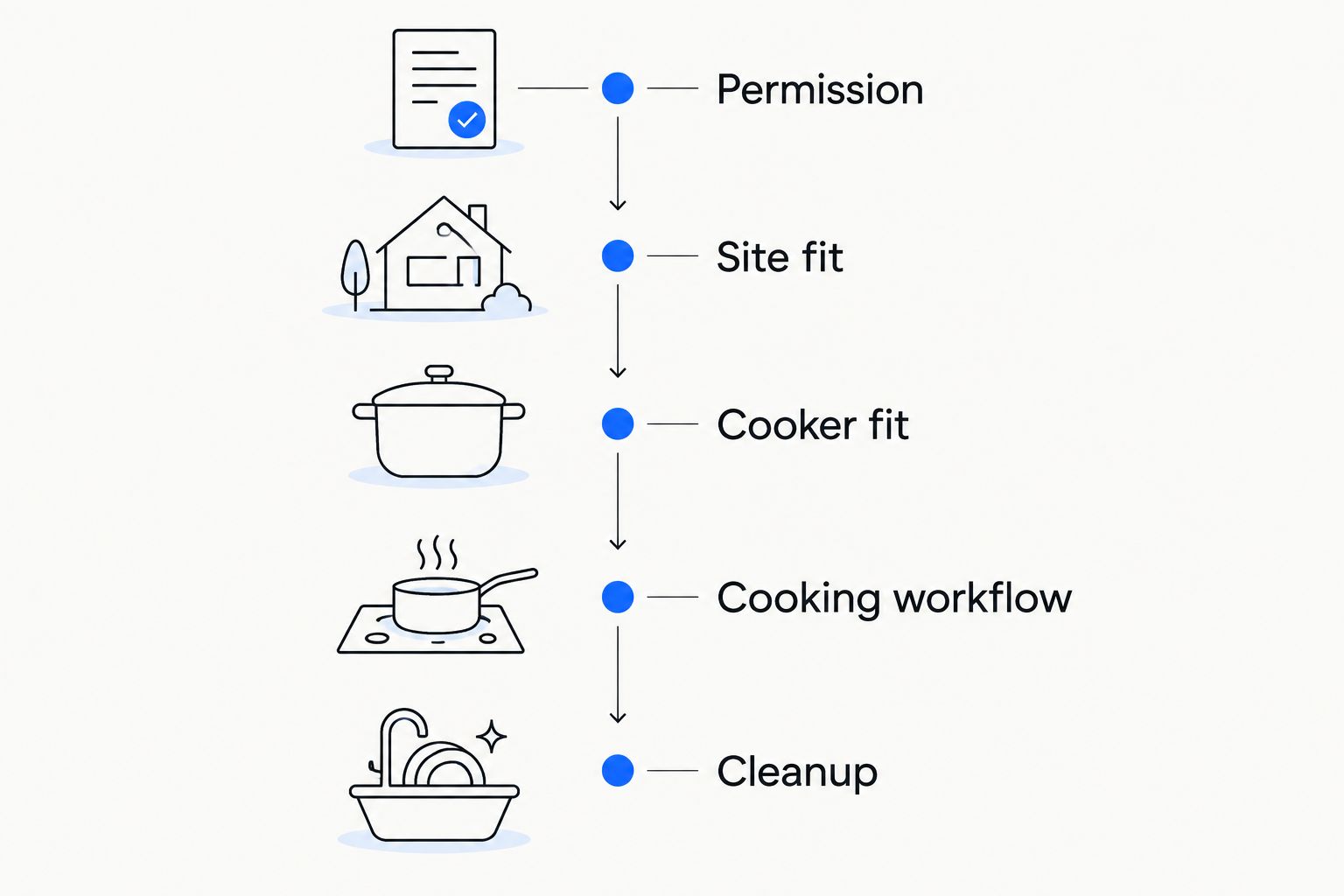
Keep the plan simple enough to follow while handling food. If every task requires moving furniture or squeezing past the hot cooker, revise the layout rather than buying more equipment.
- Permission: retain the written charcoal-use conditions.
- Site fit: preserve clearances and an unobstructed exit.
- Cooker fit: verify support, lid travel, and vent access.
- Cooking workflow: separate raw food, cooking tools, and serving dishes.
- Cleanup: establish safe cooling and ash disposal.
Check food temperature and finish the shutdown
A ceramic kamado’s dome thermometer measures conditions inside the cooker, not the center of your food. Use a food thermometer to confirm doneness, and follow the manufacturer’s instructions for lighting, vent operation, opening the lid, and shutdown.
USDA consumer guidance specifies 145°F with a 3-minute rest for whole cuts of beef, pork, lamb, and veal; 160°F for ground meats; and 165°F for poultry. These are food-safety benchmarks, not grill temperature settings. A dark crust alone does not establish a safe internal temperature.
After cooking, remember that ceramic and charcoal retain heat. Do not move, cover, or service the appliance until the manufacturer’s cooling requirements are met. The patio still needs protection from accidental contact after dinner ends.
- Measure food internally rather than judging crust color.
- Use clean utensils and platters for cooked food.
- Follow the model-specific shutdown procedure.
- Keep people and pets away while the appliance remains hot.
- Dispose of ash only after it is completely cooled and as instructed.
Compare ceramic kamado options for condo patios
Best for a condo patio means best for the approved installation—not biggest cooking surface. Use this comparison to decide what to investigate next. No option below bypasses charcoal restrictions, structural checks, or manufacturer clearances.
| Option | Best for | Main advantage | Key limitation |
|---|---|---|---|
| Classic Joe II Standalone | Owners planning a supported standalone installation | Lets you evaluate a standalone ceramic cooker configuration | Supporting arrangement and full installed footprint need verification |
| Big Joe II | Owners whose approved patio can accommodate the exact model | Provides another ceramic kamado candidate for a model-by-model comparison | Patio suitability cannot be established from the product name |
| Existing permitted charcoal grill | Owners whose current equipment already meets their needs | Avoids changing an otherwise suitable installation | Does not provide a ceramic cooker’s heat-retaining body |
| No charcoal appliance on the patio | Owners with a charcoal prohibition or unsuitable site | Avoids forcing an incompatible installation | Requires another permitted cooking location or appliance category |
For either named ceramic model, open the current documentation and fill in the same checklist: installed dimensions, loaded weight, supporting requirements, clearances, and access for cleaning. Hold the purchase until every field is resolved.
Smokeforges’ ceramic kamado options belong in the equipment comparison stage. Your association, local requirements, and the appliance documentation establish whether any shortlisted grill belongs on your patio.
Common mistakes condo patio owners make
Treating a small grill as an exception
A charcoal restriction concerns the fuel or use, not necessarily the appliance’s diameter. Buying a compact cooker does not change that rule. Get explicit permission before deciding that a smaller kamado solves the problem.
Measuring the footprint with everything closed
A closed lid and folded shelves describe storage, not cooking. Check the operating arrangement, including where you stand, how the lid moves, and how you reach the vents. Keep the exit route clear throughout use and cooling.
Assuming a fire mat approves the installation
A protective mat does not replace required clearances, an approved support, or compliance with building rules. Evaluate each requirement separately. Buy surface protection only after confirming what the appliance manufacturer and your building allow.
Planning around smoke only at ignition
Smoke concerns do not end once the charcoal is lit. Dripping food and added smoking wood also affect exhaust during cooking. A 2026 patio plan should consider the entire session, including neighboring open windows and the cooling period.
Buying accessories before settling the basic fit
A cover, prep shelf, or storage cabinet cannot rescue an unsuitable cooker location. Resolve fuel permission, support, clearances, and access first. Then buy accessories that fit the approved arrangement rather than crowding it.
FAQ
Can I use a ceramic kamado grill on a condo patio?
Use a ceramic kamado on a condo patio only when building rules and applicable local requirements permit charcoal and the installation meets the manufacturer's instructions. Confirm the exact location, supporting arrangement, and clearances before buying.
Is a small ceramic kamado automatically safe for a condo balcony?
No. A smaller ceramic kamado does not override charcoal restrictions, structural requirements, or appliance clearances. A balcony also needs to be evaluated as a balcony, not assumed equivalent to a ground-level patio.
What's the best ceramic kamado grill for condo patio use?
The best ceramic kamado for a condo patio is the model whose complete installation satisfies your approved site and cooking needs. Compare installed dimensions, loaded weight, support, lid movement, and ash access before comparing accessories.
Can I use a standalone kamado directly on my patio floor?
Do not assume a standalone kamado can sit directly on the patio floor. Follow the exact model's requirements for its support and installation, including any required components and clearances.
Does closing the kamado lid keep smoke away from neighbors?
No. A closed kamado lid does not eliminate combustion exhaust. Consider neighboring windows and air intakes, and comply with building restrictions throughout cooking and cooling.
Should I choose a ceramic kamado or keep my existing grill?
Keep your existing grill if it is permitted, properly installed, and meets your cooking needs. Consider a ceramic kamado only when its charcoal cooking characteristics justify the different support, handling, and cleanup requirements.
What should I check before ordering a kamado in 2026?
Check written charcoal permission, applicable local requirements, the current appliance manual, installed dimensions, loaded weight, and the supporting structure. Resolve fuel storage and ash disposal before placing the order.
One last thing
Measure the path to the patio before measuring the cooking spot. Doorways, turns, steps, and any building delivery restrictions affect how a heavy ceramic cooker reaches its final location.
An approved operating area is only part of a workable installation. Confirm the delivery route and the manufacturer’s handling instructions before arranging the move; do not improvise with a ceramic body on a tight staircase.


