KoKoMo Classic Series · Model KO-CHAR32
Real Charcoal Flavor, With a Crank That Gives You Actual Temperature Control
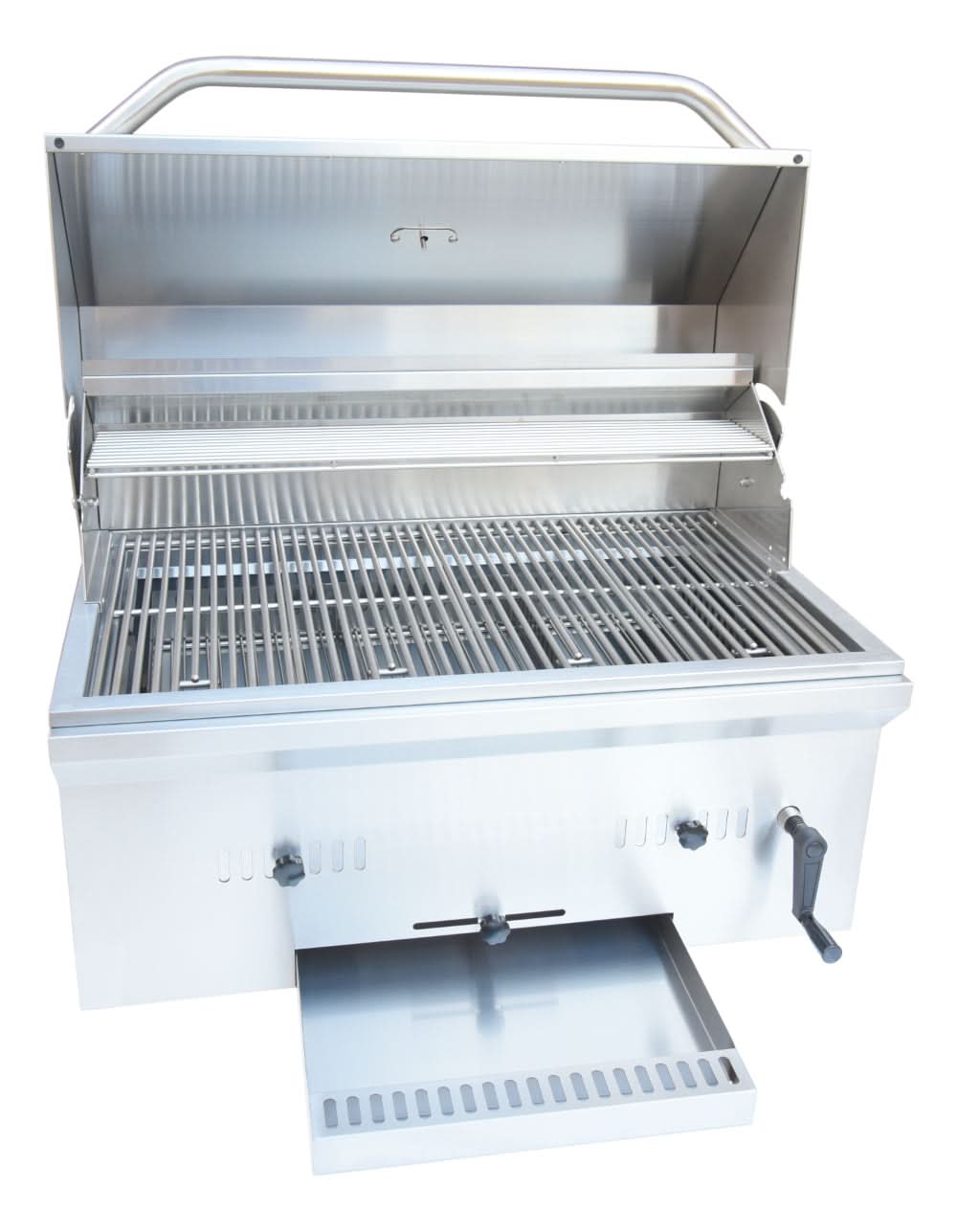
The knock on charcoal has always been control. You build the fire, and then you live with whatever it decides to do. This grill answers that with a hand crank on the front face that raises and lowers the entire charcoal tray — moving the coals closer to the food for searing heat, or dropping them away for low and slow, without opening the hood or moving a single briquette.
Built from 304 stainless steel across a 32-inch built-in footprint, with a double-wall hood, front-mounted air dampers, and a front ash clean-out. It's live-fire cooking with the operational sanity of a gas grill.
32"Built-In Width
3Heat Zone Separators
304Stainless Grade
106Lbs Crated Weight
At a Glance
What You're Actually Getting
- Crank-adjustable charcoal tray, operated from the front of the grill
- Three heat zone separators built into the tray
- Adjustable air dampers mounted at the front for airflow control
- Front charcoal clean-out for ash removal
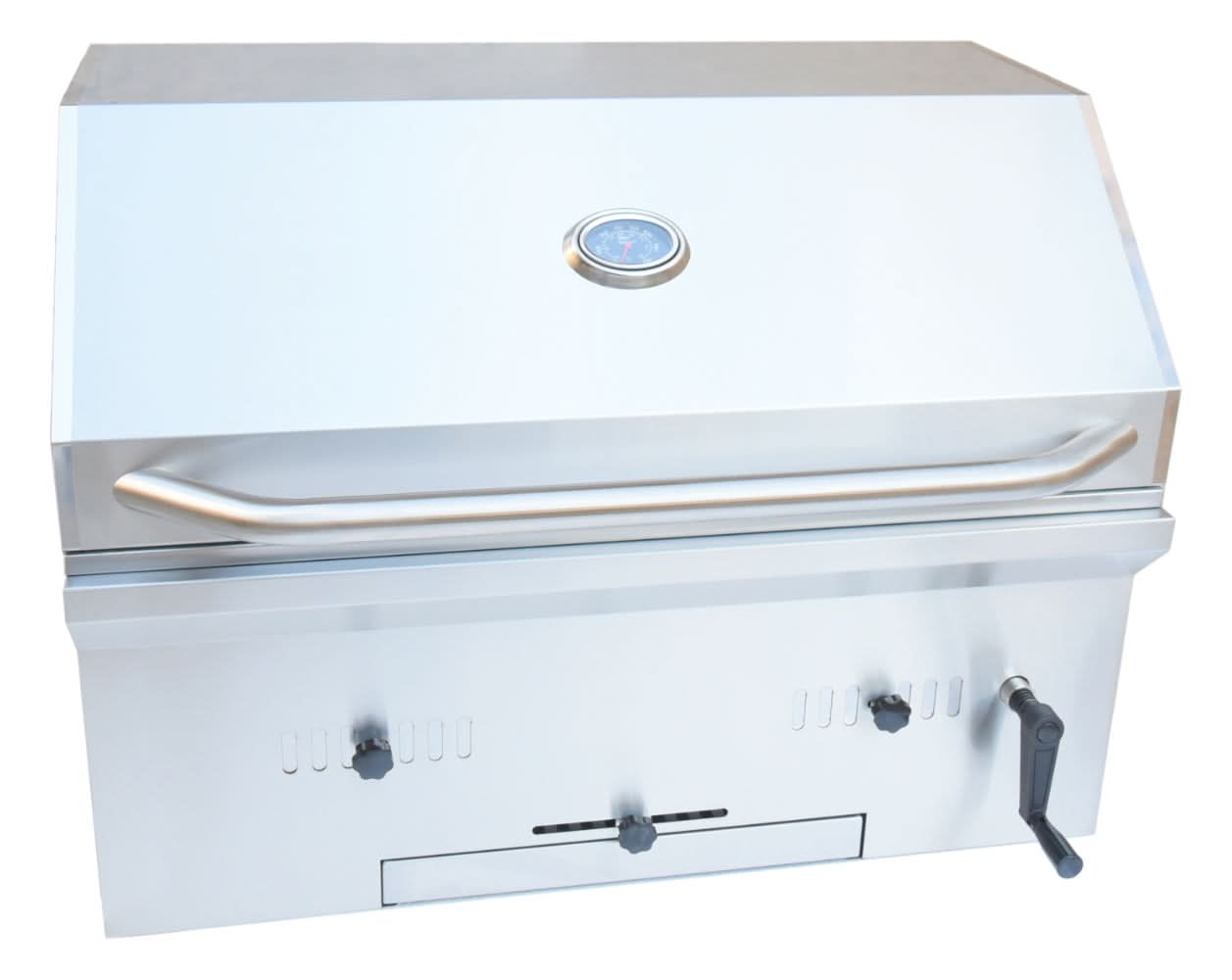
- Double-wall hood construction with a hood-mounted temperature gauge
- Full 304 stainless steel build, inside and out
- Drops into a 31" island opening
- No gas line, no electrical, no ignition system to fail
Fit & Application
Who Buys a Built-In Charcoal Grill
The flavor purist
Gas is convenient. Charcoal tastes different, and everyone who has cooked on both knows it. If you've been running a kettle in the corner of the yard while a gas grill sits in the island, this puts the fire you actually want into the kitchen you already built.
The second-appliance build
Most serious outdoor kitchens end up with both. Gas for Tuesday, charcoal for Saturday. At 32 inches this sits alongside a gas head in a longer island without demanding the whole run.
The low-and-slow cook
Drop the tray to its lowest position, damp the airflow down, and the chamber will hold a long, gentle heat. That's ribs and pork shoulder territory — the cooking a standard charcoal grill makes genuinely difficult.
Worth knowing before you order: this is a charcoal appliance. There's no gas connection, no igniter, and no electrical requirement — which also means no conversion kit and nothing to wire. Installation is a masonry cutout and nothing else.
The Crank System
Move the Fire, Not the Food
On a conventional charcoal grill, the distance between coals and grate is fixed. Your only controls are how much fuel you load and how much air you let in — both slow, both imprecise, both requiring you to open the lid. Here, a hand crank on the front face raises and lowers the entire charcoal tray while you cook.
Raised
Searing positionCoals close to the grate. Maximum radiant intensity for crust on steaks, chops, and burgers — the reason people cook over charcoal in the first place.
Middle
Standard grillingThe everyday setting. Chicken pieces, sausages, vegetables, fish — hot enough to mark and cook through without scorching the outside before the middle is done.
Lowered
Low and slowCoals dropped well away from the grate. Combined with damped airflow, this holds the long gentle heat that ribs, shoulder, and brisket need.
Positions shown are illustrative. The crank adjusts continuously, so you can settle anywhere between them.
Why adjusting on the fly matters
Reverse-searing on a normal charcoal grill means building a two-zone fire and physically dragging meat across the grate, hoping the cool side is still cool. Here you bring a thick ribeye up slowly with the tray dropped, then crank it to the top for ninety seconds a side. Same grate, same coals, same piece of meat — you just moved the fire instead.
The crank is on the front
This sounds minor and isn't. On a built-in installation, the sides and back of the grill are buried in masonry. A control mounted anywhere but the front face is a control you can't reach. KoKoMo put both the crank and the air dampers on the front for exactly that reason.
Heat Zone Separators
Three Fires on One Grate
The charcoal tray is divided by three heat zone separators, so you can load fuel unevenly and keep those differences intact. Bank coals heavily into one section, run a moderate bed in the middle, and leave the third nearly empty.
What that gets you
- Sear steaks over the loaded section while chicken renders gently over the light one
- Keep finished food genuinely warm instead of slowly overcooking it
- Char vegetables hard on one end without heating everything else to the same point
- Run a true indirect zone for anything that needs to cook through before it browns
Separators plus crank
The separators divide the fire horizontally. The crank moves it vertically. Together they give a charcoal grill something close to the zone control of a multi-burner gas unit — which is unusual on live fire, and is the specific reason to choose this over a kettle or a basic built-in charcoal box.
Airflow Control
Front-Mounted Adjustable Dampers
Fuel needs oxygen, and oxygen is your throttle
Charcoal burns as fast as the air you feed it. Open the dampers wide and the bed runs hot and burns down quickly. Close them down and the same fuel load will hold a lower temperature for considerably longer. It's the difference between a two-hour cook and a six-hour one on the same amount of charcoal.
Positioned where you can reach them
The dampers sit on the front of the grill alongside the crank. In a built-in installation that's the only accessible face, so adjusting airflow mid-cook takes a second rather than requiring you to reach over an open fire or around a masonry return.
Crank and dampers work together. Tray height sets how much heat reaches the food. Damper position sets how hot and how long the fire itself burns. For a long cook, drop the tray and close the dampers down — adjusting only one gives you half the effect.
Maintenance
Front Charcoal Clean-Out
The single worst thing about charcoal cooking is what happens the next morning. On most grills, ash removal means lifting out grates, lifting out the tray, and carrying a bowl of fine grey dust across the patio. On a built-in, it means doing all of that while leaning into a fixed appliance you can't tip or move.
This unit has a dedicated clean-out at the front. Ash comes out through the accessible face without dismantling the cooking surface, which is what determines whether you actually use a charcoal grill regularly or let it become the thing you fire up twice a summer.
Keep ash cleared
Accumulated ash smothers airflow from below, which makes the dampers less effective and the fire harder to control. Clearing it between cooks is the main maintenance this grill asks of you.
Let it cool completely
Charcoal ash holds live embers for far longer than it looks like it should. Give it a full day before disposal, and put it in a metal container — never a plastic bin, and never a bag.
Construction
304 Stainless and a Double-Wall Hood
KoKoMo builds this unit entirely from 304 stainless steel — the grade specified across commercial kitchens and marine applications for corrosion resistance and sanitation. Charcoal is harder on an appliance than gas: ash is mildly alkaline, it holds moisture, and it gets into every seam. Grade matters more here than on a gas grill, not less.
-
Double-wall hood construction — two stainless layers with an air gap, holding smoke and heat inside the chamber while keeping the exterior surface cooler
-
Hood-mounted temperature gauge, which matters more on charcoal than gas since there's no knob position to read a setting from
-
Full 304 stainless firebox and tray assembly, not just the visible exterior panels
-
Mounting flange around the perimeter to conceal the cutout edge for a clean drop-in
Why the hood matters on charcoal. A single-wall hood bleeds heat, which forces you to burn more fuel to hold temperature and makes long cooks harder to manage. The double wall is what makes low-and-slow practical on this grill rather than merely theoretical.
Measurements
Dimensions & Island Cutout
These are the numbers to hand your mason or cabinet fabricator before anyone starts cutting.
Confirm this one before you cut. KoKoMo publishes cutout figures for the charcoal model with slight variation between sources — differences under an inch, but an inch is the whole game on a masonry opening. The numbers above come from the manufacturer's specification block. Call
833-777-2962 and we'll confirm against the unit shipping to you before your fabricator commits.
Fuel & Cooking System
Charcoal tray
Crank-adjustable height, front-operated
Air dampers
Adjustable, front-mounted
Ash removal
Front charcoal clean-out
Hood
Double-wall construction with temperature gauge
Gas connection
None required
Materials & Configuration
Exterior material
Stainless steel
Collection
KoKoMo Classic
Before You Build
Island Requirements & Clearances
A built-in charcoal grill runs hotter and produces live sparks in a way a gas grill does not. The structure around it matters.
Non-combustible construction
The island must be built from non-combustible material throughout. This is not negotiable on any built-in grill, and it's especially not on one burning solid fuel.
Clearance to combustibles
KoKoMo specifies a minimum 14" from the sides and 16" from the back to adjacent combustible construction. Plan island depth around it before block goes down.
Overhead clearance
Charcoal produces smoke continuously, not just at startup. Under a covered patio or pergola, give the hood generous vertical clearance and think about where that smoke goes when the hood opens.
Permits and local code
Check with your city and fire department before building. Some jurisdictions treat solid-fuel appliances differently from gas, and outdoor kitchen construction frequently requires a permit either way.
One advantage over the gas models: no gas line, no licensed gas fitter, no regulator, no conversion, no leak test. The install is a correctly sized non-combustible opening and a two-person lift. That's the entire scope.
Warranty & Support
Manufacturer Warranty Coverage
KoKoMo covers this grill under a tiered limited warranty to the original purchaser under normal residential use. Coverage periods by component:
Limited Warranty Periods
Stainless steel frame and housing
Lifetime
Stainless steel grates
10 years
Grill accessories
30 days
Warranty applies to residential use and excludes rental or commercial applications. It does not cover rust, corrosion, oxidation, or discoloration arising from moisture or overheating, and does not cover labor charges. Coverage is valid at the original delivery site with proof of purchase. Refer to your unit's manual for the full terms.
Register your unit
Record your model number, serial number, and purchase date before installation. Once the grill is seated in a masonry island, the label becomes considerably harder to reach.
Authorized dealer support
Buying through an authorized dealer is what keeps your warranty valid and gives you a real person to call. If a claim needs filing, reach us at 833-777-2962 or info@smokeforges.com and we handle it with KoKoMo directly.
Common Questions
Questions Before You Buy
How exactly does the adjustable charcoal tray work?
A hand crank on the front face of the grill raises and lowers the entire charcoal tray inside the firebox. Raising it brings the coals closer to the cooking grate for higher, more intense heat; lowering it increases the distance for gentler cooking. You adjust it while the grill is running, with the hood closed, without touching the fuel. It's the primary temperature control on this grill — the air dampers are the secondary one.
Can I really do low-and-slow cooking on this?
Yes, and it's one of the better arguments for this grill over a basic charcoal box. Drop the tray to its lowest position, close the air dampers down, and load fuel into one section using the heat zone separators to keep it contained. The double-wall hood holds that heat rather than bleeding it, which is what makes a long cook practical. It takes some practice to learn your particular grill's behavior, as any charcoal cooking does.
Does it need a gas line or electrical hookup?
Neither. This is a pure charcoal appliance with no gas connection, no igniter, and no electrical requirement. That makes the installation considerably simpler than a gas built-in — you need a correctly sized non-combustible cutout and two people to set it. No licensed gas fitter, no regulator, no conversion kit, no leak test.
What kind of charcoal should I use?
Both lump charcoal and briquettes work. Lump lights faster, burns hotter, and produces less ash, which suits searing and shorter cooks. Briquettes burn more evenly and predictably for longer, which suits low-and-slow. Many people keep both. Avoid self-lighting charcoal treated with accelerant — it affects flavor and leaves residue in a firebox you'll be living with for years.
How hard is the ash to deal with on a built-in?
Easier than most, because of the front clean-out. Ash comes out through the accessible face rather than requiring you to lift the grates and tray on an appliance that can't be moved or tipped. Clear it between cooks — accumulated ash blocks airflow from below and makes the dampers less effective. Let it cool a full day before disposal, and use a metal container.
Should I get this instead of a gas grill, or alongside one?
Honestly, most people who buy this already own a gas grill or are building an island with room for both. Charcoal tastes better and takes longer; gas is faster and more convenient on a weeknight. If you're only ever going to have one appliance and you cook most days, gas is the more practical choice. If you're building a kitchen you'll use for weekend cooking, or you already have gas covered, this is the one that gets people talking. Call us and we'll give you a straight answer for your situation.
What does delivery look like?
It ships free on all orders. At 106 pounds crated, this moves by freight on a pallet rather than parcel. You'll be contacted to schedule a delivery window. Plan on a second person for offloading and for setting the grill into the cutout — it's a two-person lift.
Can I return it if it doesn't fit my island?
Eligible unused returns are subject to our published return policy, including freight and restocking conditions; and we'd much rather help you avoid the situation. Measure your opening against the cutout dimensions above, and given the source variation noted in that section, call
833-777-2962 before ordering if you're building a new opening. Ten minutes on the phone beats a freight return every time.
Documentation
Manual, Specs & Install Support
KoKoMo User Manual & Care Guide
The manufacturer manual covering island build specifications, clearance requirements, care and cleaning, and the full warranty schedule for KoKoMo built-in appliances.
Open the KoKoMo manual (PDF)
KoKoMo Cutout Dimension Sheet
The manufacturer's cutout reference for KoKoMo built-in appliances — grills, side burners, power burners, drawers, doors, refrigeration, and sinks. Useful if you're planning a full island around this grill.
Open the cutout dimension sheet (PDF)
Before you order
Confirm your cutout dimensions and your overhead clearance if the grill is going under cover. Both are worth a two-minute conversation before your fabricator starts.
Call 833-777-2962
Email info@smokeforges.com
Authorized KoKoMo Grills Dealer
Put the Fire You Actually Want in the Island
The KoKoMo 32" built-in charcoal grill ships free to your door with authorized dealer support from cutout planning through your first cook. If you're deciding between this and a gas head — or planning room for both — call us before the concrete sets.
Call 833-777-2962
Prefer email? Reach us at info@smokeforges.com
Free Shipping on All Orders Easy Returns Authorized Dealer 304 Stainless Construction
[sf-highlights]
flame :: Crank-Adjustable Charcoal Tray
shield :: 304 Stainless Steel Construction
tool :: Three Heat-Zone Separators
[/sf-highlights]