

A 20-pound propane tank has no fixed fire-pit runtime: the hours depend on how much fuel remains and how quickly your burner uses it. Divide the remaining propane weight by the fire pit’s fuel consumption per hour, and account for any other appliance drawing from the same cylinder.
At a glance
- How long does a propane tank last in a fire pit? Remaining fuel and burner consumption determine runtime.
- A 20-pound cylinder designation does not confirm that 20 pounds of propane remain inside.
- Smokeforges propane fire pits include portable options; compare fuel consumption separately from appliance weight.
- Measure fuel use at your normal flame setting rather than treating maximum burner input as everyday consumption.
How long does a 20-pound propane tank last in a fire pit?
Calculate runtime from remaining fuel, not tank size alone. A full cylinder and a partially used cylinder can look identical, but they cannot deliver the same operating time at the same burn rate.
Use this calculation for your 2026 setup:
Remaining runtime in hours = remaining propane in pounds ÷ propane consumption in pounds per hour.
- Find the remaining fuel weight. Weigh the cylinder and subtract its stamped tare weight, which represents the empty cylinder.
- Find the consumption rate. Check the fire pit’s documentation for fuel consumption at the setting you plan to use, or measure consumption during operation.
- Match the units. Divide pounds by pounds per hour. A burner rating in BTU per hour needs a fuel-energy conversion before you can use it with fuel weight.
- Adjust for shared use. Include consumption from every appliance connected to that cylinder.
If you’re comparing Smokeforges propane fire pits, keep the appliance specifications separate from your fuel calculation. Physical size, materials, and portability help you choose the equipment; consumption tells you how long the cylinder lasts.
A runtime estimate is useful only when its assumptions match your setup. Ask whether a published figure assumes a full cylinder, a particular flame setting, and the fire pit operating alone.
Why this matters
Running out of propane halfway through an evening is usually a planning problem, not a mystery about the tank. The missing detail is often the starting fuel level or the burner setting used to estimate consumption.
For your 2026 buying decision, treat runtime as a relationship between fuel supply and fuel demand, not a fixed property of the fire pit. A larger cylinder provides more fuel capacity, but it does not change how much fuel the burner consumes at a given operating condition.
The same distinction prevents a poor comparison between products. A lower fuel-use figure is not automatically a better result if the fire pit delivers less of the heat you actually want.
Measure your fire pit’s fuel use at your normal setting
A practical measurement gives you a benchmark for your own fire pit, cylinder, and flame setting. Follow the manufacturer’s operating instructions throughout; shut off the appliance and cylinder before disconnecting anything for weighing.
- Weigh the cylinder. Record its total weight before operation. Use a scale suitable for the cylinder’s weight and keep the weighing method consistent.
- Record the setting. Note the control position you normally use. Changing the flame midway makes the result an average across different settings.
- Time the session. Record the actual operating duration. Include only the time the burner runs.
- Weigh again. Once the equipment is safely shut down and disconnected as instructed, record the cylinder’s new weight.
- Calculate consumption. Subtract the ending weight from the starting weight, then divide the fuel used by the session length in hours.
Those steps separate the fuel you actually burned from the fuel the cylinder is capable of holding. Keep the notes together so the next estimate uses the same setting and units.
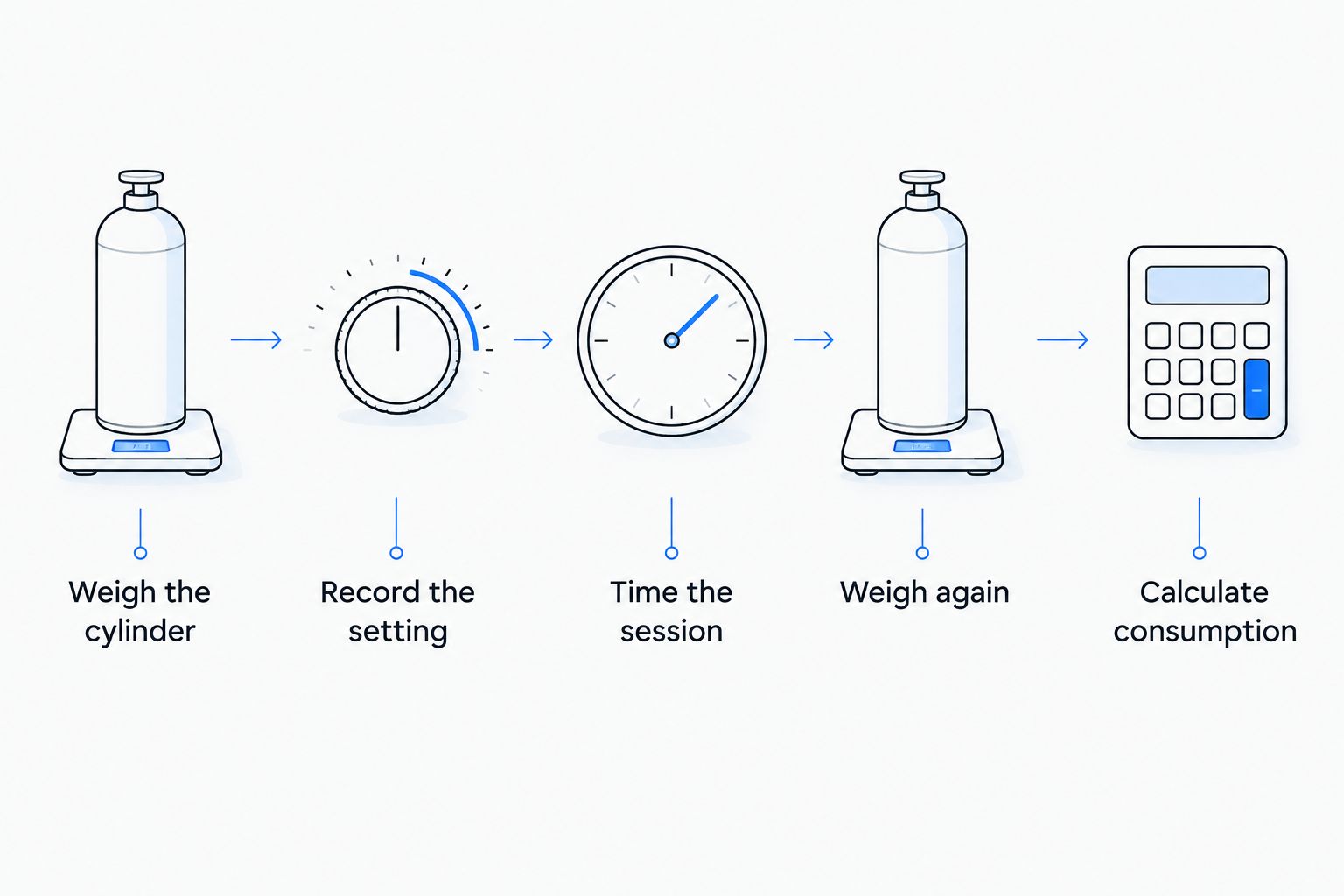
Use the measured rate as your benchmark, not a promise. It describes that operating session. Repeat the measurement if you change your usual setting or connect another appliance to the cylinder.
For a useful 2026 fuel log, record the date, starting weight, ending weight, operating time, and flame setting. You do not need a complicated spreadsheet; you need measurements you can compare without guessing what changed.
Why propane fire-pit runtime varies
These factors change either the fuel available or the rate at which your setup consumes it:
- Starting fuel level. The cylinder’s nominal capacity does not tell you how much propane remains after previous use. Weigh it before relying on a full-cylinder estimate.
- Burner input. A burner consuming more fuel per hour empties the same supply sooner. Compare input ratings using the same units and operating conditions.
- Flame setting. Lowering an adjustable burner reduces fuel demand when the appliance permits that adjustment. Do not assume a particular control position corresponds to a precise fraction of maximum consumption.
- Shared appliances. A grill and fire pit connected to one cylinder draw from the same supply. A fire-pit-only estimate excludes the grill’s consumption.
- Wind and your response. If exposed conditions lead you to turn up the flame, your consumption changes. Compare sessions at the settings you actually used, not just similar outdoor temperatures.
- Cold-weather fuel delivery. Low temperatures affect propane vaporization and cylinder pressure. A weakening flame in cold conditions does not, by itself, prove that the cylinder is empty.
Do not turn a fuel-delivery problem into a tank-heating experiment. Never apply external heat to a propane cylinder to restore performance. Follow the appliance and cylinder instructions when conditions interfere with operation.
For cold-weather use in 2026, check the manufacturer’s operating guidance before you rely on an estimate made in warmer conditions.
A BTU rating is not a tank-life rating
A burner’s BTU-per-hour input describes its fuel-energy demand at the stated operating condition. It does not tell you how much propane remains in your cylinder, and it is not automatically the amount of useful warmth reaching your chair.
That distinction matters when you compare fire pits. A fuel-consumption calculation answers how quickly you use propane; it does not independently establish comfort, heat distribution, or performance in wind.
If the documentation supplies only maximum input, use it to understand maximum demand. Do not label the resulting calculation as low-flame runtime or average evening runtime.
Check whether a specification describes input or output before using it. Fuel consumption follows input; substituting an output figure without accounting for efficiency gives you the wrong basis for the calculation.
When the manual lists propane consumption directly in pounds per hour, the calculation is simpler. Keep the remaining fuel and consumption rate in matching units rather than mixing cylinder weight with an unconverted energy rating.
Keep portable fire-pit weight separate from propane capacity
Smokeforges is best for homeowners comparing propane fire pits alongside outdoor cooking equipment. For runtime, however, compare each fire pit’s documented fuel demand rather than treating its carrying weight as a shortcut.
The portable options below illustrate the distinction. Their listed weights or folded widths help with packing decisions; none of those measurements establishes hours of operation from a 20-pound cylinder.
| Portable fire pit | Best for | Confirmed specification | Useful advantage | Limitation for runtime planning |
|---|---|---|---|---|
| Howl R1 | Buyers prioritizing a small carrying package | Listed as 10 lb; folded width of 8.43 inches | Smaller listed folded width than the other options here | Appliance weight is not fuel consumption |
| Howl R3 | Buyers comparing an intermediate folded width | Folded width of 12 inches, rounded manufacturer specification | Falls between the listed R1 and R4 MKII folded widths | Width does not establish burner demand |
| Howl R4 MKII portable propane fire pit | Buyers considering a larger folded package | Folded width of 14.34 inches | Provides a defined dimension for checking storage fit | Larger listed width requires more packing space and proves nothing about runtime |
The Howl R1, Howl R3, and Howl R4 MKII descriptions list 304 stainless steel, aircraft aluminum, and brass construction. Those material details belong in a build-quality comparison, not a fuel-duration formula.
Use these products as a shortlist only after checking your transport space. Before choosing between them, confirm the fuel connection requirements and the consumption information relevant to your intended setting.
Portable propane fire pits to compare


Does turning the flame down make a 20-pound tank last longer?
A 20-pound tank lasts longer when an adjustable fire pit consumes less propane per hour. The trade-off is the flame and heat delivered at that lower setting.
Choose the lowest manufacturer-approved setting that gives you the result you want. Do not assume that turning a control halfway produces half the consumption; the control position alone is not a calibrated fuel measurement.
If you regularly start high and turn the flame down later, measure that complete routine. An average consumption rate from your normal session is more useful than a calculation based on a setting you rarely maintain.
Can a grill and fire pit share a 20-pound propane tank?
A 20-pound propane tank supplying multiple appliances must support their combined demand through a manufacturer-approved connection arrangement. A splitter alone does not establish that the regulators, hoses, fittings, and cylinder delivery are suitable.
When both appliances operate, calculate runtime from their combined consumption. If they run at different times, track the fuel each session uses rather than assuming all remaining propane belongs to the fire pit.
Follow each appliance’s instructions before connecting a shared supply. Do not infer compatibility from matching-looking connectors, and do not bypass a required regulator to make a connection fit.
How can I tell whether my 20-pound cylinder is actually empty?
A 20-pound cylinder’s remaining fuel is its measured total weight minus its stamped tare weight. That measurement is more useful than judging by flame appearance alone.
If the flame drops unexpectedly, shut down and follow the manual’s troubleshooting procedure. Fuel level, temperature, regulator behavior, and the appliance itself require different checks; do not repeatedly relight equipment with an unresolved problem.
If you smell gas, stop using the setup and follow the manufacturer’s emergency instructions. A runtime estimate never takes priority over safe operation.
Your 2026 propane-runtime checklist
Before an evening outside, make sure your estimate answers these questions:
- Is the starting fuel amount measured, or merely assumed from the cylinder’s capacity?
- Does the consumption figure match the flame setting you intend to use?
- Are fuel weight and consumption expressed in compatible units?
- Will another appliance draw from the cylinder?
- Have you checked the connections and operating instructions before lighting?
- Do you have a plan if the cylinder runs out before you finish?
Avoid planning to use the last possible moment of calculated runtime. Leave yourself a fuel reserve rather than treating an estimate as a countdown clock. The right reserve depends on how disruptive an interruption would be, not an invented universal percentage.
FAQ
How long does a propane tank last in a fire pit?
Propane-tank runtime equals remaining fuel weight divided by fuel consumption per hour. Use consumption for your actual flame setting and include any other appliances sharing the cylinder.
How many hours will a full 20-pound propane tank run my fire pit?
A full 20-pound tank’s operating hours depend on the fire pit’s consumption rate. Divide 20 pounds by documented or measured consumption in pounds per hour; tank capacity alone does not establish an hour figure.
Does a low flame make my propane tank last longer?
A lower flame setting extends runtime when it reduces the fire pit’s propane consumption. The control position does not establish an exact consumption rate, so use manufacturer information or measure your normal session.
Can I use the fire pit’s BTU rating to calculate runtime?
You can use a burner’s BTU-per-hour input rating with the propane supply’s energy content to estimate runtime at that input. Do not divide pounds of fuel directly by BTU per hour or substitute heat output for fuel input.
How do I check how much propane is left in my tank?
Weigh the cylinder and subtract the tare weight stamped on it to find the remaining propane weight. Shut down and disconnect the equipment according to its instructions before weighing.
Will a splitter make my propane tank run out faster?
A splitter does not itself establish consumption, but operating multiple connected appliances increases the cylinder’s total fuel demand. Confirm that the complete connection arrangement is approved for the equipment.
Does a smaller portable fire pit always use less propane?
A smaller physical size does not establish lower propane consumption. Compare documented burner input or measured fuel use at the settings you intend to operate.
One last thing
You do not need the cylinder’s tare weight to measure how much propane a session consumed. Subtract its ending total weight from its starting total weight; the cylinder’s own weight cancels out.
You do need the tare weight to determine how much propane remains afterward. Keeping those calculations separate gives you both pieces of the runtime estimate: your actual consumption rate and your remaining supply.
Make that your benchmark before buying a different fire pit to solve a runtime problem. First establish whether you need lower consumption, more fuel capacity, or simply a more accurate starting measurement.
Compare portable propane fire pits
Check the fuel and cylinder requirements for the exact model you plan to use.


