
Best overall: a freestanding open-bowl wood burning fire pit for seated entertaining. Best for smoke-conscious patios: a secondary-combustion fire pit. Best for cooking-centered gatherings: the Arteflame 40" Grill with High Euro Base. This 2026 guide compares those choices with a permanent masonry fire pit so you can match the fire to the way you host.
At a glance
- An open-bowl wood burning fire pit is the default for seated backyard entertaining; smoke and sparks are the trade-offs.
- Secondary-combustion fire pits suit smoke-conscious hosts, but smokeless does not mean smoke-free.
- The Arteflame 40-inch wood-fired grill suits cooking-centered gatherings, not buyers seeking a dedicated seated fire pit.
- Choose permanent masonry only after settling the location, drainage, clearances, and local requirements.
If you're comparing fire features at Smokeforges, start with the fuel and the job—not the shape. A gas fire bowl, a wood-fired grill, and a water bowl aren't interchangeable, even when their product photos look equally suited to a patio.
Why this matters
A good entertaining fire pit leaves you free to talk. The wrong setup keeps you moving chairs out of smoke, squeezing past hot surfaces, or tending a cooking fire when everyone else wants to sit down.
Choose the gathering first and the fire pit second. Seated conversation, active cooking, and a permanent landscape feature call for different designs. No single option wins all three.
For your 2026 shortlist, separate essential functions from accessories. A lid, grate, or cover doesn't fix a fire pit that burns the wrong fuel or doesn't fit the space.
What makes the best wood-burning fire pit?
Use these criteria as your benchmark before comparing finishes:
- Fuel suitability: Confirm that the manufacturer permits burning wood. Never put logs into a gas-only fire feature.
- Seating fit: Check the complete footprint, required clearances, and room to walk behind occupied chairs—not just the bowl diameter.
- Smoke management: Compare an open fire with a design that introduces secondary air to burn more combustion gases. Neither removes the need for dry wood.
- Fire tending: Look for practical access to add logs and remove cold ash without disturbing the seating arrangement.
- Cooking role: Decide whether food preparation is the main event or an occasional extra. A cooking station isn't automatically a comfortable conversation pit.
- Installation demands: Check the approved supporting surface, drainage, weather protection, and local restrictions before committing to a location.
Don't treat decorative terms as specifications. “Steel,” “concrete,” and “fire bowl” don't establish fuel compatibility, safe deck use, or cooking suitability.
Wood-burning fire pits at a glance
This 2026 comparison ranks design types by their best use. The Arteflame entry is a named wood-fired cooking alternative, not a claim that every grill should double as a seated fire pit.
| Rank and option | Best for | Standout feature | Key limitation |
|---|---|---|---|
| 1. Freestanding open-bowl fire pit | Seated conversation | Open access for viewing and tending the fire | No secondary-combustion system to address smoke |
| 2. Secondary-combustion fire pit | Smoke-conscious entertaining | Secondary air supports more complete combustion | Performance still depends on fuel and fire management |
| 3. Arteflame 40" Grill with High Euro Base | Cooking-centered gatherings | A wood-fired grill format | Not the default choice for seated conversation |
| 4. Permanent masonry fire pit | A fixed backyard gathering area | A site-specific layout | Location and construction are difficult to change |
1. Open-bowl fire pit: best for seated conversation
A freestanding open-bowl fire pit is the straightforward choice when you want guests seated around a visible wood fire. You can see the fuel bed and tend it from the open top. Look for a model explicitly approved for wood burning rather than assuming every metal bowl qualifies.
The advantage is simplicity. The compromise is exposure: smoke, sparks, and hot surfaces remain part of the experience, and wind affects where the smoke goes.
Open-bowl fire pit pros:
- Keeps the fire itself, rather than food preparation, at the center of the gathering.
- Provides direct visual access when adding and arranging logs.
- Lets you choose the seating layout separately from a built-in structure.
Open-bowl fire pit cons:
- Doesn't use secondary combustion to reduce smoke.
- Requires planning for sparks, ash, and nearby combustible materials.
- Still needs a manufacturer-approved surface; freestanding doesn't mean safe anywhere.
Best for: Hosts who want chairs, conversation, and an uncomplicated wood fire.
Before buying, check how you will remove cold ash. A bowl that's easy to light but awkward to clean adds work to every gathering. Also confirm whether a spark screen is included, optional, or unsuitable for that model.
Verdict: Buy an open-bowl fire pit when seated entertaining is the priority and you accept hands-on fire tending.
2. Secondary-combustion fire pit: best for smoke-conscious hosts
A secondary-combustion fire pit routes additional air into the combustion process to help burn gases that would otherwise contribute to smoke. It's the better design category to investigate when smoke is your main objection to a traditional open bowl. It still burns wood and requires an appropriate outdoor location.
Don't interpret “smokeless” as a guarantee. Startup, damp fuel, restricted airflow, and overloading can all produce smoke.
Secondary-combustion fire pit pros:
- Addresses combustion rather than relying only on moving chairs away from smoke.
- Suits hosts who want a wood fire with smoke reduction as a design priority.
- Keeps the gathering focused on the fire instead of a cooking station.
Secondary-combustion fire pit cons:
- Doesn't eliminate smoke under every operating condition.
- Requires attention to loading instructions and unobstructed air passages.
- Doesn't make wood burning acceptable where local restrictions prohibit it.
Best for: Hosts who enjoy burning wood but want smoke management to guide the purchase.
Use fuel quality as part of the comparison. The EPA's Burn Wise guidance recommends firewood with less than 20% moisture; a moisture meter gives you a better check than the appearance of the bark. Follow the fire pit's loading instructions rather than building a fire above its intended burn area.
Verdict: Buy a secondary-combustion fire pit when reducing smoke matters more than the simplicity of an open bowl.
3. Arteflame wood-fired grill: best for cooking-centered gatherings
The Arteflame 40" Grill with High Euro Base is explicitly a wood-fired cooking product. Its stated 40-inch size gives you a concrete starting point for comparing the appliance footprint with your patio plan. That dimension isn't a safe-clearance specification or a measure of how many guests it serves.
For Smokeforges wood burning fire pit shoppers who want cooking to lead the gathering, the Arteflame wood-fired grill is the benchmark. Choose it because you want to cook over wood—not because you're assuming it behaves like a low conversation bowl.
Arteflame wood-fired grill pros:
- Provides a named wood-fired option for buyers prioritizing outdoor cooking.
- Makes food preparation the central activity rather than an improvised add-on.
- Gives you a stated size and base configuration to compare against your space.
Arteflame wood-fired grill cons:
- Is a grill-first alternative, not a like-for-like dedicated fire pit.
- Needs a working area around the cook, separate from guest circulation.
- Requires confirmation of operating instructions before any use beyond cooking.
Best for: Hosts who want guests gathering around food preparation rather than remaining seated around a fire.
Sketch the cook's position before ordering. Keep the route between the house and dining table out of the working area, and provide a separate surface for serving dishes. Don't make guests reach across a hot appliance for food or utensils.
Verdict: Buy the Arteflame wood-fired grill for cooking-led entertaining; skip it if your main goal is a seated conversation pit.
4. Permanent masonry fire pit: best for a fixed gathering area
A permanent masonry fire pit makes sense when the gathering location is settled and the fire belongs in the landscape plan. The design can account for seating, paths, and surrounding hardscape together. Construction must address heat exposure and local requirements, not merely match the patio materials.
This is a site decision as much as an appliance decision. Moving it later involves more than rearranging furniture.
Permanent masonry fire pit pros:
- Lets the fire location and surrounding seating be planned together.
- Creates a defined gathering area within a permanent landscape layout.
- Allows drainage and access to be considered during construction.
Permanent masonry fire pit cons:
- Is difficult to relocate after construction.
- Requires materials and construction details suitable for fire exposure.
- Doesn't inherently reduce smoke just because the structure is permanent.
Best for: Homeowners completing a settled backyard plan rather than experimenting with a seating location.
Before approving construction in 2026, confirm applicable permits, setbacks, fuel restrictions, and manufacturer requirements for any insert. Ordinary landscape blocks aren't automatically suitable for direct fire exposure. Resolve those details before choosing the exterior finish.
Verdict: Hold until the site and construction requirements are confirmed; then choose masonry for permanence, not flexibility.
Plan the gathering area before choosing accessories
Separate the space into Fire area, Guest seating, and Clear route. The fire area includes the appliance and all required clearances; guest seating sits outside it. The clear route lets people reach the house without cutting through the fire-tending or cooking position.
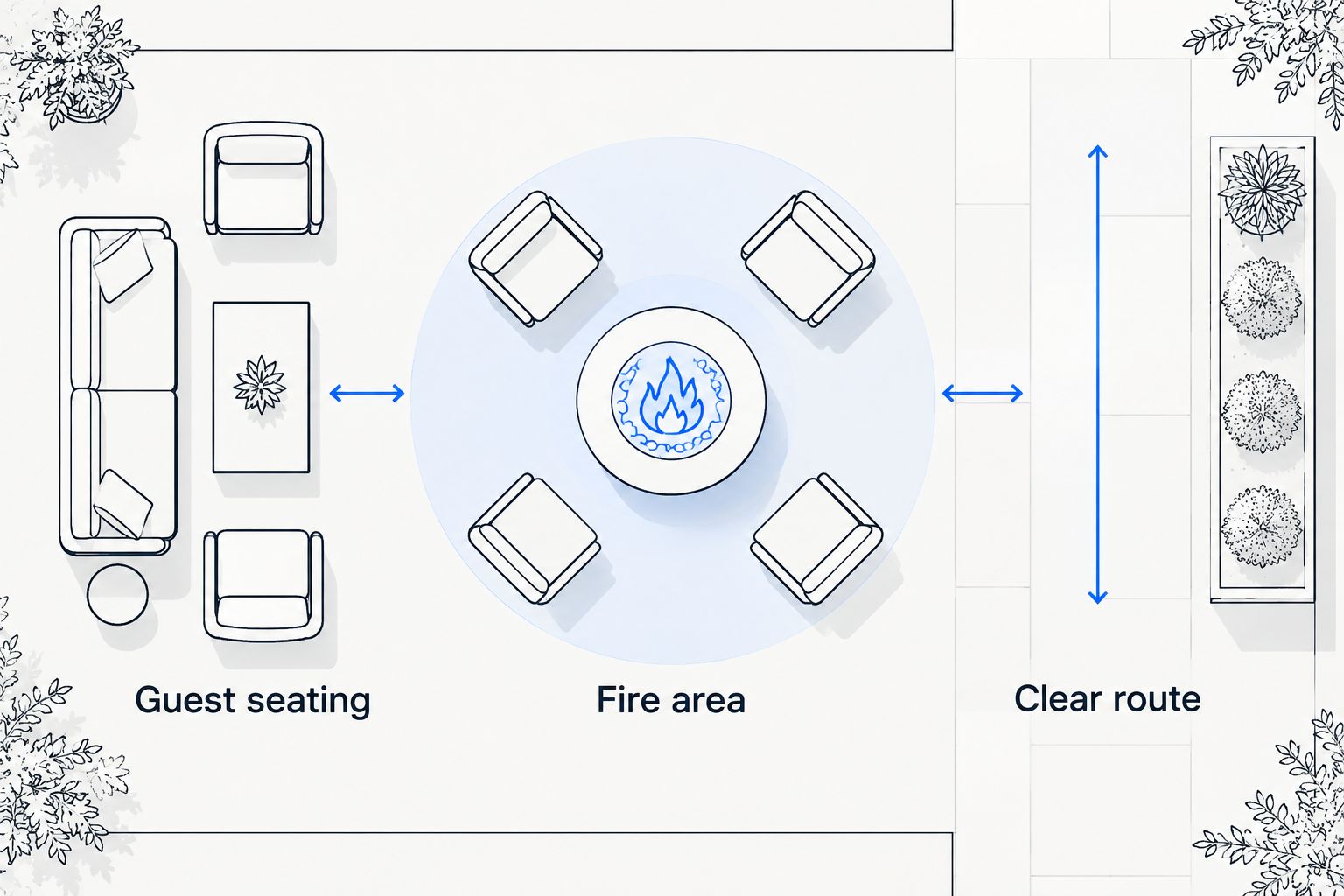
Use the appliance manual for actual distances. A layout diagram cannot establish safe clearances, and a heat-resistant pad doesn't override a manufacturer's surface restrictions.
Accessories come after that check. A log grate must fit the fire pit and be permitted by its manufacturer; don't add one to a secondary-combustion design unless its instructions allow it. The Round Steel Log Grate for Fire Pits lists sizes from 14 to 26 inches, so measure the intended internal fit rather than using the outside bowl width.
The products below serve different jobs: the Arteflame is a cooking alternative, while the grate is an accessory for a compatible fire pit. Neither substitutes for checking the operating manual.
Cooking option and fire-pit accessory


How we ranked these options
This 2026 ranking prioritizes seated entertaining, then smoke management, cooking, and permanent installation. It compares design trade-offs, not measured heat output, durability testing, or model-by-model smoke performance.
The open bowl earns the default position because conversation is the stated job. Change that job to cooking or smoke reduction, and the recommended category changes with it.
Which wood-burning fire pit should you choose?
Choose a freestanding open bowl if you're undecided and mainly want to sit around a fire. Choose secondary combustion if smoke management drives the purchase, or permanent masonry if the location is already part of a fixed landscape plan.
For a cooking-led setup, use the Arteflame wood-fired grill as your Smokeforges comparison point. Keep the distinction clear: you're choosing a place to cook over wood, not simply a different-looking conversation pit.
FAQ
What's the best wood burning fire pit for backyard entertaining?
A freestanding open-bowl wood burning fire pit is the default for seated conversation. Choose secondary combustion instead when smoke management is your main concern, or a wood-fired grill when cooking leads the gathering.
Is a smokeless fire pit completely smoke-free?
No, a secondary-combustion fire pit is not completely smoke-free. Dry fuel, correct loading, and unobstructed airflow still matter, especially during startup.
Can I burn wood in a propane fire bowl?
No, don't burn wood in a propane fire bowl unless its manufacturer explicitly approves that use. A gas burner and its surrounding components are not automatically designed for burning logs.
Can I put a wood-burning fire pit on a wooden deck?
Use a wooden deck only if the fire pit manufacturer explicitly permits that installation and local requirements allow it. A protective mat alone doesn't establish that a fire pit is safe for a combustible surface.
Is the Arteflame wood-fired grill better than a regular fire pit?
The Arteflame 40-inch wood-fired grill is the more relevant choice when cooking is the main activity. A dedicated fire pit is the clearer choice when you want guests seated around a fire rather than gathered near a cooking station.
What wood should I use in a backyard fire pit?
Use dry, seasoned, untreated firewood that meets your fire pit manufacturer's instructions. Don't burn painted or pressure-treated wood, trash, or other prohibited materials.
What should I compare when shopping at Smokeforges?
Compare approved fuel, intended use, dimensions, installation requirements, and maintenance instructions first. Separate wood-fired cooking equipment from gas fire features before comparing appearance or accessories.
One last thing
Before you finalize your 2026 purchase, arrange the chairs in the proposed location without lighting anything. Walk from the house carrying a serving tray, pull each chair back, and identify where the person tending the fire will stand.
If that dry run feels cramped, change the layout before choosing the fire pit. A different finish won't solve a blocked walking route.


